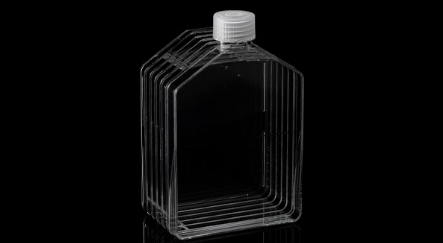
Cell Culture Flask surface is very smooth based on precise molding technology and it gives clear view when examined with microscope.
Volume: 25mL75mL175mL225mL
Detail
Cell Culture Flask 5 Layers
Cell Culture Flask surface is very smooth based on precise molding technology and it gives clear view when examined with microscope.
Volume: 25mL75mL175mL225mL
PRODUCT FEATURES
The product is made of medical grade USP CLASS VI polymer polystyrene
The product is made under a 100,00- class dust-free manufacturing site
Two kinds of product line up are providing.
For adherent cell culture: Initial adherence and proliferative property of cells via hydrophilic surface treatment.
For suspension cell culture: The surface is resistant to cell adherence, which minimizes damage or loss of cell.
Large mouthed design makes easy operation of pipet or cell scraper. The surface of flask is uniform and smooth, hence the clear view can be obtained when microscopic observation.
The hydrophobic filter cap can prevent invasion of fungi and bacteria without water absorb.
DirectBlood Genotyping PCR Kit is a novelty on the market. It allows genotyping in real-time and without any previous DNA isolation. You simply save time and money: directly use EDTA blood without any extraction steps. The DirectBlood Genotyping PCR Kit is optimized to function with a wide range of different SNPs to detect possible nucleotide variations. It has been successfully tested with a variety of hydrolysis probes and hybridization probes.The setup of a genotyping experiment can not be simpler anymore: Mix primers&probes with the Genotying mastermix, add the respective blood sample and start real-time PCR, this is it.
It is even more simple: store the DirectBlood Genotyping PCR Kit at room-temperature. A cool chain is not needed anymore. The included master mix is freeze-dried and dissolves within a few seconds after addition of the rehydration buffer.Additionally, we have already established SNP-assays for you. In case, you can not find your respective SNPs, please provide us with the rs-number of the SNP-assays your are interested-in and you will receive an individual quotation from us.For research use and further manufacturing.In case you are aiming to use our RUO products as components or for your development of e.g. an IVD medical device, please contact us.
DirectBlood Genotyping Kit (#5000) performance with a hydrolysis probe assay
The DirectBlood Genotyping Kit is compatible with a wide range of assays: Here we are detecting a SNP in the Factor V gene (rs6025; G1691A), which is connected with a higher risk for venous thrombosis, with a fluorescent hydrolysis probe assay.
Homozygous wild type blood samples will show a strong signal and amplification plot (blue curve) in channel 2 (Cy5) and none or a very low signal
(red curve) in the other channel 1 (ROX).
Heterozygous blood samples will give an intermediate signal and amplification plots with very similar intensities in both channels 1 and 2 (blue and red curve). Homozygous mutant blood samples, channel 1 (ROX) will show a strong signal and amplification plot (red curve) and channel 2 (Cy5) none or a very low signal and amplification plot (blue curve). So the signals are reversed on homozygous mutant samples.
DirectBlood Genotyping Kit performance with a hybridization probe assay
Here we are detecting the same SNP in the Factor V gene (rs6025; G1691A), which is connected with a higher risk for venous thrombosis, with a fluorescent hybridization probe assay.
Three blood samples with known genotype were used. All the genotypes can clearly be identified. The blue curve shows the specific wild type (homozygous G;G) peak at 61°C. The red curve shows the specific mutant (homozygous A;A) peak at 53°C. A heterozygous case (A;G) will result in both melting curve peaks, respectively at the same specific temperature for wild type and mutant (orange curve).
Document
DirectBlood Genotyping PCR Kit is a novelty on the market. It allows genotyping in real-time and without any previous DNA isolation. You simply save time and money: directly use EDTA blood without any extraction steps. The DirectBlood Genotyping PCR Kit is optimized to function with a wide range of different SNPs to detect possible nucleotide variations. It has been successfully tested with a variety of hydrolysis probes and hybridization probes.
Plasma/Serum Exosome and Free-Circulating RNA Isolation Kits
Product Info
Document
Product Info
Overview
Isolate all sizes of RNA, including microRNA, irrespective of size or GC content, without bias.
Versatile sample input ranges
Isolate all sizes of free-circulating RNA, including microRNA
The purified exosomal RNA is free from any circulating RNA-binding proteins
No phenol extractions, Proteinase K treatment, nor carrier RNA
No time-consuming ultracentrifugation, filtration nor special syringes are required
No precipitation reagents, nor overnight incubation required
Concentrate isolated exosomal RNA and are free-circulating RNA into a flexible elution volume ranging from 50 µL to 100 µL
Purification is based on spin column chromatography that uses Norgen’s proprietary resin separation matrix
These kits provide a fast, reliable and convenient method to sequentially isolate and concentrate exosomal RNA as well as Free-Circulating RNA from different plasma/serum sample volumes. The purification is based on spin column chromatography that employs Norgen’s proprietary resin. These kits are designed to isolate all sizes of RNA, including microRNA as well as all sizes of the free-circulating protein-bound RNA, including microRNA. These kits provide a clear advantage over other available kits in that they do not require any special instrumentation, protein precipitation reagents, extension tubes, phenol/chloroform or protease treatments. Moreover, these kits allow the user to elute into a flexible elution volume ranging from 50 µL to 100 µL. The RNA isolated from the purified exosomes is free from any protein-bound circulating RNA and is of the highest integrity. Moreover, the free-circulating, protein-bound, RNA is free from any exosomal RNA. The purified RNA can be used in a number of downstream applications including real time PCR, reverse transcription PCR, Northern blotting, RNase protection and primer extension, and expression array assays.
Plasma/Serum Exosome and Free-Circulating RNA Isolation Mini Kit
For sample volumes ranging from 50 µL to 1 mL.
Plasma/Serum Exosome and Free-Circulating RNA Isolation Midi Kit
For sample volumes ranging from 1 mL to 4 mL.
Plasma/Serum Exosome and Free-Circulating RNA Isolation Maxi Kit
All sizes, including miRNA and small RNA (< 200 nt)
Elution Volume
50 – 100 µL
Time to Complete 10 Purifications
40 – 45 minutes
Average Yields*
Variable depending on specimen
*Please check page 5 of the product insert for the average yields and the common RNA quantification methods
Storage Conditions and Product Stability All solutions should be kept tightly sealed and stored at room temperature. This kit is stable for 2 years after the date of shipment. It is recommended to warm Lysis Buffer A for 20 minutes at 60°C if any salt precipitation is observed.
Important Note This kit is suitable for the purification of exosomes from fresh or frozen serum or plasma prepared from blood collected on either EDTA or Citrate. Plasma samples prepared from blood collected on heparin should not be used as heparin can significantly interfere with many downstream applications such as RT-PCR.