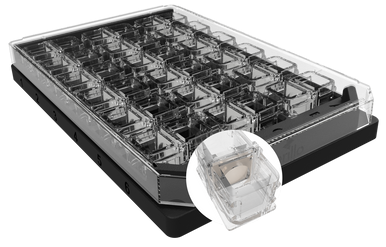
Cerillo’s Co-culture Discovery Bundle is a ready-to-use Co-Culture System designed for real-time phenotypic measurements. You can collect data from individual microbial populations without the need to custom build a solution. Shipped with 6 plates that hold 18 duvets per plate and 216 duvets.
Detail
Cerillo’s Co-culture Discovery Bundle is a ready-to-use Co-Culture System designed for real-time phenotypic measurements. You can collect data from individual microbial populations without the need to custom build a solution. Shipped with 6 plates that hold 18 duvets per plate and 216 duvets.
Other Products
EXTRAClean Urine Exosome Purification and RNA Isolation Kits
Product Info
Document
Product Info
Overview
Ensure optimal results for sensitive applications like NGS
Up to a tenfold increase in microRNA mapping during sequencing runs to reduce costs
Purification and enrichment of intact urinary exosomes for functional studies.
Bind and elute all RNA irrespective of size or GC content, without bias.
Isolate all sizes of RNA, including microRNA, irrespective of size or GC content, without bias.
No phenol extractions, Proteinase K treatment, nor carrier RNA required.
No time-consuming ultracentrifugation, filtration nor special syringes are required.
No precipitation reagents nor overnight incubation required.
Compatible with urine from any species.
Pure exosomes are purified and are free-from any other RNA-binding proteins.
Purification is based on EXTRAClean spin column chromatography that uses Norgen’s proprietary resin separation matrix.
Norgen’s EXTRAClean Urine Exosome Purification and RNA Isolation Mini Kit constitutes an all-in-one system for the purification of exosomes and the subsequent isolation of RNA from different urine sample volumes ranging from 250 μL to 1 mL. The purification is based on spin column chromatography that employs Norgen’s proprietary resin. The EXTRAClean columns undergo stringent processing and rigorous quality control measures to minimize contamination traces, ensuring optimal results for sensitive applications such as NGS. The kit is designed to isolate all sizes of RNA, including microRNA. The kit provides a clear advantage over other available kits in that it does not require any special instrumentation, protein precipitation reagents, extension tubes, phenol/chloroform or protease treatments. Moreover, the kit allows the user to elute into a flexible elution volume ranging from 50 μL to 100 μL. The purified RNA is free from any protein-bound circulating RNA and of the highest integrity. The purified RNA can be used in a number of downstream applications including real time PCR, reverse transcription PCR, NGS application, Northern blotting, RNase protection and primer extension, and expression array assays.
All sizes, including miRNA and small RNA (< 200 nt)
Elution Volume
50-100 μL
Time to Complete 10 Purifications
35-40 minutes
Average Yields
Variable depending on specimen
Storage Conditions and Product Stability All buffers should be kept tightly sealed and stored at room temperature. This kit is stable for 2 years after the date of shipment. It is recommended to warm Lysis Buffer A for 20 minutes at 60°C if any salt precipitation is observed.
Efficient, leaf punch tools for quick, precise field sampling. For use with the 3CR Bio Leaf Sample Collection Kit.
About
BASIC LEAF CUTTING TOOL
The 3CR Bio Basic Leaf Cutting Tool is a lightweight, easy-to-use, low-cost punch designed for precise sampling of thin or soft materials, ideal for fieldwork. This tool is expertly designed to core, punch, and retrieve samples from thin or soft source materials such as leaves. The tool comprises a convenient, hollow plastic pen-style holder, mounted with a durable stainless steel cutting tip at one end. It features an internal push-button-operated plunger for safe and efficient sample disc ejection. The tool produces a precise ¼ inch diameter disc, making it ideal for detailed sampling tasks. For best results, clean the cutting tip between each sample extraction by coring blank filter paper or rinsing with water or ethanol. This low-cost leaf punch is lightweight, easy to use, and perfect for fieldwork.
ADVANCED LEAF CUTTING TOOL
The 3CR Bio Advanced Leaf Cutting Tool is designed to streamline and enhance your sampling process. This high-precision leaf tissue punch produces a single ¼ inch diameter disc effortlessly. It features a unique mechanism that securely holds a standard snap-top or screw-top 2 mL storage tube in a fixed position, allowing the sample to be received without any need for touching or manipulation. Ideal for fieldwork, this advanced leaf punch significantly reduces effort and time when performing multiple samplings, ensuring accuracy and efficiency in every use.
Document
Efficient, leaf punch tools for quick, precise field sampling. For use with the 3CR Bio Leaf Sample Collection Kit.