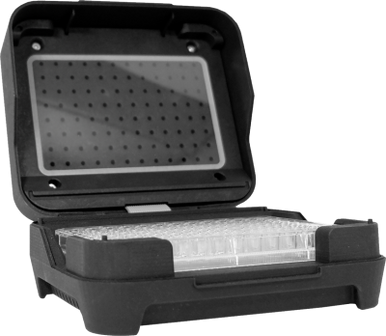
Cerillo’s Stratus Plate Reader is a third party module that can be placed next to or inside the OT-2 or Opentrons Flex for post experimental analysis. The worktable adapter will allow you to utuilize the OT-2 or Opentrons Flex to prepare the samples directly into the plate reader positions on the worktable.
This small portable device is primarily for microbial growth curve analysis. The Stratus is compatible with Cerillo’s Canopy wireless device that allows real time visualization, control, and analytics. This product is compatible with reading 600nm wavelengths.
Detail
Cerillo’s Stratus Plate Reader is a third party module that can be placed next to or inside the OT-2 or Opentrons Flex for post experimental analysis. The worktable adapter will allow you to utuilize the OT-2 or Opentrons Flex to prepare the samples directly into the plate reader positions on the worktable.
This small portable device is primarily for microbial growth curve analysis. The Stratus is compatible with Cerillo’s Canopy wireless device that allows real time visualization, control, and analytics. This product is compatible with reading 600nm wavelengths.
Other Products
028074P1 Tryptic Soy Agar
Product Info
Document
Product Info
Introduction
Usages: For enumerating and enriching nonfastidious or fastidious bacteria.
Principle: Tryptone, peptone and yeast extract multivalent powder provides a nitrogen source, vitamins, and growth factors; sodium chloride to maintain osmotic balance.
Formulation(per liter): Pancreatic Digest of Casein 15g Papaic Digest of Soybean 5g Sodium chloride 5g Agar 15g Final pH 7.3±0.2
How to use: 1.Suspend 40g in 1L of distilled water , stirring heated to boiling ,autoclave at 121℃ for 15 minutes. 2.Diluted and treated samples.
Storage: Keep container tightly closed, store in a cool, dry place, away from bright light. Storage period of 3 years.
The 16S V3-V5 Library Preparation Kit for Illumina consists of the reagents and components required for library preparation of the 16S V3-V4 amplicon libraries to be used for next-generation sequencing on Illumina platforms. All molecular reagents including primers, enzyme mixes, indexes, and buffers are provided. Instructions for PCR clean up with the AMPure XP Magnetic Beads (supplied by customer) are also included for rapid purification of nucleic acid products generated at two steps of the workflow. The library prep workflow could be used for purified DNA inputs from different sources including stool, soil, water, saliva, plant, urine, skin swab, vaginal swab, cheek swab, nasal swab, plasma/serum, tongue swab, gum swab, and others.
The 16S V3-V5 Library Preparation Kit for Illumina has a streamlined procedure that reduces the handling time such that the library prep procedure can be completed in approximately 4 hours (see diagram below). Input DNA is first subjected to targeted PCR to amplify the V3-V4 region of the DNA encoding 16S rRNA. The post-PCR reaction is then cleaned up using AMPure XP beads. Dual index primers are then added using a limited-cycle PCR. The indexed amplicons flanked by 5′ and 3′ barcoded adaptors are then cleaned using AMPure XP beads. The libraries are then ready for quantification, pooling and sequencing.
Storage Conditions and Product Stability Norgen’s 16S V3-V5Library Prep Kit for Illumina is shipped as one kit box (for the 24 prep kit) or two sub-component kits (for the 96 prep kit). All kits should be stored at -20°C upon arrival.
All kit components should remain stable for at least 1 year when stored at the specified storage conditions.
MutS Homolog 2 (MSH2) is a protein involved in the mismatch-repair pathway. This protein is commonly associated with hereditary non-polyposis colorectal cancer, and mutations in this gene are correlated with the development of sporadic colorectal carcinoma. Expression levels of MSH2 are abnormally low in a high percentage of patients with microsatellite instability, as well as endometrial and ovarian cancers. Use of Anti-MSH2 is optimized when paired in an IHC panel with antibodies against MSH6, MLH1, and PMS2. Reports have shown Anti-MSH2 to be useful in the detection of the protein in a number of normal and neoplastic tissues, and for identifying a loss of MSH2 in tumors that are microsatellite-unstable.