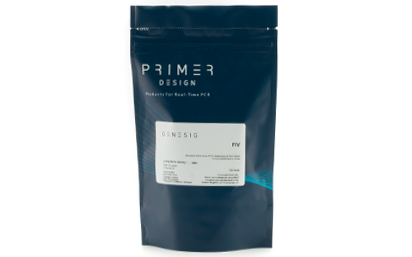
Primer and probe mix (150 reactions) Reverse Transcription, target specific primers (RNA genome viruses only) Copy number standard curve (sufficient for multiple standard curves) Internal extraction control – Read through VIC channel* Endogenous control (150 tests) RNAse/DNAse free water *alternative fluorophores available on request
Nucleic acid testing (NAT) is the method of choice for detection and quantification of a wide range of micro organisms. Primerdesign manufactures and supplies high quality quantitative real-time PCR kits for the detection and simultaneous quantification of numerous significant pathogens . A copy number standard curve is provided for quantification and an the internal extraction template (DNA or RNA), controls for the quality of the nucleic acid extraction and eliminates false negative results.
The kit is designed with the broadest possible detection profile to ensure that all clinically relevant strains and subtypes are detected. Target sequences are selected by working with data from key opinion leaders in the field. Multiple sequence alignments and unprecedented real-time PCR expertise in design and validation ensure the best possible kit. Details of the target and priming specificity are included in the individual handbooks above.
Packaged, optimised and ready to use. Expect Better Data.
Other Products
t-Boc-aminooxy-PEG1-propargyl
Product Info
Document
Product Info
t-Boc-aminooxy-PEG1-propargyl is a click chemistry PEG linker with a t-Boc-aminooxy group. The propargyl group can react with azide-bearing compounds or biomolecules via copper catalyzed azide-alkyne Click Chemistry to yield a stable triazole linkage. The t-Boc aminooxy group can be deprotected under mild acidic conditions and then can react with an aldehyde or ketone group to form a stable oxime linkage. The hydrophilic PEG spacer increases solubility in aqueous media. Reagent grade, for research purpose. Please contact us for GMP-grade inquiries.
Document
t-Boc-aminooxy-PEG1-propargyl is a click chemistry PEG linker with a t-Boc-aminooxy group. The propargyl group can react with azide-bearing compounds or biomolecules via copper catalyzed azide-alkyne Click Chemistry to yield a stable triazole linkage. The t-Boc aminooxy group can be deprotected under mild acidic conditions and then can react with an aldehyde or ketone group to form a stable oxime linkage. The hydrophilic PEG spacer increases solubility in aqueous media. Reagent grade, for research purpose. Please contact us for GMP-grade inquiries.
HiPure Soil RNA Kit is suitable for extracting high-purity microbial total RNA from soil samples. The kit adopts silica gel column purification technology and original humic acid adsorbent technology. It is suitable for extracting high-yield and high-purity total RNA from various soil samples, such as forest soil, grassland soil, mining soil, sediment and so on. The obtained RNA can be directly used in RT-PCR, Northern blot, poly-A + purification, nucleic acid protection and in vitro translation.
Details
Specifications
Features
Specifications
Main Functions
Isolation total RNA from 500 mg soil sample
Applications
RT-PCR, Northern blot, poly-A + purification, nucleic acid protection and in vitro translation
Purification method
Mini spin column
Purification technology
Silica technology
Process method
Manual (centrifugation or vacuum)
Sample type
Forest soil, grassland soil, mining area soil, sediment and other samples
Sample amount
500 mg
Elution volume
≥30μl
Time per run
≤60 minutes
Liquid carrying volume per column
800µl
Binding yield of column
100µg
Principle
Hipure silica gel column is based on glass fiber filter membrane with high binding force. Under the condition of high concentration of ionizing agent (such as guanidine hydrochloride or guanidine isothiocyanate), the filter membrane can adsorb nucleic acid through hydrogen bond and electrostatic, while protein and other impurities are not adsorbed and removed. The filter membrane adsorbed with nucleic acid is washed to remove the residual protein and salt. Finally, the nucleic acid adsorbed on the filter membrane can be washed out with low salt buffer (such as buffer TE) or water. The obtained nucleic acid has high purity and can be directly used in various downstream experiments.
Advantages
High quality – high purity total RNA can be directly used in various sensitive downstream applications
Fast – extraction of several samples can be completed in 60 minutes by column purification method
Safe – no phenol chloroform extraction required
Sensitive – RNA can be purified at the level of PG
Kit Contents
Contents
R418302
R418303
Purification Times
50 Preps
250 Preps
HiPure RNA Micro Columns
50
250
2ml Collection Tubes
100
500
gDNA Filter Column
50
250
2ml Beads Tubes
50
250
Buffer SOL
30 ml
150 ml
Buffer SDS
4 ml
15 ml
Buffer PHC
30 ml
150 ml
Buffer GDP
40 ml
150 ml
Buffer RW1
50 ml
200 ml
Buffer RW2 *
20 ml
2 x 50 ml
RNase Free Water
10 ml
30 ml
Storage and Stability
Buffer PHC should be stored at 2–8°C upon arrival. However, short-term storage (up to 12 weeks) at room temperature (15–25°C) does not affect their performance. The remaining kit components can be stored dry at room temperature (15–25°C) and are stable for at least 18 months under theseconditions.The entire kit can be stored at 2–8°C, but in this case buffers should be redissolvedbefore use. Make sure that all buffers are at room temperature when used.
Experiment Data
Document
HiPure Soil RNA Kit is suitable for extracting high-purity microbial total RNA from soil samples. The kit adopts silica gel column purification technology and original humic acid adsorbent technology. It is suitable for extracting high-yield and high-purity total RNA from various soil samples, such as forest soil, grassland soil, mining soil, sediment and so on. The obtained RNA can be directly used in RT-PCR, Northern blot, poly-A + purification, nucleic acid protection and in vitro translation.
Principle: Beef extract powder and casein hydrolyzate provide nitrogen, vitamins and amino acids; soluble starch absorption of toxic metabolites.
Formulation(per liter): Beef extract 2g Soluble starch 1.5g Acid hydrolysis of casein 17.5g Final pH7.3 ± 0.2
How to use: 1.Suspend 21g in 1 L of distilled water , stirring heated to boiling until completely dissolved, dispensing flask, 121 autoclave for 15min. 2.Diluted and treated samples.
Storage: Keep container tightly closed, store in a cool, dry place, away from bright light. Storage period of 3 years.