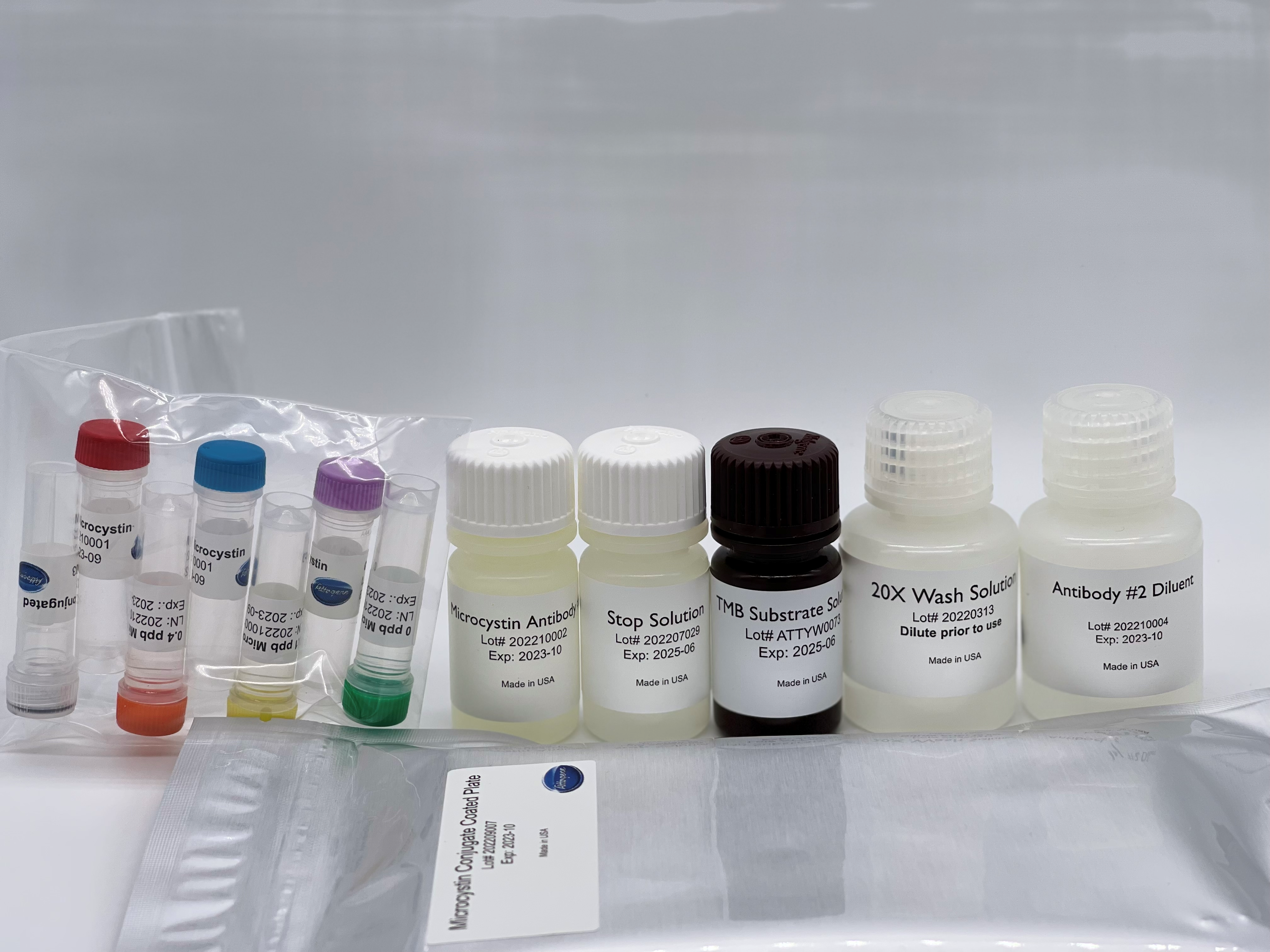
Microcystin are a class of hepatotoxins produced by blue-green algae such as Microcystis aeruginosa. Microcystin-LR is the most common of the over 50 different congeners. Cyanobacteria can produce microcystin in large quantities during an algae bloom which then pose a major threat.
This kit can be used for Congener-Independent quantitative test of Microcystin in liquid samples such as drinking, ambient and waste water and algal cultures.
Additional Quality Control, Calibration Verification, and Spiking Solution materials can be obtained separately in optional Supplemental Pack for Method 546 (catalog # EL2024-Q).
Microcystin-LR
Informational sign postings about HABs at recreational waters: < 6 μg/L
Recreational public health advisory: 6 μg/L
Elevated recreational public health advisory (e.g. no contact): 20 μg/L
EPA 10-day drinking water health advisories:
Do Not Drink – 0.3 μg/L for bottle fed infants and preschool children, pregnant and nursing woman, elderly immunocompromised and liver conditions.
Do Not Drink – 1.6 μg/L for school-age children to adults.
Do not Use – 20 μg/L
Other Products
Propargyl-PEG2-acid
Product Info
Document
Product Info
Propargyl-PEG2-acid is a linker consisting of propargyl and carboxylic acid functional groups. In the presence of activators (e.g. EDC, or HATU), the carboxylic acid reacts with primary amine to form a stable amide bond. The propargyl group reacts with azide group in biomolecules to yield a stable triazole linkage. Reagent grade, for research purpose. Please contact us for GMP-grade inquiries.
Document
Propargyl-PEG2-acid is a linker consisting of propargyl and carboxylic acid functional groups. In the presence of activators (e.g. EDC, or HATU), the carboxylic acid reacts with primary amine to form a stable amide bond. The propargyl group reacts with azide group in biomolecules to yield a stable triazole linkage. Reagent grade, for research purpose. Please contact us for GMP-grade inquiries.
High yield and high quality genomic DNA with no RNA or protein contamination
DNA ready for any application including PCR, qPCR, genotyping and more
Norgen’s Cells and Tissue DNA Isolation Kits are designed for the rapid preparation of genomic DNA from cultured cells as well as various tissue samples and urine. The purified genomic DNA is fully digestible with all restriction enzymes tested, and is completely compatible with PCR and Southern Blot analysis.
Cells and Tissue DNA Isolation Kit (Spin Column)
Purification is based on spin column chromatography as the separation matrix. Norgen’s columns bind DNA under optimized salt concentrations and release the bound DNA under low salt and slightly alkali conditions. The protocol can be completed in approximately 30 minutes for cells and within 90 minutes for tissues. Each kit contains sufficient materials for 50 preparations.
Cells and Tissue DNA Isolation Micro Kit (Micro)
Optimized for small inputs of cells and tissues, such as Laser-Captured Microdissection (LCM). Purification is based on spin column chromatography as the separation matrix. Norgen’s columns bind DNA under optimized salt concentrations and release the bound DNA under low salt and slightly alkali conditions. Preparation time for a single sample is approximately 60 minutes, and each kit contains sufficient materials for 50 preparations.
Cells and Tissue DNA Isolation Kit (Magnetic Bead System)
Purification is based on the use of magnetic beads that bind DNA under optimized binding conditions. Norgen’s Cells and Tissue DNA Isolation Kit (Magnetic Bead System) allows for the isolation of genomic DNA from various types of animal tissues or cell samples. Preparation for 10 purifications is approximately 40 minutes of hands-on time.
Cells and Tissue DNA Isolation 96-Well Kit (High Throughput Magnetic Bead System)
Purification is based on the use of magnetic beads that bind DNA under optimized binding conditions. Norgen’s Cells and Tissue DNA Isolation 96-Well Kit (Magnetic Bead System) allows for the isolation of genomic DNA from various types of animal tissues or cell samples. The Cells and Tissue DNA Isolation 96-Well Kit (Magnetic Bead System) also can be integrated with a robotic automation system.
8-10 µg (20 mg of animal tissue) 8-12 µg (3 x 10⁶ cells)
Average Purity (OD260/280)
1.8 – 1.9
Time to Complete 10 Purifications
40 minutes hands-on time (Cat. 59100) 50 minutes hands on time (Cat. 62500)
* Average DNA yield will vary depending on the donor
Storage Conditions and Product Stability All solutions should be kept tightly sealed and stored at room temperature (15 – 25°C). This kit is stable for 1 year after the date of shipment.
MutS Homolog 2 (MSH2) is a protein involved in the mismatch-repair pathway. This protein is commonly associated with hereditary non-polyposis colorectal cancer, and mutations in this gene are correlated with the development of sporadic colorectal carcinoma. Expression levels of MSH2 are abnormally low in a high percentage of patients with microsatellite instability, as well as endometrial and ovarian cancers. Use of Anti-MSH2 is optimized when paired in an IHC panel with antibodies against MSH6, MLH1, and PMS2. Reports have shown Anti-MSH2 to be useful in the detection of the protein in a number of normal and neoplastic tissues, and for identifying a loss of MSH2 in tumors that are microsatellite-unstable.