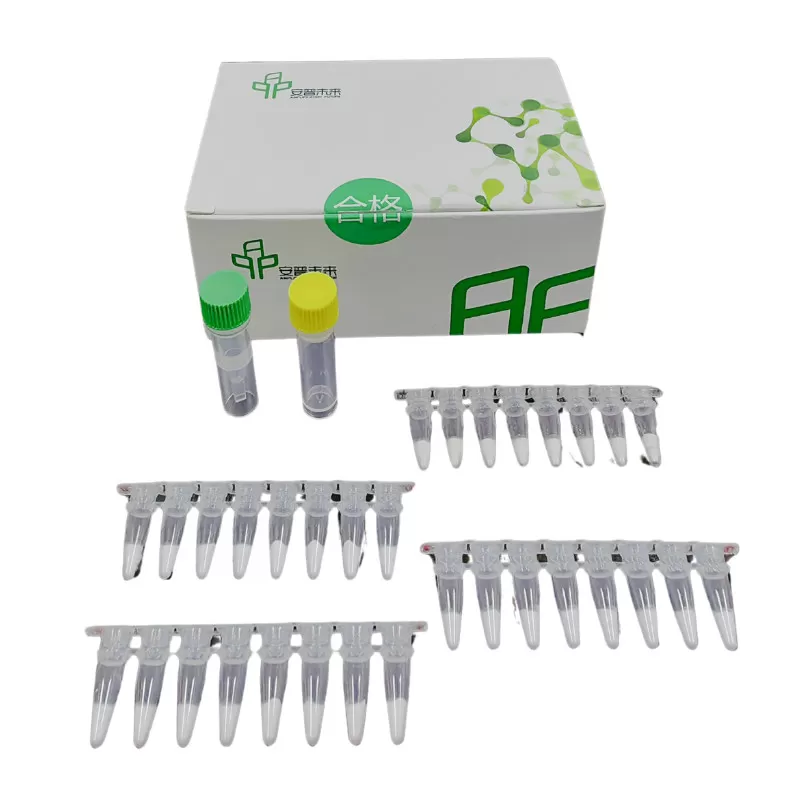
Conveniently Test RNA Isothermal PCR Kit At Home Reagent Buffer
Facebook
X
Pinterest
Email
Detail
Product Description
Conveniently Test RNA At Home With At Home Test Kit – Reagents Buffers
Product Detail
Kit Storage and term of Validity
Storage term: stored at ≤-20℃,keep away from light, avoid heavy weight and repeated freezing and thawing.
Term of Validity: 14 months
Isothermal nucleic acid Principle Summary
This kit is based on a rapid nucleic acid amplification technology at room temperature and constant temperature:at room temperature and constant temperature(generally 39℃~42℃),reverse transcriptaseuses specific primers and template RNA tosynthesize cDNA strands,and binds the auxiliary protein and single strand with the help of the protein, the recombinase and the primer form a complex; perform a homology search and bind the target homology domain, at this time a D-loop region is formed at the homology positionand strand exchange begins; accompanied by the recombinase from the complex upon dissociation,the polymerase also bindsto the 3′ end of the primer,initiating chainextension.It is suitable for laboratory-level RNA amplification and RNA amplification for other detection purposes.
Isothermal nucleic acid Product Features
1/ High sensitivity and specificity, short reaction time.
2/ The reagent form is freeze-dried, stable and easy to operate.
3/ The reaction can be operated by metal bath and water bath pot without purchasing expensive PCR apparatus.
Technical Parameters:
Parameters
Details
Product Name
RNA Isothermal Amplification Kit Basic
Manufacturer
Amp-future
Storage Temperature
-20°C
Kit Components
Enzymes, Buffers ,Reagents
Packaging
48 Tests/box
Detection Limit
500-1000copies/µL
Shipping
ICE
Test Time
5-20mins
Isothermal nucleic acid Applications
Suitable for RNA isothermal rapid amplification kit(BASIC type)
Primer: Require pair of nucleotide primers with the length of 25-35 bp.
RNA basic kit reaction temperature is 39 to 42℃ and time is 5-20 minutes.
Notes
1/ Please avoid nucleic acid contamination and set blank control during reaction due to the high sensitivity of the kit.
2/ Please take out the required quantity of MIRA reaction units for the experiment, and put the rest under storage conditions when performing the experiment.
Other Products
P1014 HiPure Fastfilter Plasmid Maxi Kit
Product Info
Document
Product Info
Introduction
The HiPure FastFilter Plasmid DNA Maxi Kits combine the power of HiPure technology with the time-tested consistency of alkaline-SDS lysis of bacterial cells to deliver high-quality DNA. HiPure DNA columns facilitate the binding, washing and elution steps thus enabling multiple samples to be simultaneously processed. This system also includes a special filter cartridge which replaces the centrifugation step following alkaline lysis. Plasmid DNA purified by this system is suitable for automated fluorescent DNA sequencing, restriction endonuclease digestion, transfection of mammalian cells, and other manipulations. Up to 1000 µg high copy number plasmid DNA or 50-500 µg low copy number plasmid DNA can be purified from 200mL overnight culture.
Details
Specifications
Features
Specifications
Main Functions
Isolation up to 1mg plasmid DNA from 200ml bacterial culture
Applications
Enzyme digestion, sequencing, PCR and labeling, etc.
Purification method
Maxi spin column
Purification technology
Silica technology
Process method
Manual (centrifugation or vacuum)
Sample type
Conventional plasmid, plasmid less than 30KB
Sample amount
100-200ml
Yield
0.4-1mg
Elution volume
≥500μl
Time per run
≤60 minutes
Liquid carrying volume per column
20ml
Binding yield of column
1mg
Principle
The HiPure Plasmid procedure is based on alkaline lysis of bacterial cells followed by adsorption of DNA onto silica in the presence of high salt. The unique silica membrane used in the kit completely replaces glass or silica slurries for plasmid DNA minipreps. The procedure consists of 3 basic steps: Preparation and clearing of a bacterial lysate by alkaline method,then transfer the supernatant to column to bind DNA. After washing proteins and other impurities, nucleic acid was finally eluted with low-salt buffer (10mm Tris, pH9.0, 0.5mm EDTA).
Advantages
High purity – purified plasmid can be directly used in sequencing, enzyme digestion and PCR, etc.
Fast – it takes only 15-60 minutes to complete the isolation
Economy – high cost performance
Kit Contents
Contents
P101402
P101403
Purification Times
10 Preps
50 Preps
RNase A
20 mg
40 mg
Buffer P1
140 ml
2 x 350 ml
Buffer P2
140 ml
2 x 350 ml
Buffer LEN3
70 ml
350 ml
Buffer GBT
120 ml
550 ml
Buffer PW1
60 ml
300 ml
Buffer PW2*
50 ml
4 x 100 ml
Elution Buffer
20 ml
120 ml
HiPure DNA Maxi Columns III
10
50
Lysate Clear Maxi Syringe
10
50
50 ml Collection Tubes
20
100
Storage and Stability
The kit components can be stored dry at room temperature (15-25°C) and are stable for at least 18 months under these conditions. If any precipitates form in the buffers, warm at 37℃ to dissolve. After addition of RNase A,Buffer P1 is stable for 6 months when stored at 2-8°C.
The HiPure FastFilter Plasmid DNA Maxi Kits combine the power of HiPure technology with the time-tested consistency of alkaline-SDS lysis of bacterial cells to deliver high-quality DNA. HiPure DNA columns facilitate the binding, washing and elution steps thus enabling multiple samples to be simultaneously processed. This system also includes a special filter cartridge which replaces the centrifugation step following alkaline lysis. Plasmid DNA purified by this system is suitable for automated fluorescent DNA sequencing, restriction endonuclease digestion, transfection of mammalian cells, and other manipulations. Up to 1000 µg high copy number plasmid DNA or 50-500 µg low copy number plasmid DNA can be purified from 200mL overnight culture.
These kits provide a fast, reliable and convenient spin column method for the isolation of high quality, high purity and inhibitor-free cell-free circulating DNA (cfc-DNA) from plasma/serum sample. These kits are designed to isolate all sizes of cfc-DNA from either fresh or frozen plasma/serum samples and the purified DNA is eluted into a flexible elution volume ranging from 25 µL to 50 µL. The purified plasma/serum cfc-DNA is fully compatible with all downstream applications including PCR, qPCR, methylation-sensitive PCR and Southern Blot analysis, microarrays and NGS.
Background
Plasma/Serum cell-free circulating DNA (cfc-DNA) has the potential to provide biomarkers for certain cancers and disease states as well as fetal DNA in maternal blood. Currently, significant advancements are being made in utilizing cfc-DNA as biomarkers for the early diagnosis, prognosis and monitoring of therapy for several cancer types and autoimmune diseases. Cell-free mitocondrial DNA (cfmtDNA) is also under investigation for its clinical significance. This cfc-DNA is usually present as short fragments of less than 1000 bp. In addition, cell-free fetal DNA has been widely used as a non-invasive method for prenatal diagnosis including early identification of fetal sex, genetic studies for families at high risk for inherited genetic disorders, screening for Rhesus factor, screening for aneuploidy and identification of preeclampsia.
Plasma/Serum Cell-Free Circulating DNA Purification Micro Kit Dx
For serum input volumes 10 µL – 200 µL. Purify high-quality DNA in 15-20 minutes
Plasma/Serum Cell-Free Circulating DNA Purification Mini Kit Dx
For serum input volumes 200 µL – 500 µL. Purify high-quality DNA in 15-20 minutes.
Plasma/Serum Cell-Free Circulating DNA Purification Midi Kit Dx
The first column will handle the large volume input of bodily fluids that is followed by a concentration on a mini column for a final elution of 25 µL to 50 µL. All components for the purification & concentration are provided in one convenient & fast kit for the easy processing of large input volumes of bodily fluids. For a schematic workflow of the protocol click here to view. For serum input volumes 1 mL – 4 mL. Purify high-quality DNA in 90 minutes.
Plasma/Serum Cell-Free Circulating DNA Purification Maxi Kit Dx
The first column will handle the large volume input of bodily fluids that is followed by a concentration on a mini column for a final elution of 25 µL to 50 µL. All components for the purification & concentration are provided in one convenient & fast kit for the easy processing of large input volumes of bodily fluids. For a schematic workflow of the protocol click here to view. For serum input volumes 5 mL – 10 mL. Two kits in one – purify and concentrate DNA from bodily fluids using a convenient two column system.
*Please check page 7 in the product manual for the Plasma/Serum Average Yields and the Common DNA Quantification Methods.
Storage Conditions and Product Stability All buffers should be kept tightly sealed and stored at room temperature (15-25°C) for up to 2 years without showing any reduction in performance. Norgen’s Plasma/Serum Cell-Free Circulating DNA Purification Kits contain ready-to-use Proteinase K solution, which is dissolved in a specially prepared storage buffer. The Proteinase K is stable for up to 2.5 years after delivery when stored at room temperature. To prolong the lifetime of Proteinase K, storage at 2–8°C is recommended.
Biocolor’s Purple-Jelley assay kit is the perfect tool for accurate measurement of hyaluronic acid / Hyaluronan levels in your samples. This colorimetric assay is optimised for quantitative analysis in-vivo, tissue-derived hyaluronic acid / Hyaluronan and includes full step-by-step instructions.
Colorimetric Detection (655nm) (Endpoint)
Hyaluronic Acid: A gentle giant!
Hyaluronic acid, in its hydrated form, is a unique carbohydrate polymer, often referred to as a ‘gentle giant.’ It consists of a lengthy, flexible, non-branching chain with a repeating disaccharide pattern. This disaccharide is composed of alternating uronic acid and aminosugar units.
Why is our kit called ‘Purple-Jelley’?
Discovering the J-Aggregate Effect in Cyanine DyesIn 1936, Edwin Jelley made a fascinating observation, documented it in a letter to Nature (Nature 138, 1009 – 1010). He noted a peculiar behaviour of certain cyanine dyes, that when dissolved in 5 M NaCl, they dyes exhibited a third absorbance peak at a longer wavelength, around 650nm. In deionized water, however, they displayed only a double peak at approximately 540nm and 570nm. The 650nm peak in concentrated dye solutions resulted from the aggregation of dye molecules and was later termed a ‘J-aggregate,’ in honor of Edwin Jelley. The J-aggregate is known as a supra-molecular complex, formed by stacking individual dye molecules.
Subsequent research in the 1960s, notably by Kay et al. (J. Physical Chem. 68, 1896 – 1906), revealed that various biological polymers, including proteins, DNA, polar lipids, and glycosaminoglycans, could also induce this third absorbance peak. This phenomenon led to the development of the Purple-Jelley assay, named after the purple color of the dye reagent and Edwin Jelley himself.
An overview of the Purple-Jelley assay steps:
During the assay, hyaluronic acid is selectively purified during the assay sample preparation protocol. This is then reacted with the Purple-Jelley dye reagent, and the absorption of the characteristic third wavelength recorded. By comparison with a calibration curve the hyaluronic acid content of the sample can be measured.
Step 1. The assay protocol takes tissue samples through a sequential sample preparation protocol which involves enzymatic protein digestion, followed by precipitation and purification of GAGs, culminating in the precipitation of purified Hyaluronic acid.
Step2. The processed sample is then incubated for 10 minutes with the Purple-Jelley dye reagent, forming a coloured product which can be measured spectrophotometrically.
Step 3. The Hyaluronic acid content of unknown samples can be calculated by comparison against a calibration curve prepared using a standard comprising hyaluronic acid (supplied with the kit).
Assay range
10 – 100µg/ml
Limit of Detection
10µg/ml
Detection Method
Colorimetric Detection (655nm) (Endpoint)
Measurements per kit
100 in total (allows a maximum of 46 samples to be run in duplicate alongside a standard curve).
Suitable Samples
In-vivo: Hyaluronic acid purified from in-vivo tissues. The kit protocol involves extraction and purification of hyaluronic acid prior to reaction with the Purple-Dye reagent.
Precautions
This kit is designed for research use only. Not for use in diagnostic procedures. Kit requires access to a centrifuge, as well as a spectrophotometer/colorimeter capable of colorimetric, absorbance detection at 655nm. Specific sample preparation protocols may require customer to provide further reagents, consult assay manual for further information.
2. Hyaluronan Reference Standard (1x 5ml, 0.2mg/ml soluble Hyaluronic Acid)
3. Precipitating Reagent (2x 34ml)
4. Sodium Chloride (1x 20ml)
5. Cetylpyridinium Chloride (1x 20ml)
6. TRIS-buffered Saline (5x tablets)
7. 2ml screw-cap tubes for preparation of samples.
8. Assay kit manual
NB: Additional reagents may be required for sample preparation prior to assay. Consult manual or contact us for further details.
Document
Biocolor’s Purple-Jelley assay kit is the perfect tool for accurate measurement of hyaluronic acid / Hyaluronan levels in your samples. This colorimetric assay is optimised for quantitative analysis in-vivo, tissue-derived hyaluronic acid / Hyaluronan and includes full step-by-step instructions.