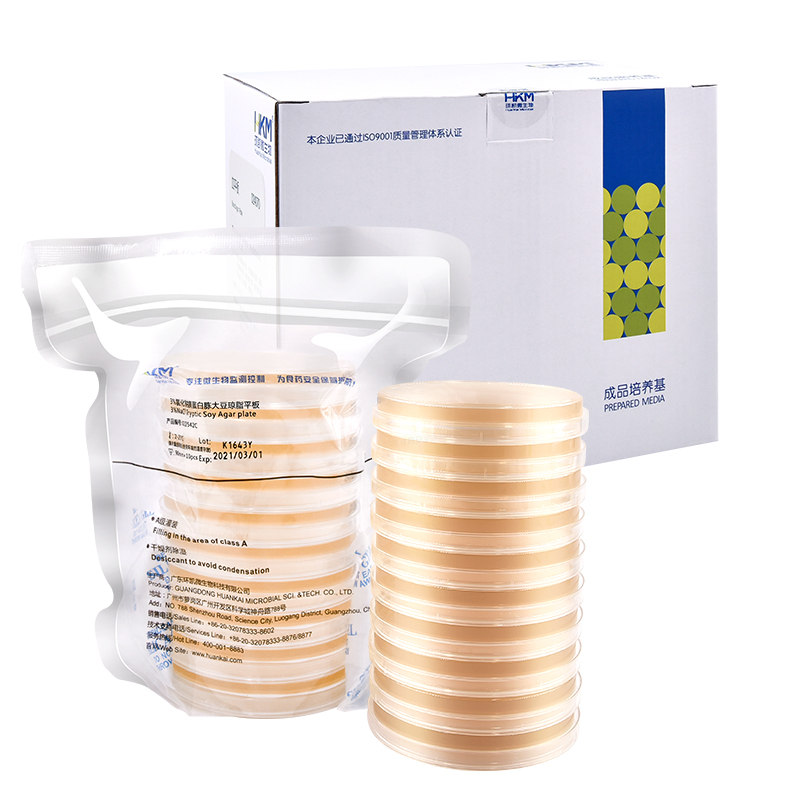
CP0301J Triple Wrapped Irradiated Plate-Sabouraud Dextrose Agar
Facebook
X
Pinterest
Email
55mm*10 plates / bag
Detail
Introduction
Usages: For monitoring and detection of surface of equipment and personnel hygiene.
Advantage: 1.This series of products was filling at A level of environment, and final sterilization by Gamma ray irradiation, triple packaging insure sterility and long shelf life. 2.Each dish was marking label product name, batch number, expiration date .Information is available of traceability. 3.Inner additional desiccant, reducing formation of condensation water, while inner additional sterile paper and plastic bags for easier transfer and cultivation. 4.Triple packing dense bags to avoid the penetration of hydrogen peroxide; clean gas was filled as a buffer to reduce broken bags and dish in transit.. 5.This series of products is available to store at (2-25 ℃), shelf life of up to 6 months.
Storage: Store in a cool (2-25 ℃), dry place, away from bright light. Storage period of 6 months.
Specifications: 55mm*10 plates / bag
Other Products
NEST 96-Well Plate, Flat (100 count)
Product Info
Document
Product Info
NEST 96 Well Plate Flat, polystyrene, sterile, DNase, RNase, pyrogen, and endotoxin free. Individually wrapped.
100 count, 200 uL max volume per well
Labware definition is available for immediate use in Opentron’s Labware Library
Document
NEST 96 Well Plate Flat, polystyrene, sterile, DNase, RNase, pyrogen, and endotoxin free. Individually wrapped.
100 count, 200 uL max volume per well
Labware definition is available for immediate use in Opentron’s Labware Library
The Livestock Disease Kit is a reliable and easy-to-use test kit designed to detect the presence of diseases in livestock, such as cattle, sheep, goats, pigs and horses. The kit has been designed to detect diseases with high accuracy and sensitivity. Also it requires only a small sample volume of 50 μl, making it highly efficient and cost-effective. It is also suitable for a range of canine dog test kit applications, providing fast and accurate results.The reliable detection results make it a reliable and cost-effective solution for farmers and veterinarians looking to diagnose livestock diseases quickly and accurately.
Amp-future bio Livestock Disease Kit is an innovative animal health care product designed to detect and diagnose livestock diseases. Developed by a Chinese research team, this kit is a simple and reliable solution to test and treat livestock diseases. With its detection limit of 0.1 ng/ml, users can obtain accurate results quickly and accurately. The test time takes from 5-20 minutes, and the kit typically contains 48 tests/kit. Furthermore, it is easy to store with its cold storage temperature of -20°C.
The Amp-future bio Livestock Disease Kit provides an innovative solution for animal health care. It is an essential product for veterinary professionals, pet owners, and animal health researchers to detect and diagnose livestock diseases. With its simple and reliable detection and diagnosis, this kit is a must-have for anyone who wants to ensure the health of their animals.
Support and Services:
Livestock Disease Kit Technical Support and Services
We provide technical support and services for our Livestock Disease Kit. We are committed to helping you get the most out of your product and ensuring your satisfaction with our products and services.
Our technical support staff is available to answer any questions you may have about the product.
We offer online tutorials and user guides to help you understand the product better.
We provide technical assistance to help troubleshoot any issues you may be having with the product.
We offer a warranty on our products.
If you have any questions or need technical support, please do not hesitate to contact us. We are here to help you make the most of your Livestock Disease Kit.
FAQ:
Q: What diseases can Livestock Disease Kit detect? A: Livestock Disease Kit can detect different infectious diseases, such as Foot and Mouth Disease, Bluetongue Disease, Bovine Viral Diarrhea.
Q: How does Livestock Disease Kit work? A: Livestock Disease Kit uses advanced MIRA technology to amplify the target DNA/RNA targent sequences , and detect the disease by analyzing the amplified sequences.
Q: How long does it take to get results from Livestock Disease Kit? A: Livestock Disease Kit can give a result within 5-20 mins.
Q: What type of sample is suitable for Livestock Disease Kit? A: Livestock Disease Kit is suitable for blood, serum, and tissue samples.
Q: Does Livestock Disease Kit require professional equipment? A: No, Livestock Disease Kit does not require any professional equipment,can use with our isothermal equipment or pcr machine
Document
The Livestock Disease Kit is a reliable and easy-to-use test kit designed to detect the presence of diseases in livestock, such as cattle, sheep, goats, pigs and horses. The kit has been designed to detect diseases with high accuracy and sensitivity. Also it requires only a small sample volume of 50 μl, making it highly efficient and cost-effective. It is also suitable for a range of canine dog test kit applications, providing fast and accurate results.The reliable detection results make it a reliable and cost-effective solution for farmers and veterinarians looking to diagnose livestock diseases quickly and accurately.
Ready to Use CdSe/ZnS Qdots Nanoparticle Streptavidin Conjugate for Lateral Flow
Our Streptavidin CdSe/ZnS Quantum Dots (QDs)conjugate is manufactured using special conjugation technology and functonally tested by lateral flow. We have coated our high quality nanoparticles with a proprietary surface coat that covalently binds the biotin forming ultra stable conjugates. The resulting Streptavidin CdSe/ZnS QDs can irreversibly bind biotin.
fluorescent broad range UV light excitation range of 100nm to 400nm, 655nm emission
Document
Highly stable and uniform Streptavidin CdSe/ZnS Qdots in a Ready To Use format