
Introduction
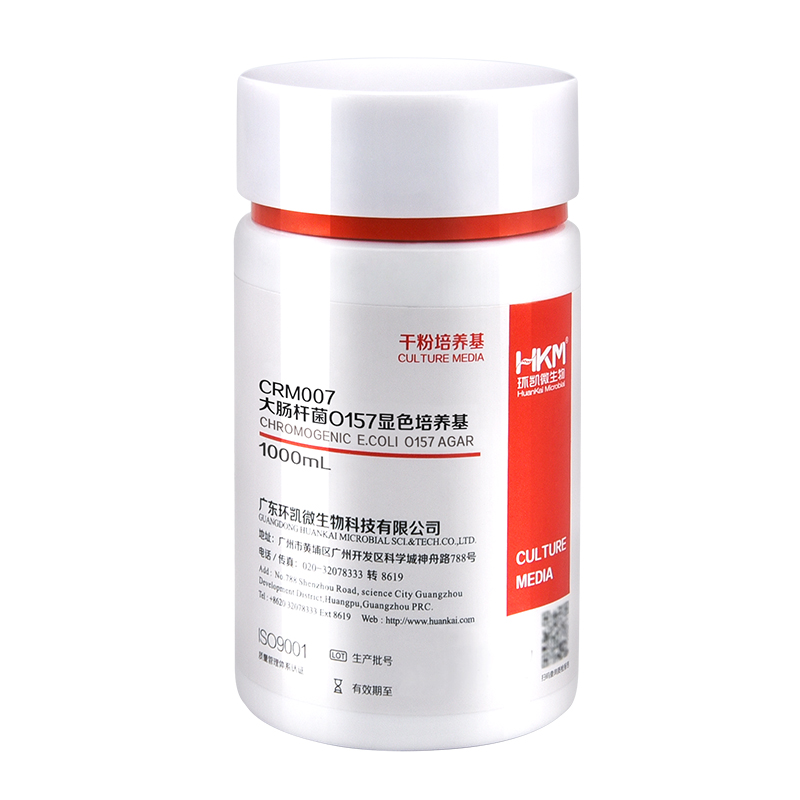
Place of Origin: Guangdong, China
Warranty: 2 years
Customized support: OEM
Brand Name: HKM
Model Number: CRM007
Reagent grade: Biochemical Reagent
Form: Powder
Color: Light yellow
Type: E. coli O157 Agar

Place of Origin: Guangdong, China
Warranty: 2 years
Customized support: OEM
Brand Name: HKM
Model Number: CRM007
Reagent grade: Biochemical Reagent
Form: Powder
Color: Light yellow
Type: E. coli O157 Agar

Giardiasis is a disease of the small bowel caused by the protozoan parasite Giardia intestinalis (syn.duodenalis or lamblia). Giardia is one of the most common intestinal parasites in the world, and occurs at very high prevalence rates in places with poor water sanitation. Individuals become infected through ingesting or coming into contact with contaminated water, food or soil. It can also be spread through the faecal-oral route due to poor hygiene practices, which makes it common in day-care centers. G. intestinalis lives inside the intestines of infected humans or other animals including cats, dogs, birds, cows, beaver and deer. Symptoms of infection include diarrhea, malaise, excessive gas, bloating, nausea, diminished interest in food, possible vomiting and weight loss.
There are 2 kits available for the detection of Giardia intestinalis:
Giardia intestinalis TaqMan RT-PCR Kit, 100 reactions
Giardia intestinalis TaqMan RT-PCR Probe/Primer Set and Controls, 100 reactions
Figure 1 / 3

Click for expanded view
Storage Conditions and Product Stability
All kit components can be stored for 1 year after the date of production without showing any reduction in performance.
All kit components should be stored at -20°C upon arrival. Repeated thawing and freezing (> 2 x) of the Master Mix and Positive Control should be avoided, as this may affect the performance of the assay. If the reagents are to be used only intermittently, they should be frozen in aliquots.
| Component | Cat. TM43850 (100 preps) | Cat. TM43810 (100 preps) |
|---|---|---|
| MDx TaqMan 2X PCR Master Mix | 2 x 700 μL | – |
| Giardia intestinalis Primer & Probe Mix | 280 μL | 280 μL |
| Giardia intestinalis Positive Control | 150 μL | 150 μL |
| Nuclease-Free Water (Negative Control) | 1.25 mL | 1.25 mL |
| Product Insert | 1 | 1 |

Usages:
For pre-enrichment of Salmonella spp.
Principle:
Peptone provide carbon and nitrogen sources to meet the needs of bacterial growth; sodium chloride maintains osmotic equilibrium; potassium dihydrogen phosphate and disodium hydrogen phosphate as buffer.
Formulation(per liter):
Peptone: 10g
Sodium chloride:5g
Disodium hydrogen phosphate:3.5g
Potassium dihydrogen phosphate: 1.5g
Final pH7.2 ± 0.2
How to use:
1. Suspend 20g of product, adding 1L of distilled or deionized water, heated to boiling stirring until completely dissolved, dispensing into flask, autoclave at 121 for 15min, set aside.
2.Diluted and treated samples.
Quality control:
Item The name and number of strain Growth Colony Color
1 Salmonella typhi CMCC (B) 50071 good Cloudy broth
2 Salmonella typhimurium CMCC (B) 50115 good Cloudy broth
3 Paratyphoid Salmonella CMCC (B) 50093 good Cloudy broth
Storage: Keep container tightly closed, store in a cool, dry place, away from bright light. Storage period of 3 years.
500g

Propargyl-PEG5-Ms represents a bifunctional linker possessing a proparygyl group reactive towards azides in copper (I) click chemistry to form stable triazoles with the target compound as well as a mesyl group which is a good leaving group for nucleophilic reactions.

Propargyl-PEG5-Ms represents a bifunctional linker possessing a proparygyl group reactive towards azides in copper (I) click chemistry to form stable triazoles with the target compound as well as a mesyl group which is a good leaving group for nucleophilic reactions.