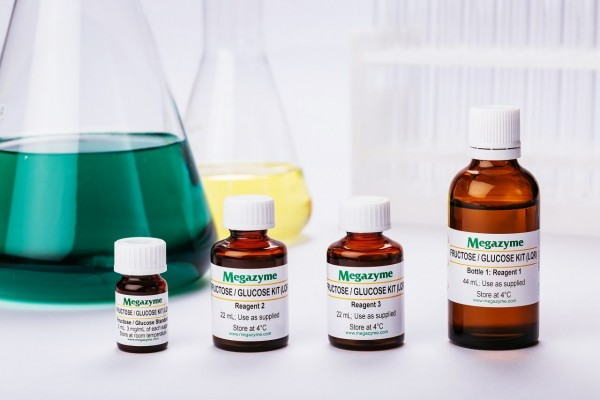
Short term stability: 2-8oC, Long term stability: See individual component labels
Stability:
> 6 months under recommended storage conditions
Analyte:
D-Fructose, D-Glucose
Assay Format:
Microplate, Auto-analyser
Detection Method:
Absorbance
Wavelength (nm):
340
Signal Response:
Increase
Linear Range:
0.4 to 20 µg of D-glucose plus D-fructose per assay
Limit of Detection:
133 mg/L
Reaction Time (min):
~ 13 min
Application examples:
Wine, beer, fruit juices, soft drinks, milk, jam, honey, dietetic foods, bread, bakery products, candies, desserts, confectionery, ice-cream, fruit and vegetables, condiments, tobacco, cosmetics, pharmaceuticals, paper and other materials (e.g. biological cultures, samples, etc.).
Method recognition:
Methods based on this principle have been accepted by AOAC, EN, NEN, NF, DIN, GOST, OIV, IFU, AIJN, MEBAK and IOCCC
This product has been discontinued, you may be interested in the following replacement product K-FGLQR; 700007621)
The D-Fructose/D-Glucose (Liquid Ready) test kit is a rapid, reliable and accurate method for the specific measurement and analysis of D-fructose and D-glucose in wine, beverages, foodstuffs and other materials. Supplied as a “ready to use” liquid stable formulation that is suitable for auto-analyser and microplate formats.
Simultaneous isolation of both host DNA and microbial DNA (universal protocol)
Fully compatible with Norgen’s Stool Nucleic Acid Collection and Transport Tubes
Eliminates PCR inhibitors including humic acids
High quality DNA for sensitive downstream applications including PCR, qPCR, Sequencing and microarray
96-Well and Magnetic Bead System formats also available
These kits provide a convenient and rapid method to isolate total DNA from fresh, frozen and preserved stool samples, including those preserved using Norgen’s Stool Nucleic Acid Collection and Preservation Tubes (Cat. 45660). The universal protocol conveniently allows for the isolation of total genomic DNA from all the various microorganisms and host cells found in the stool sample simultaneously. Purifies the DNA with high yields and molecular weights of up to 50 kb plus. The purified DNA can be used with a number of downstream applications.
Stool DNA Isolation Kit (Spin Column)
Universal method to detect microorganism and host cell DNA simultaneously in stool samples. Eliminates PCR inhibitors including all traces of humic acid using a combination of chemical and physical homogenization and lysis. A simple and rapid spin column procedure is then used to further purify the DNA. The purified DNA is of the highest quality and is fully compatible with all downstream applications such as PCR, qPCR, NGS and microarrays since all humic acid substances and other PCR inhibitors are removed during the isolation process.
Stool DNA Isolation 96-Well Kit (High Throughput)
Fast and easy high throughput processing using centrifugation. Eliminates PCR inhibitors including all traces of humic acid using a combination of chemical and physical homogenization and lysis. A simple and rapid spin column procedure is then used to further purify the DNA. The purified DNA is of the highest quality and is fully compatible with all downstream applications such as PCR, qPCR, NGS and microarrays since all humic acid substances and other PCR inhibitors are removed during the isolation process.
Stool DNA Isolation Kit (Magnetic Bead System)
Fast and easy processing using a magnetic bead system. Robust lysis system (chemical lysis combined with a mechanical homogenization).
Stool DNA Isolation 96-Well Kit (High Throughput Magnetic Bead System)
This kit provides fast and easy processing using a magnetic bead system, and a robust lysis system (chemical lysis combined with a mechanical homogenization). High throughput and compatible with an automation robotic system.
Free Download
Extracting Biological Insights from Stool
Tips and tricks for isolating high yield and quality DNA, RNA, miRNA and EV’s from fecal samplesDownload for Free
200 mg (fresh/frozen stool) or 400 μL (preserved stool)
Type of Stool Processed
Frozen, fresh or preserved stool
Format
Spin Column
Maximum Column Binding Capacity
50 μg
Maximum Column Loading Volume
650 μL
Elution Volume
50 μL
Time to Complete 10 Purifications
30 minutes
Applications
PCR, qPCR, Southern Blot Analysis, Sequencing, Microarray Analysis.
Storage Conditions and Product Stability All solutions should be kept tightly sealed and stored at room temperature. This kit is stable for 2 years after the date of shipment.
Propargyl-PEG4-(CH2)3-methyl ester consists of a propargyl group and a methyl ester. The propargyl group reacts with azide-bearing compounds or biomolecules in copper catalyzed Click Chemistry reactions to form a stable triazole linkage. Under strong basic condition, methyl ester can be hydrolyzed. Reagent grade, for research purpose. Please contact us for GMP-grade inquiries.
Document
Propargyl-PEG4-(CH2)3-methyl ester consists of a propargyl group and a methyl ester. The propargyl group reacts with azide-bearing compounds or biomolecules in copper catalyzed Click Chemistry reactions to form a stable triazole linkage. Under strong basic condition, methyl ester can be hydrolyzed. Reagent grade, for research purpose. Please contact us for GMP-grade inquiries.
This product provides fast and easy methods for purification of total DNA for reliable PCR and Southern blotting. Total DNA (e.g., genomic, viral, mitochondrial) can be purified from tissue and culture cells.
Details
Specifications
Features
Specifications
Main Functions
Isolation total DNA from <25 mg tissue, culture cells, FTA card
Applications
PCR, southern bolt and virus detection, etc.
Purification method
Mini spin column
Purification technology
Silica technology
Process method
Manual (centrifugation or vacuum)
Sample type
Animal tissue or cultured cells
Sample amount
Animal tissue : <25mg, Cultured cells : <5 x 10⁶
Elution volume
≥30μl
Time per run
30 – 60 minutes
Liquid carrying volume per column
800μl
Binding yield of column
100μg
This product is based on silica Column purification. The sample is lysed and digested with lysate and protease, DNA is released into the lysate. Transfer to an adsorption column. Nucleic acid is adsorbed on the membrane, while proteinis not adsorbed and is removed with filtration. After washing proteins andother impurities, Nucleic acid was finally eluted with low-salt buffer (10mmTris, pH9.0, 0.5mm EDTA).
Advantages
Good repeatability – suitable for extracting high-yield DNA from different types of tissue samples
High purity – can be used for downstream applications such as multiplex and quantitative PCR
Fast – simplified process, extracting several samples in 20 minutes (after digestion)
Safety – no phenol orchloroform extraction, no alcohol precipitation
Kit Contents
Contents
D312102
D312103
Purification Times
50 Preps
250 Preps
Buffer ATL
15 ml
65 ml
Buffer DL
15 ml
65 ml
Buffer GW1
22 ml
110 ml
Buffer GW2
12 ml
50 ml
RNase A
10 mg
50 mg
Proteinase K
24 mg
120 mg
Protease Dissolve Buffer
5 ml
15 ml
Buffer AE
15 ml
60 ml
HiPure gDNA Mini Columns
50
2 x 125
2 ml Collection Tubes
100
5 x 100
Storage and Stability
RNase A and Proteinase K should be stored at 2-8°C upon arrival. However, short-term storage (up to 24 weeks) at room temperature (15-25°C) does not affect its performance. The remaining kit components can be stored dry at room temperature (15-25°C) and are stable for at least 18 months under these conditions. The entire kit can be stored at 2-8°C, but in this case buffers should be redissolved before use. Make sure that all buffers are at room temperature when used.
Purchase Guide
Document
This product provides fast and easy methods for purification of total DNA for reliable PCR and Southern blotting. Total DNA (e.g., genomic, viral, mitochondrial) can be purified from tissue and culture cells.