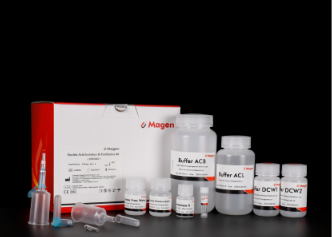
D3182D HiPure Circulating DNA Midi Spin Kit D (Spin Protocol)
Facebook
X
Pinterest
Email
Free-circulating nucleic acids, such as tumor-specific extracellular DNA fragments and mRNAs in the blood or fetal nucleic acids in maternal blood, are present in serum or plasmausually as short fragments,
Detail
Introduction
Free-circulating nucleic acids, such as tumor-specific extracellular DNA fragments and mRNAs in the blood or fetal nucleic acids in maternal blood, are present in serum or plasmausually as short fragments, <1000bp(DNA). HiPure Circulating DNA Midi Kit enables efficient purification of these circulating nucleic acids from human plasma, serum, or urine. The extracted products can be used for clinical in vitro detection.
Details
Specifications
Features
Specifications
Main Functions
Isolation circulating DNA from 1-5ml plasma, serum, bodyfluids by spin
Applications
qPCR, liquid or solid chip analysis, hybridization and SNP detection, etc.
Purification method
Mini spin column
Purification technology
Silica technology
Process method
Manual (centrifugation)
Sample type
Serum, plasma and other cell-free fluid samples
Sample amount
1-5ml
Elution volume
≥50μl
Time per run
≤70 minutes
Liquid carrying volume per column
4ml
Binding yield of column
1mg
Principle
This product is based on silica gel purification. The sample is lysed and digested with lysate and protease, DNA is released into the lysate. Transfer to an adsorption plate and filter column. Nucleic acid is adsorbed on the membrane, while protein is not adsorbed and is removed with filtration. After washing proteins and other impurities, nucleic acid was finally eluted with low-salt buffer (10 Mm Tris,pH 8.0).
Advantages
High yield – most optimal process, free DNA (>50bp) can be obtained to the maximum extent
High concentration – low elution volume, ensuring high nucleic acid concentration
High purity – low alcohol binding method, completely removing inhibitor and protein pollution
High recovery – DNA can be recovered at thelevel of PG by silica gel column purification
Kit Contents
Contents
D318203D
Purification Times
50 Preps
Buffer ACL
250 ml
Buffer ACB*
300 ml
Buffer DCW1*
22 ml
Buffer DCW2*
10 ml
Proteinase K
540 mg
Protease Dissolve Buffer
30 ml
Carrier RNA
110 μg
Nuclease Free Water
20 ml
HiPure CFDNA Mini Columns
50
2 ml Collection Tubes
100
Extender Tubes
50
Sealing O-Ringes
50
50ml Collection Tube
50
Support Tube
50
Storage and Stability
Proteinase K, Carrier RNA should be stored at 2-8°C upon arrival. However, short-term storage (up to 12weeks) at room temperature (15-25°C) does not affect their performance. The remaining kit components can be stored dry at room temperature (15-25°C) and are stable for at least 18 months under these conditions. The entire kit can bestored at 2-8°C, but in this case buffers should be redissolved before use. Make sure that all buffers are at room temperature when used.
Other Products
Human Immunodeficiency Virus (HIV) TaqMan RT-PCR Detection Kits
Product Info
Document
Product Info
Overview
Detection kits for HIV
Available in TaqMan format for analysis
Human Immunodeficiency Virus (HIV) is a retrovirus which destroys essential cells in the human immune system, such as CD4+ lymphocytes (a type of T cell), macrophages and dendritic cells. Infection with HIV therefore leads to an impaired immune system and increased susceptibility to opportunistic cancers and infections. Due to the mutating nature of HIV and damage to the T cells, the immune system is unable to fight off infections and disease. Without treatment, HIV can progress to Acquired Immunodeficiency Syndrome (AIDS). The rate of HIV progression to AIDS depends on a number of different factors including viral, host and environmental factors. However, with adherence to antiretroviral therapy (ART), many individuals with HIV will never progress to AIDS, having near normal life expectancy. Transmission of HIV is through direct contact with infected bodily fluids, either sexually; by the sharing of blood-contaminated needles or instruments; maternally through childbirth or breastfeeding; or via blood transfusion/organ transplant.
HIV TaqMan RT-PCR Kit, 100 reactions
Ready to use format, including Master Mix for the target and PCR control to monitor for PCR inhibition and validate the quality
Specific Primer and Probe mix for the pathogen/virus/viroid of interest
Primer and Probe mix
Positive and negative control to confirm the integrity of the kit reagents
HIV TaqMan RT-PCR Probe/Primer Set and Controls, 100 reactions
Specific Primer/Probe mix and Positive Control for the pathogen/virus/viroid of interest
Nuclease-free water
Can be used together with Norgen’s RT-PCR Master Mix (#28113) or customer supplied master mix
For research use only and NOT intended for in vitro diagnostics.
Storage Conditions and Product Stability All kit components can be stored for 1 year after the date of production without showing any reduction in performance.
All kit components should be stored at -20°C upon arrival.
N-(Boc-PEG3)-N-bis-(PEG3-Amino-Tri-(Propargyl-PEG2-ethoxymethyl)-methane) is a crosslinker consisting of six propargyl groups and a t-Boc protected aminooxy group. The propargyl groups can form triazole linkage with azide-bearing compounds or biomolecules via copper catalyzed Click Chemistry. The protected amine can be deprotected under acidic conditions. The hydrophilic PEG spacer increases solubility in aqueous media. Reagent grade, for research use only.
Document
N-(Boc-PEG3)-N-bis-(PEG3-Amino-Tri-(Propargyl-PEG2-ethoxymethyl)-methane) is a crosslinker consisting of six propargyl groups and a t-Boc protected aminooxy group. The propargyl groups can form triazole linkage with azide-bearing compounds or biomolecules via copper catalyzed Click Chemistry. The protected amine can be deprotected under acidic conditions. The hydrophilic PEG spacer increases solubility in aqueous media. Reagent grade, for research use only.
Magnetic bead nucleic acid purification technology uses nano or micron superparamagnetic material as the matrix, generally black ferric oxide or yellowish brown ferricoxide as the magnetic material. The surface of bead is coated with appropriate functional groups, which can adsorb nucleic acid. Magnetic beads commonly used for nucleic acids, containing carboxyl groups, hydroxyl groups, or silicon groups. Silicon-based magnetic beads are the most common, and its principle of adsorbing nucleic acid is consistent with the classical glass milk purification technology or glass fiber filter membrane purification method. Magpure particle is a kind of polydisperse fast speed silica magnetic beads. The core is ferricoxide, accounting for 50%, and the surface coating is silica, accounting for 50%. The product can be used for plasmid extraction, gel DNA recovery, product purification, genomic DNA and RNA extraction, and viral nucleic acid extraction.
Details
Specifications
Features
Specifications
Concentration
70 mg/ml
Appearance
Suspension of yellowish brown particles
Surface functional group
Si-OH, Silanol
Dispersibility
Polydisperse Amorphous
Particle size
0.2-2 μm
Preservation conditions
Room Temperature, valid for up to 2 years.It is recommended to store in 2-8°C to prevent microbial growth.
Magnetic response speed
~60 seconds
Settling velocity
>10 minutes
High salt mediated binding
>2M guanidine isothiocyanate, DNA recovery up to 80%
Alcohol mediated binding
2M guanidine hydrochloride / isopropanol (30%), and the recovery of DNA / RNA was as high as 85%
PEG8000 mediated binding
The recovery of DNA/RNA was up to 85%
DNase/RNase
Not detected
DNA residue
<1 ppm
Recommended application
Plasmid extraction, gel DNA recovery, viral nucleic acid isolation
Principle
Highsalt mediated binding: in the solution containing 2-4M guanidine isothiocyanate, Magpure particles can selectively recover DNA molecules, and impurities such as protein polysaccharides are not adsorbed.
Alcohol mediated binding: in the solution containing guanidine salt and alcohol (>25%), Magpure particles can selectively recover DNA/RNA molecules, and proteins and other impurities are not adsorbed.
After biological samples are treated with digestive solution or lysis Buffer, DNA/RNA is released from cells, organelles and protein complexes (ribosomes and nucleosomes) into reagents. After Magpure particles and binding solution are added, DNA/RNA is adsorbed to the surface of Magpure particles to form DNA/RNA bead complex. Under the action of the magnetic field, the magnetic beads are separated and collected, and the impurities such as protein are removed with the waste liquid. After two or three steps of further cleaning, the DNA/RNA magnetic bead complex is resuspended in sterilized water or TE buffer, and the DNA/RNA falls off from the surface of the magnetic beads, so as to achieve the purpose of purification.
gDNA/RNA Isolation from Blood, Tissue, Plant, Swab, Spots, Stool, Soil and etc.Viral DNA/RNA IsolationAgarose Gel DNA Purification
DNA/RNA Isolation from low nucleic acid content samplesPlasmid IsolationDNA/RNA Clean Up
Circulating DNA IsolationViral Nucleic acid IsolationgDNA Isolation FFPE DNA/RNA Isolation
Plasmid extractiongel DNA recoverygenomicDNA/RNA extraction viral nucleic acid extractionCirculating DNA extraction
DNA/RNA Clean Up and concentrationDNA/RNA Isolation from low nucleic acid content samplesResearch immuno assays
The MagPure magnetic-particle technology combines the speed and efficiency of silica-based DNA purification with the convenient handling of magnetic particles. DNA binds to the silica surface of the magnetic particles in the presence of a chaotropic salt. DNA bound to the particles is then efficiently washed, considerably improving the purity of DNA. High-quality DNA is eluted. The automated purification procedure completely removes enzymes, nucleotides, and other contaminants and inhibitors. Purified DNA is suitable for direct use in downstream applications, such as sequencing and microarray analysis.
Document
Magnetic bead nucleic acid purification technology uses nano or micron superparamagnetic material as the matrix, generally black ferric oxide or yellowish brown ferricoxide as the magnetic material. The surface of bead is coated with appropriate functional groups, which can adsorb nucleic acid. Magnetic beads commonly used for nucleic acids, containing carboxyl groups, hydroxyl groups, or silicon groups. Silicon-based magnetic beads are the most common, and its principle of adsorbing nucleic acid is consistent with the classical glass milk purification technology or glass fiber filter membrane purification method. Magpure particle is a kind of polydisperse fast speed silica magnetic beads. The core is ferricoxide, accounting for 50%, and the surface coating is silica, accounting for 50%. The product can be used for plasmid extraction, gel DNA recovery, product purification, genomic DNA and RNA extraction, and viral nucleic acid extraction.