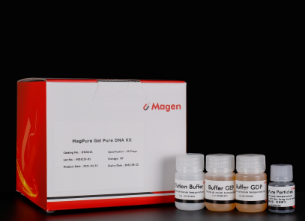
A highly efficient, easily automated PCR purification system that delivers superior quality DNA with no salt carryover. Requiring no centrifugation or filtration. This kit can be easily used in manual and automated 96 or 384-well formats.
Detail
Introduction
A highly efficient, easily automated PCR purification system that delivers superior quality DNA with no salt carryover. Requiring no centrifugation or filtration. This kit can be easily used in manual and automated 96 or 384-well formats.
Details
Specifications
Features
Specifications
Main Functions
Recover 100-400μl DNA/ RNA from PCR products / enzymatic reaction solution / or crude DNA / RNA
Applications
Automatic sequencing, enzyme digestion, PCR and labeling
The MagPure method contains magnetic particles in an optimized binding buffer to selectively bind DNA fragments 100bp and larger toparamagnetic beads. Excess primers, nucleotides, salts, and enzymes can be removed using a simple washing procedure.
Advantages
High recovery efficiency – up to 80% DNA recovery
Kit Contents
Contents
D500301
D500302
D500303
Purification Times
50 Preps
500 Preps
5000 Preps
Buffer AL
10 ml
60 ml
550 ml
Buffer BD*
5 ml
25 ml
2 x 100 ml
MagPure RNA Particles
1.2 ml
12 ml
120 ml
RNase Free Water
5 ml
30 ml
250 ml
Storage and Stability
MagPure RNA Particles should be stored at 2-8°C upon arrival. However, short-term storage (up to 12 weeks) at room temperature (15-25°C) does not affect its performance. The remaining kit components can be stored dry at room temperature (15-25°C) and are stable for at least 18 months under these conditions. The entire kit can be stored at 2-8°C, but in this case buffers should be redissolved before use. Make sure that all buffers are at room temperature when used.
Gel images of different ranges of library size selection. Sheared human genomic DNA was used as input.
.
Library size selection is an enrichment of a specific range of library sizes for NGS library preparations. The NGS library preparation is related to the quality of the sequencing data. Precise NGS library size selection can increase sequencing efficiency, improve data quality, and reduce costs.
There are two types of sequencing technologies: short-read sequencing and long-read sequencing. Short-read sequencing uses DNA libraries that contain small insert DNA fragments of similar sizes, usually several hundred base pairs. The sequencing efficiency can be improved if the DNA size selection is in the right range. Cat.# 20104S and 20104L are the best kits for NGS library size selection of illumina paired-end 100 (PE100) sequencing with 100-200 bp library inserts; Cat.# 20105S and 20105L are the best kits for NGS library size selection of illumina paired-end 150 (PE150) sequencing with 150-300 bp library inserts; and Cat.# 20106S and 20106L are the best kits for NGS library size selection of illumina paired-end 300 (PE300) sequencing with 300-600 bp library inserts.
Long-read sequencing uses a large DNA fragment as input and makes very long reads. Usually, library size selection is preferred to remove smaller fragments. Cat.# 20110S and 20110L are the best kits for long-read sequencing size selection with DNA sizes >5 kb, and Cat.# 20111S and 20111L are the best kits for long-read sequencing size selection with DNA sizes >10 kb.
The magnetic beads, or SPRI (Solid Phase Reversible Immobilization) beads, is well used for the purification of DNA due to their reversible DNA binding. The NGS library can be size-selected by the magnetic beads or SPRI beads. The properties of the magnetic beads can be changed for a specific range of DNA binding. The contaminants and other unwanted components in the libraries can also be removed during size selection.
Specific ranges of NGS libraries can be selected using magnetic beads with different buffer compositions. The first DNA-beads binding step, also called the right-side clean-up, removes large NGS library fragments. The large NGS library fragments that bind to the beads are discarded with the beads pellet. The desired NGS library fragments in the supernatant are transferred to a new well, and new beads are added to the supernatant for the second beads-DNA binding, also called the left-side clean-up. After the rinsing step, the NGS library fragments with the dual selection are eluted in water or an appropriate buffer. The magnetic beads method has great advantages over time-consuming column purification and tedious gel-based purification.
NGS library size selection with dual clean-ups.
.
Library size selection for long-read sequencing only requires a single clean-up. In this case, only the large library fragments are bound to the beads, while other small library fragments are discarded with the supernatant. The selected larger library fragments are eluted in water or an appropriate buffer after the rinsing step.
NGS library size selection with single clean-up for >5 kb and >10 kb libraries.
Mucin 5AC (MUC5AC) is a secretory-type mucin found in columnar mucous cells of surface gastric epithelium and in goblet cells of the fetal and precancerous colon, but not in normal colon cells. MUC5AC expression is indicated in carcinomas wherein the type is defined as diffuse and infiltrative, and those located mainly in the antrum. Studies have also suggested a correlation between MUC5AC and colorectal signet-ring cell carcinoma, with overexpression of MUC5AC relating to the carcinogenesis, malignant potential, progression, and clinical behaviors.