
DBCO-amine TFA salt is a simple building block containing a DBCO moiety and an amine group. Amine is very reactive with NHS ester. DBCO is commonly used for copper-free Click Chemistry reactions.


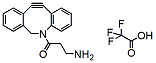
DBCO-amine TFA salt is a simple building block containing a DBCO moiety and an amine group. Amine is very reactive with NHS ester. DBCO is commonly used for copper-free Click Chemistry reactions.


DNase activity in a convenient and sensitive lateral flow colormetric assay that delivers results in real time. Great for Quality Testing for DNase contamination of materials and supplies.
Attogene’s DNaseAlarm Lateral Flow test is designed for the sensitive and accurate analysis of DNAse activity in liquid samples. DNase Alarm uses a synthetic DNA substrate that attaches to the streptavidin colloidal reporter molecule (gold) using a 5’ biotin. The DNA substrate also contains a FAM molecule that enables it to be captured by the anti-FAM antibody (test line). In the absence of DNases, the DNA oligo tethers gold to the test line giving a visual test line. When DNases are present, the DNA substrate is degraded, and the gold particles can no longer be tethered to the test line thus, signal is lost. Since the cleavage of the DNA Substrate increases over time when DNase activity is present, results can be evaluated kinetically. This assay has applications for quality control testing and analysis of unit activities of DNase and DNase inhibitors. DNase’s can cause havoc in laboratories working with DNA and are important to perform routine testing.
 This test can be used to rapidly and efficiently detect DNase’s in both liquid and on solid surfaces and a perfect tool for monitoring manufacturing.
DNase activity in a convenient and sensitive lateral flow colormetric assay that delivers results in real time. Great for Quality Testing for DNase contamination of materials and supplies

DL8M Largest Capacity Refrigerated Centrifuge
Features
1. Widely used in the field of blood bank, pharmaceutical factory and laboratory.
2. Brushless frequency motor, in great torque, free maintenance, no powder pollution, quick in speed up and down.
3. Digital display which indicates the program, speed, time, RCF, temperature.
4. Micro computer control, there are 10 kinds of program and 10 kinds off acceleration and deceleration for your choice.
 5. There are 4 kinds of rotors for your choice.
6. Electric lid lock, compact design, super speed and imbalance protection.
7. The centrifuge body is made of high-quality steel, safe and reliable.
DL8M Technical Parameter:
| Max. Speed | 8000rpm |
| Max. RCF | 14900×g |
| Max. Capacity | 8×2000ml(16*500ml blood bag) |
| Time Range | 1~9h59min |
| RPM/RCF Convert | Yes |
| Noise (dB) | ≤ 65 |
| Temperature | -20~40℃ |
| Acc/Dec | 10 Kinds |
| Speed Accuracy | ±20r/min |
| Temperature Accuracy | ±1℃ |
| Voltage(V/Hz) | AC 220V/380V 50HZ/60HZ |
| Dimensions (L x W x Hmm) | 940×890×1000mm / |
| Net Weight(Kg) | 600KG |
| Certificates | CE,ISO & Calibration report are available |
Matched Rotors for DL8M
| Order No. | Rotor No. | Max Speed (rpm) | Max Volume(ml) | Max. RCF(×g) |
| 8M-1 | Swing Rotor | 4000 | 8 x 2000ml | 5716 |
| 8M-2 | Swing Rotor | 4000 | 6×2400ml | 5330 |
| 8M-3 | Angle Rotor | 8000 | 6×1000ml | 14900 |
| 8M-4 | Swing Rotor | 4200 | 2×6×1000ml | 5680 |
DL8M large capacity refrigerated centrifuge max capacity can hold 8x2000ml, can for 16pcs 500ml blood bags, can also for 8 bottles of 2000ml