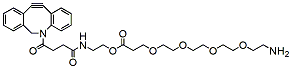
DBCO-C2-PEG4-amine is a PEG linker which contains DBCO and amine moieties. The DBCO group is commonly used in copper-free Click Chemistry reactions. The amine group is reactive with carboxylic acids, activated NHS esters, carbonyls (ketone, aldehyde) etc. The hydrophilic PEG spacer increases solubility in aqueous media. Reagent grade, for research purpose. Please contact us for GMP-grade inquiries.
Detail
DBCO-C2-PEG4-amine is a PEG linker which contains DBCO and amine moieties. The DBCO group is commonly used in copper-free Click Chemistry reactions. The amine group is reactive with carboxylic acids, activated NHS esters, carbonyls (ketone, aldehyde) etc. The hydrophilic PEG spacer increases solubility in aqueous media. Reagent grade, for research purpose. Please contact us for GMP-grade inquiries.
Other Products
Sircol-2.0 Soluble Collagen assay kit
Product Info
Document
Product Info
What is Collagen?
Collagen is a fundamental component of the extracellular matrix, and the predominant protein in animals, constituting around 30% of total protein mass. A glycoprotein, it is well known for its triple helical structure. This is formed from three polypeptide α-chains with Gly-X-Y repeating residues (Gly for Glycine, X for proline, and Y for hydroxyproline).
Types of Collagen
Over 28 types of collagens have been identified, with Type I collagen being the most abundant. It’s prevalent in ligaments, tendons, skin, and bone tissue. Its mature, insoluble form grants it remarkable strength, making it vital for the mobility of organisms. Collagen also has biochemical functions, influencing cell growth, proliferation, and differentiation.
This version of the kit is designed to detect and measure SOLUBLE forms of collagen. Chose the Sircol Insoluble collagen kit if you need to analyse INSOLUBLE collagen.
Applications of Collagen
Collagen, with its diverse properties, finds utility in various industries. It plays a role in medicine for wound healing and has an expanding role in tissue engineering and cell culture for biomedical purposes. It’s gaining popularity in the cosmetic industry for skin rejuvenation and is used in chemical formulations and the food industry as a functional food supplement and additive.
How does Sircol 2.0 detect collagen?
The Sircol 2.0 dye reagent includes Sirius Red, a linear anionic dye with sulfonic acid side chains. This reagent is specially formulated to bind to the Gly-X-Yn helical structure of soluble collagen under assay conditions.
*The improved formulation of Sircol 2.0 dye enables a greater degree of dye-collagen specificity (compared to our previous S1000 assay kit).
Overview of the Sircol 2.0 assay process:
Step 1. Prepared samples are placed in the wells of the assay microplate, together with Sircol Dye Reagent. After 30 minutes mixing, any collagen-dye complexes will form as a precipitate. These are collected on the base of the microplate wells by centrifugation.
Step 2. Unbound dye is removed by gentle aspiration, followed by a rinse with Plate Wash Reagent.
Step 3. Following further centrifugation, collagen-bound dye is eluted by incubation with a Dye Release Reagent. Eluted dye is detected ‘in-situ’ by spectrophotometric analysis of the microplate at 556nm.
Step 4. The collagen content of unknown samples can be quantified by comparison against a calibration curve, prepared using the Collagen Reference Standard supplied with the kit.
A list of suggested sample types can be found under the ‘Assay Specification‘ tab.
Colorimetric Detection (556nm) (Endpoint), Requires a microplate centrifuge.
Measurements per kit
96 in total (allows a maximum of 41 samples to be run in duplicate alongside a standard curve).
Suitable Samples
Soluble* collagens from mammalian**:
In-vivo: Tissues, cartilages and fluids.
In-vitro: Extracellular matrices / Conditioned media from 2D/3D culture environments.
The straightforward sample processing and analysis of Sirco 2.0 make it a good alternative to conventional hydroxyproline analysis.
*Prior salt/acid/acid-pepsin extraction may be necessary to release soluble collagen.
**Sircol 2.0 is primarily designed for use with in-vivo / in-vitro samples of mammalian origin. Collagens originating from other taxonomic groups and kingdoms can also be analysed. See note on p6 of manual for further information.
Precautions
This kit is designed for research use only. Not for use in diagnostic procedures. Kit requires access to a microplate centrifuge* (see note below), as well as a spectrophotometer/colorimeter capable of absorbance detection at 556nm. Specific sample preparation protocols may require customer to provide further reagents, consult assay manual for further information.
*As a minimum, we recommend that the centrifuge can centrifuge a 96-well microplate at 400 x g for 120 minutes. Higher speed centrifuges are recommended (up to a maximum of 2000 x g), allowing a reduction in centrifuge time.
Sircol 2.0 kit contents:
1. Dye Reagent (1x20ml)
2. Collagen Reference Standard (1x5ml, 200µg/ml of soluble Bovine collagen)
3. Plate Wash Reagent (1x28ml)
4. Collagen Concentration Reagent (1x25ml)
5. Neutralisation Reagent (1x8ml)
6. Dye Release Reagent (1x25ml)
7. Assay Microplate (1×96-wells)
8. Microplate Seals (6x)
9. Documentation (QuickStart Guide / Manual / Certificate of Analysis)
NB: Additional reagents may be required for sample preparation prior to assay. Consult manual or contact us for further details. This kit requires the use of a microplate centrifuge, capable of centrifuging a 96-well microplate at 400 x g for 120 minutes. Higher speed centrifuges are recommended (up to a maximum of 2000 x g), allowing a reduction in centrifuge time.
Document
Experience user-friendly detection & measurement of Soluble Collagen with Sircol™ 2.0! Our latest kit simplifies collagen quantification within in-vivo / in-vitro samples. Sircol 2.0 offers enhanced sensitivity and accuracy compared to our previous Sircol kit.
Efficient depletion of bovine exosomes from Fetal Bovine Serum
Deplete exosome-sized vesicles from versatile FBS volumes
No protease treatment required
No time-consuming ultracentrifugation
No precipitation reagents required
No overnight incubation required
Exosome depletion confirmed by reduction of bovine miRNAs below detectable levels
The depleted FBS provides the same cellular growth rates as the standard FBS
Purification is based on Norgen’s proprietary Silicon Carbide resin matrix
Norgen’s FBS Exosome Depletion Kits provides a quick and easy protocol for the depletion of bovine exosomes from FBS prior to using it as a growth supplement in your culture medium. The FBS recovered from the depletion process is exosome-depleted and does not contain any quantifiable bovine miRNAs. Moreover, the exosome-depleted FBS will support the growth of your cells of interest similar to the non-depleted FBS. Norgen’s kits allow for the processing of different FBS volumes. The depletion is based on Norgen’s proprietary resin. These kits provide a clear advantage over other available kits in that they do not require ultracentrifugation, any special instrumentation, precipitation reagents or any protease treatments. More importantly, the depletion process is an inexpensive method for exosome depletion from FBS, as compared to the expensive current ready-to-use exosome-depleted media available on the market.
Background
Most culture medium used for the growth and propagation of cells in culture require the addition of fetal bovine serum (FBS) as a growth supplement to media. FBS is obtained from bovine (cow) serum, and therefore contains large quantities of bovine exosome vesicles. These exosomes may interfere with some types of studies, or may lead to unreliable results when studying the exosomes shed from your cells of interest in normal culture conditions. Therefore, the use of exosome-depleted FBS is highly recommended for many types of studies.
Up to 140 mL (FBS Exosome Depletion Kit I (Slurry Format) Up to 280 mL (FBS Exosome Depletion Kit II (Slurry Format)
Depletion
Deplete exosome-sized vesicle
Bovine miRNA
No detectable bovine miRNA
Time to Complete 6 Purifications
40 minutes
Storage Conditions and Product Stability All buffers should be kept tightly sealed and stored at room temperature. This kit is stable for 2 years after the date of shipment.
Our SNPsig® kits use our own proprietary genotyping method to enable the identification of SARS-CoV-2 variants of concern. These products can be used on any real-time PCR machine using familiar protocols, whilst resulting in exceptional genotyping data.
Positive control templates for wild-type and variants are supplied in every kit to make data interpretation simple.
Our SNPsig® technology provides an alternative to sequencing as well as S gene target failure (SGTF) that enables scientists to analyse and monitor these specific genomic mutations. Our kits can provide a pivotal role in screening for SARS-CoV-2 variants for the purpose of genomic surveillance and studies.
Document
For the detection of the SARS-CoV-2 (20J/501Y.V3 Brazil) Rapid detection of specific detection profiles High priming efficiency Sensitive to < 100 copies of target
Positive copy number standard curve for quantification
Accurate controls to confirm findings
96 reactions, includes master mix