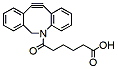
DBCO-C6-Acid is an analog of DBCO-Acid with an extended 6-carbon atom spacer arm. The extended 6-carbon atom spacer arm improves its derivatization efficiency and the stability of the yielded conjugates. This spacer arm also improves solubility in organic solvents such as dichloromethane, chloroform, THF, and ethyl acetate. DBCO is commonly used for copper-free Click Chemistry reactions. Reagent grade, for research purpose. Please contact us for GMP-grade inquiries.
Detail
DBCO-C6-Acid is an analog of DBCO-Acid with an extended 6-carbon atom spacer arm. The extended 6-carbon atom spacer arm improves its derivatization efficiency and the stability of the yielded conjugates. This spacer arm also improves solubility in organic solvents such as dichloromethane, chloroform, THF, and ethyl acetate. DBCO is commonly used for copper-free Click Chemistry reactions. Reagent grade, for research purpose. Please contact us for GMP-grade inquiries.
Other Products
D3126 HiPure FFPE DNA Kit
Product Info
Document
Product Info
Introduction
HiPure FFPE Nucleic acid Kit supplies a simple and rapid DNA extraction for formalin-fixed, paraffin-embedded (FFPE) tissue and sections samples. This kit is based on silica gel column purification technology, no phenol-chloroform extraction or alcohol precipitation. The whole extraction only takes 20 minutes (not including digestion time). DNA can be directly used for downstream applications such as PCR, southern blot and viral DNA detection, etc.
Details
Specifications
Features
Specifications
Main Functions
Isolation total DNA from FFPE tissue samples
Applications
PCR, southern blot and viral DNA detection, etc.
Purification method
Mini spin column
Purification technology
Silica technology
Process method
Manual (centrifugation or vacuum)
Sample type
Formalin-fixed, paraffin-embedded (FFPE) tissue and sections samples
Sample amount
<20mg
Elution volume
>15µl
Time per run
≤20 minutes
Liquid carrying volume per column
4ml
Binding yield of column
100μg
Principle
Hipure FFPE Nuclear acid kit adopts silica gel column purification. The sample is deparaffinated by xylene and digested by lysate and protease. After de crosslinked at 90 ℃, DNA/RNA is released into the lysate. Adding ethanol to adjust the binding conditions, the sample is transferred to the column where DNA/RNA is adsorbed on the membrane and protein is removed without adsorption. Protein and other impurities are washed by buffer GW1, and the salt is removed by buffer GW2. Finally, the DNA / RNA is eluted by low salt buffer.
Advantages
Safety – deparaffinating without contacting with xylene or other toxic solution
Fast – without overnight incubation and digestion, several samples can be extracted within 2hours
High efficiency -remove the formaldehyde modification of DNA, greatly enhancing the sensitivity of PCR
Kit Contents
Contents
D312602
D312603
Purification Times
50 Preps
250 Preps
HiPure DNA Mini Columns I
50
250
2ml Collection Tubes
50
250
Buffer DPS
30 ml
150 ml
Buffer ATL
15 ml
60 ml
Buffer AL
15 ml
60 ml
Buffer GW1*
22 ml
88 ml
Buffer GW2*
12 ml
50 ml
Proteinase K
24 mg
120 mg
Protease Dissolve Buffer
1.8 ml
10 ml
Buffer AE
10 ml
30 ml
Storage and Stability
Proteinase K should be stored at 2-8°C upon arrival. However, short-term storage (up to 12 weeks) at room temperature (15-25°C) does not affect their performance. The remaining kit components can be stored at room temperature (15-25°C) and are stable for at least 18 months under these conditions. The entire kit can be stored at 2-8°C, but in this case buffers should be redissolved before use. Make sure that all buffers are at room temperature when used.
Experiment Data
Document
HiPure FFPE Nucleic acid Kit supplies a simple and rapid DNA extraction for formalin-fixed, paraffin-embedded (FFPE) tissue and sections samples. This kit is based on silica gel column purification technology, no phenol-chloroform extraction or alcohol precipitation. The whole extraction only takes 20 minutes (not including digestion time). DNA can be directly used for downstream applications such as PCR, southern blot and viral DNA detection, etc.
Short term stability: 2-8oC, Long term stability: See individual component labels
Stability:
> 1 year under recommended storage conditions
Analyte:
D-Lactic Acid, L-Lactic Acid
Assay Format:
Spectrophotometer
Detection Method:
Absorbance
Wavelength (nm):
340
Signal Response:
Increase
Linear Range:
0.5 to 30 µg of D- or L-lactic acid per assay
Limit of Detection:
0.21 mg/L
Reaction Time (min):
~ 10 min (L-lactic acid), ~ 5 min (D-lactic acid)
Application examples:
Wine, soft drinks, milk, dairy products, foods containing milk (e.g. dietetic foods, bakery products, baby food, chocolate, sweets and ice-cream), vinegar, fruit and vegetables, processed fruit and vegetables, meat products, food additives, paper (and cardboard), cosmetics, pharmaceuticals and other materials (e.g. biological cultures, samples, etc.).
Method recognition:
Methods based on this principle have been accepted by DIN, GOST, IDF, EEC, EN, ISO, OIV, IFU, AIJN and MEBAK
The D-/L-Lactic Acid (D-/L-Lactate) (Rapid) test kit is used for the rapid and specific concurrent measurement and analysis of L-lactic acid (L-lactate) and D-lactic acid (D-lactate) in beverages, meat, dairy and food products.
Note for Content: The number of manual tests per kit can be doubled if all volumes are halved. This can be readily accommodated using the MegaQuantTM Wave Spectrophotometer (D-MQWAVE).
Extended cofactors stability. Dissolved cofactors stable for > 1 year at 4oC.
Rapid total analysis time (concurrent / flexible D and L-lactic acid reaction format)
D-lactate dehydrogenase reaction very rapid with most samples (~ 5 min)
Very competitive price (cost per test)
All reagents stable for > 2 years after preparation
Mega-Calc™ software tool is available from our website for hassle-free raw data processing
Standard included
Document
The D-/L-Lactic Acid (D-/L-Lactate) (Rapid) test kit is used for the rapid and specific concurrent measurement and analysis of L-lactic acid (L-lactate) and D-lactic acid (D-lactate) in beverages, meat, dairy and food products.
Short term stability: 2-8oC, Long term stability: See individual component labels
Stability:
> 2 years under recommended storage conditions
Analyte:
Nitrogen, Primary Amino Nitrogen, YAN
Assay Format:
Spectrophotometer, Microplate, Auto-analyser
Detection Method:
Absorbance
Wavelength (nm):
340
Signal Response:
Increase
Linear Range:
0.2 to 10 µg of amino nitrogen per assay
Limit of Detection:
2.59 mg N/L
Reaction Time (min):
~ 15 min
Application examples:
Grape juice, must, wine and other materials.
Method recognition:
Novel method
The Primary Amino Nitrogen (PANOPA) Assay Kit is suitable for the measurement and analysis of primary amino nitrogen in grape juice/must and wine.
Note for Content: The number of manual tests per kit can be doubled if all volumes are halved. This can be readily accommodated using the MegaQuantTM Wave Spectrophotometer (D-MQWAVE).