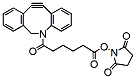
DBCO-C6-NHS ester is an amine-reactive compound, which can be used to modify an amine-containing molecule in organic media. This reagent isn’t soluble in aqueous media. The extended 6-carbon atom spacer arm improves solubility in commonly used organic solvents including dichloromethane, chloroform, THF, and ethyl acetate and it also improves derivatization efficiency and stability of conjugates. DBCO is commonly used for copper-free Click Chemistry reactions. Reagent grade, for research purpose. Please contact us for GMP-grade inquiries.
Detail
DBCO-C6-NHS ester is an amine-reactive compound, which can be used to modify an amine-containing molecule in organic media. This reagent isn’t soluble in aqueous media. The extended 6-carbon atom spacer arm improves solubility in commonly used organic solvents including dichloromethane, chloroform, THF, and ethyl acetate and it also improves derivatization efficiency and stability of conjugates. DBCO is commonly used for copper-free Click Chemistry reactions. Reagent grade, for research purpose. Please contact us for GMP-grade inquiries.
Other Products
Plasma/Serum Exosome Purification and RNA Isolation Kits
Product Info
Document
Product Info
Overview
Purification and enrichment of intact plasma/serum exosomes for functional studies
Isolate all sizes of RNA, including microRNA, irrespective of size or GC content, without bias
Versatile plasma/serum input volume
No phenol extractions, Proteinase K treatment, nor carrier RNA required
No time-consuming ultracentrifugation, filtration nor special syringes required
No precipitation reagents, nor overnight incubation required
Compatible with plasma/serum from most species
Pure exosomes are purified and are free from any other RNA-binding proteins
Purification is based on spin column chromatography that uses Norgen’s proprietary resin
The purified RNA is suitable for a variety of downstream applications, including Small RNA Sequencing. Find out more information on Norgen’s NGS services
Norgen’s Plasma/Serum Exosome and RNA Isolation Kits constitute all-in-one systems for the purification of exosomes and the sequential isolation of exosomal RNA from different plasma/serum sample volumes. The purification is based on spin column chromatography that employs Norgen’s proprietary resin. These kits are designed to isolate all sizes of RNA, including microRNA, irrespective of size or GC content, without bias. These kits provide a clear advantage over other available kits in that they do not require any special instrumentation, protein precipitation reagents, extension tubes, phenol/chloroform or protease treatments. The RNA isolated from the purified exosomes is free from any protein-bound circulating RNA and is of the highest integrity. The purified RNA can be used in a number of downstream applications including real time PCR, reverse transcription PCR, Northern blotting, RNase protection and primer extension, and expression array assays.
Norgen’s Plasma/Serum Exosome and RNA Isolation Mini Kit
For sample volumes ranging from 50 µL to 1 mL. This kit allows the user to elute into a flexible elution volume ranging from 50 µL to 100 µL.
Norgen’s Plasma/Serum Exosome and RNA Isolation Midi Kit
For sample volumes ranging from 1 mL to 4 mL. This kit allows the user to elute into a flexible elution volume ranging from 50 µL to 100 µL.
Norgen’s Plasma/Serum Exosome and RNA Isolation Maxi Kit
For sample volumes ranging from 4 mL to 10 mL. This kit allows the user to elute into a flexible elution volume ranging from 50 µL to 100 µL.
All sizes, including miRNA and small RNA (< 200 nt)
Elution Volume
50-100 μL
Time to Complete 10 Purifications
35 – 40 minutes
Average Yields*
Variable depending on specimen
*Please check page 4 of the product insert for the average yields and the common RNA quantification methods.
Storage Conditions and Product Stability All solutions should be kept tightly sealed and stored at room temperature. This kit is stable for 2 years after the date of shipment. It is recommended to warm Lysis Buffer A for 20 minutes at 60°C if any salt precipitation is observed.
Important Note This kit is suitable for the purification of exosomes from fresh or frozen serum or plasma prepared from blood collected on either EDTA or Citrate. Plasma samples prepared from blood collected on heparin should not be used as heparin can significantly interfere with many downstream applications such as RT-PCR.
DMSO resistant peelable heat sealing foil which is suitable for low temperature storage, high temperature uses and PCR testing.
Heat sealing offers a 100% effective method of plate sealing, for complete seal integrity, as well as being quick and cost effective
Our PeelASeal Foil Super is a laminate seal compatible with all plate types
It can be removed by peeling, even with a plate which has been removed directly from -80°C storage
PeelASeal Foil Super forms a complete seal to a plate enabling very low temperature uses, including very low temperature storage, and high temperature uses, such as PCR
The seal demonstrates high solvent resistance (including DMSO) and can be utilized for short term compound storage at room temperature
The seal is available as sheets, for use with manual and semi-automated sealers, such as our HeatASeal 500 Sealing Machine
Also available in multiple roll formats compatible with specified automated heat sealers, such as our Wasp or Chameleon XT