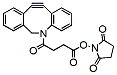
DBCO-NHS Ester is a very popular amine-reactive click chemistry reagent. It can be used to modify an amine-containing molecule in organic solvents (limited solubility in aqueous media). It reacts with primary amines such as the side chain of lysine residues or aminosilane-coated surfaces at neutral or slightly basic pH to form covalent bonds. The low mass weight will add minimal spacer to modified molecules. DBCO is commonly used for copper-free Click Chemistry reactions. Reagent grade, for research purpose. Please contact us for GMP-grade inquiries.
Detail
DBCO-NHS Ester is a very popular amine-reactive click chemistry reagent. It can be used to modify an amine-containing molecule in organic solvents (limited solubility in aqueous media). It reacts with primary amines such as the side chain of lysine residues or aminosilane-coated surfaces at neutral or slightly basic pH to form covalent bonds. The low mass weight will add minimal spacer to modified molecules. DBCO is commonly used for copper-free Click Chemistry reactions. Reagent grade, for research purpose. Please contact us for GMP-grade inquiries.
Other Products
[DM2160] FluoroBand™ 100 bp Fluorescent DNA Ladder, 500 μl
Product Info
Document
Product Info
Description
The DM2160 FluoroBand™ 100 bp Fluorescent DNA Ladder is a ready-to-use DNA ladder, which is pre-mixed with high sensitivity DNA binding fluorescent dye and loading dye for direct gel loading. The DNA Ladder DM2160 is composed of 11 individual DNA fragments: 1.5k, 1k, 900, 800, 700, 600, 500, 400, 300, 200 and 100 bp derived from a mixture of PCR products and specifically digested plasmid DNA; these bands can be visualized when illuminated with 470 nm blue light or UV light. This product contains two enhanced bands (1.5 kb and 500 bp) for easier reference. In addition, two tracking dyes, Xylene cyanol FF and Orange G which mimic the migration of 4,000 bp and 50 bp dsDNA during electrophoresis are also added for real time monitoring. Real time observation of the electrophoresis is also possible if compatible light source is fitted to the electrophoresis tank.
Features
Sharp bands
Quick reference— enhanced bands
Ready-to-use— premixed with loading dye for direct loading
Stable— room temperature storage over 6 months
Directly observed by UV or blue light— premixed with high sensitive DNA fluorescent dye
Source
Phenol extracted PCR products and dsDNA digested with specific restriction enzymes, equilibrated in 10 mM Tris-HCl (pH 8.0) and 10 mM EDTA.
Range
100 ~ 1,500 bp
Concentration
52.2 µg/ 500 µl
Recommended loading volume
5 µl/ well
Storage
Protected from light Room temperature for 6 months 4°C for 12 months -20°C for 24 months
Document
The DM2160 FluoroBand™ 100 bp Fluorescent DNA Ladder is a ready-to-use DNA ladder, which is pre-mixed with high sensitivity DNA binding fluorescent dye and loading dye for direct gel loading. The DNA Ladder DM2160 is composed of 11 individual DNA fragments: 1.5k, 1k, 900, 800, 700, 600, 500, 400, 300, 200 and 100 bp derived from a mixture of PCR products and specifically digested plasmid DNA; these bands can be visualized when illuminated with 470 nm blue light or UV light. This product contains two enhanced bands (1.5 kb and 500 bp) for easier reference. In addition, two tracking dyes, Xylene cyanol FF and Orange G which mimic the migration of 4,000 bp and 50 bp dsDNA during electrophoresis are also added for real time monitoring. Real time observation of the electrophoresis is also possible if compatible light source is fitted to the electrophoresis tank.
Permagen’s Dual Volume 0.2 mL PCR Strip separator uses the same magnet configuration as our MSR812 rack above, however, when using the opposite side, the magnets are positioned towards the bottom of the tubes allowing low elution’s to be achieved. Angled tube holes allow clean area at the front of the well for clean, fast aspiration without the concern of disturbing bead pellets Features include solid aluminum alloy design with hard coat finish for years of trouble-free use, rubber feet to help prevent slipping on work bench, less tippy than common plastic products, and fast separations using any magnetic beads
Permagen’s Dual Volume 0.2 mL PCR Strip separator uses the same magnet configuration as our MSR812 rack above, however, when using the opposite side, the magnets are positioned towards the bottom of the tubes allowing low elution’s to be achieved. Angled tube holes allow clean area at the front of the well for clean, fast aspiration without the concern of disturbing bead pellets Features include solid aluminum alloy design with hard coat finish for years of trouble-free use, rubber feet to help prevent slipping on work bench, less tippy than common plastic products, and fast separations using any magnetic beads
Fast and easy processing using rapid spin-column format
Isolate high quality mitochondrial DNA
Recovered DNA is compatible with various downstream applications
Over the past several decades, mitochondrial DNA (mtDNA) has played an increasingly important role in forensic analyses of various criminal cases. A few hairs left at a crime scene contain enough mtDNA for extraction. The hair shaft, which protrudes out of the scalp, does not contain any nuclear DNA. It does, however, contain mtDNA. While nuclear DNA is present in only two copies per cell, the small circular mtDNA molecule is present in hundreds to thousands of copies per cell making it very abundant. Mitochondrial DNA is maternally inherited, and all of a woman’s offspring will have the same mtDNA profile. An advantage of this is that a single maternal relative of that person may provide a reference sample for comparison to a sample found at a crime scene.
Norgen’s Hair Mitochondrial DNA Isolation Kit provides a fast, reliable, and simple procedure for isolating mtDNA from hair shafts. Purification is based on spin column chromatography and the DNA is preferentially purified from other components. Typical yields will vary depending on the sample input volume used. The purified DNA is compatible with all downstream applications including PCR and NGS.
Storage Conditions and Product Stability Store DTT at -20°C upon arrival. All other solutions should be kept tightly sealed and stored at room temperature. These reagents should remain stable for at least 1 year in their unopened containers. The kit contains a ready to-use Proteinase K solution, which is dissolved in a specially prepared storage buffer. The Proteinase K is stable for up to 2 years after delivery when stored at room temperature. To prolong the lifetime of Proteinase K, storage at 2–8°C is recommended.