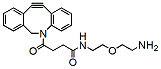
DBCO-PEG1-amine is a PEG linker which contains DBCO and amine moieties. The DBCO group is commonly used in copper-free Click Chemistry reactions. The amine group is reactive with carboxylic acids, activated NHS esters, carbonyls (ketone, aldehyde) etc. Reagent grade, for research purpose. Please contact us for GMP-grade inquiries.
Detail
DBCO-PEG1-amine is a PEG linker which contains DBCO and amine moieties. The DBCO group is commonly used in copper-free Click Chemistry reactions. The amine group is reactive with carboxylic acids, activated NHS esters, carbonyls (ketone, aldehyde) etc. Reagent grade, for research purpose. Please contact us for GMP-grade inquiries.
Other Products
RNase-Free DNase I Kit
Product Info
Document
Product Info
Overview
Convenient optimized on-column DNase treatment using Norgen’s RNA Purification Kits
Also includes protocol for digestion in-solution followed by RNA Clean-Up
Guaranteed RNase-Free
Includes Enzyme Incubation Buffer
Cat. 25710 contains one vial of 1,600 units and Cat. 25720 contains 4 vials (1,600 units/vial)
Norgen’s RNA purification kits isolate total RNA with minimal amounts of genomic DNA contamination. However, for some sensitive downstream applications, it may be desirable to remove all traces of residual DNA. Norgen’s RNase-free DNAse I Kit, with Enzyme Incubation Buffer, can be used for optional on-column DNase digestion with any of Norgen’s RNA purification kits. Alternatively, after isolating total RNA using one of Norgen’s RNA purification kits, the RNA elution can be treated with this DNase I. The RNA can then be purified from the DNase using Norgen’s RNA Clean-Up and Concentration Kit (Cat# 23600), and the RNA can then be used in downstream applications.
Details
Each RNase-Free DNase I Kit is supplied complete with sufficient enzyme and enzyme incubation buffer for 50 or 200 reactions.
Storage Conditions The DNase I provided is in lyophilized form. It is stable for at least 3 months if stored at room temperature. However, it is recommended to store the DNase I vial at 2 – 8ºC (or below) upon receipt to maintain stability beyond 3 months. Buffer DR and Enzyme Incubation Buffer can be stored at room temperature. After reconstitution with Buffer DR (see product manual), the DNase I should be stored at -20ºC. All reagents should remain stable for at least 1 year in their unopened containers at the appropriate storage temperature.
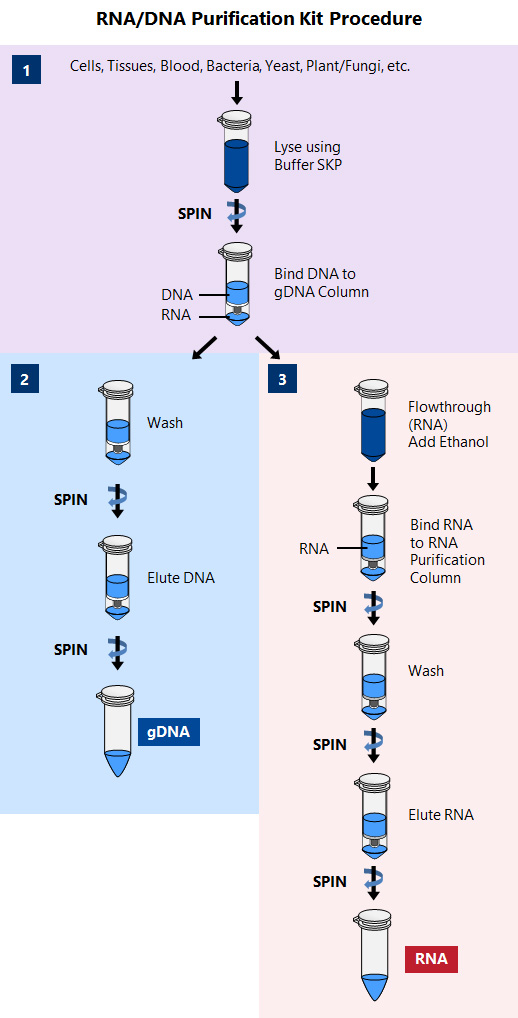
This Kit is designed to purify genomic DNA and total RNA simultaneously from a single biological sample. Lysate is first passed through a DNA spin column to selectively isolate DNA and then through an RNA column to selectively isolate RNA. Pure DNA and RNA are purified from the entire sample, in contrast to other procedures where either the biological sample or the purified total nucleic acids is divided into two before being processed separately. The kit is compatible with small amounts of a wide range of animal cells and tissues.
Details
Specifications
Features
Specifications
Main Functions
Co-isolation DNA and RNA from skin, muscle, connective tissue, fibrous tissue sample
Applications
PCR and southern blot, etc.
Purification method
Mini spin column
Purification technology
Silica technology
Process method
Manual (centrifugation or vacuum)
Sample type
Cultured cells and tissue samples
Sample amount
Tissue: < 20mg
Principle
The Kits are designed to purify both genomic DNA and total RNA from the same cellor tissue sample. Samples are first lysed and homogenized. The lysate is passed through a DNA Mini column and bind DNA. Ethanol is added to the flow-through and the sample is applied to an RNA column. DNA/RNA binds to the membrane and contaminants are washed away. High-quality RNA is eluted in as little as 30µl water using the Kit. High-quality DNA is eluted in as little as 50µl water using the Kit.
Advantages
High quality – high purity total RNA / DNA can be directly used in a variety of downstream applications
Fast – column method can complete the extraction of several samples in 30 minutes
Safe – no phenol chloroform extraction required
Simultaneous extraction- simultaneously isolate DNA and RNA from one sample
Kit Contents
Contents
R511402
R511403
Purification Times
50 Preps
250 Preps
HiPure DNA Mini Columns
50
250
HiPure RNA Mini Columns
50
250
2ml Collection Tubes
100
2 x 250
Buffer RL
30 ml
150 ml
RNA Digestion Buffer
15 ml
80 ml
Buffer DW1
30 ml
150 ml
Buffer RW1
50 ml
200 ml
Buffer RW2*
20 ml
2 x 50 ml
RNase Free Water
10 ml
30 ml
Buffer AE
10 ml
50 ml
Storage and Stability
HiPure DNA/RNA Kit can be stored dry at room temperature (15-25°C) and are stable for at least 18 months under these conditions. Make sure that all buffers are at room temperature when used. During shipment, crystals or precipitation may form in the Buffer RLC. Dissolve by warming buffer to 37°C.
Document
This Kit is designed to purify genomic DNA and total RNA simultaneously from a single biological sample. Lysate is first passed through a DNA spin column to selectively isolate DNA and then through an RNA column to selectively isolate RNA. Pure DNA and RNA are purified from the entire sample, in contrast to other procedures where either the biological sample or the purified total nucleic acids is divided into two before being processed separately. The kit is compatible with small amounts of a wide range of animal cells and tissues.
Sequentially isolate and purify total RNA and DNA from a single sample
Two column system: one for DNA and one for RNA
The RNA column is for the purification of total RNA including microRNA
No need to split the lysate, or to use phenol or precipitation methods
Rapid and efficient spin column procedure – it takes only 30 minutes
Purification is based on spin column chromatography that uses Norgen’s proprietary resin separation matrix
These kits provide a rapid method for the isolation and purification of total RNA and DNA sequentially from a single sample of cultured animal cells and tissues, blood, bacteria, yeast, or fungi. The lysate is passed over two columns: 1) a DNA column and 2) an RNA column. Total RNA of all sizes is purified, including microRNA. Both DNA and RNA are of the highest purity and yield.
These kits are ideal for researchers who are interested in studying the genome and transcriptome of a single sample, such as for studies of microRNA profiling, gene expression including gene silencing experiments or mRNA knockdowns, studies involving biomarker discovery, and for characterization of cultured cell lines. Norgen’s RNA/DNA Purification Kits are especially useful for researchers who are isolating macromolecules from precious, difficult to obtain or small samples such as biopsy materials or single foci from cell cultures, as they eliminate the need to fractionate the sample. Furthermore, analysis will be more reliable since the RNA and DNA are derived from the same sample, thereby eliminating inconsistent results. The purified macromolecules are of the highest purity and can be used in a number of different downstream applications
RNA/DNA Purification Kit (Spin Column)
Maximum column binding capacity of 50 μg for RNA and 20 μg for DNA.
RNA/DNA Purification Micro Kit (Micro)
The purified RNA and DNA fractions can be eluted in as little as 20 μL. Ideal for cell number inputs of 500,000 and as little as 5 cells. Maximum column binding capacity of 35 μg for RNA and 10 μg for DNA.
Maximum Amount of Starting Material: Animal Cells Animal Tissues Blood Bacteria Yeast Fungi Plant Tissues
5 x 10⁶ cells 25 mg (for most tissues)** 200 μL 1 x 10⁹ cells 1 x 10⁸ cells 50 mg 50 mg
Time to Complete 10 Purifications
30 minutes
Average Yield*: HEK 293 Cells (1 x 10⁶ cells) HEK 293 Cells (1 x 10⁶ cells) Liver (15 mg) Liver (15 mg)
10-15 μg RNA 2-4 μg DNA 30-35 μg RNA 4-6 μg DNA
*Average Yield will vary depending upon a number of factors including species, growth conditions used, and development stage.
**Tissue inputs of up to 40 mg may be used, however for inputs greater than the recommended 25 mg, cross-contamination of the RNA and DNA fractions is possible.
Storage Conditions and Product Stability Store Proteinase K at -20°C upon arrival. All other solutions should be kept tightly sealed and stored at room temperature. This kit is stable for 1 year after the date of shipment.