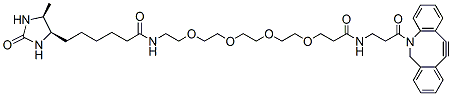
DBCO-PEG4-Desthiobiotin is a PEG linker containing a desthiobiotin group and a DBCO functional group. Desthiobiotin is used for affinity-based applications such as pull-down assays or for ligating with streptavidin proteins while DBCO is a click chemistry handle that quickly reacts with azide groups on target molecules. Desthiobiotin is a sulfur-free analogue of biotin which binds streptavidin with slightly less strength than biotin, which provides it with a soft-release characteristic that is useful for in pull-down assays by minimizing co-elution with endogenous biotinylated molecules. The inclusion of a PEG linker in this molecule improves its aqueous solubility.
Detail
DBCO-PEG4-Desthiobiotin is a PEG linker containing a desthiobiotin group and a DBCO functional group. Desthiobiotin is used for affinity-based applications such as pull-down assays or for ligating with streptavidin proteins while DBCO is a click chemistry handle that quickly reacts with azide groups on target molecules. Desthiobiotin is a sulfur-free analogue of biotin which binds streptavidin with slightly less strength than biotin, which provides it with a soft-release characteristic that is useful for in pull-down assays by minimizing co-elution with endogenous biotinylated molecules. The inclusion of a PEG linker in this molecule improves its aqueous solubility.
Other Products
endo-BCN-PEG2-PFP ester
Product Info
Document
Product Info
endo-BCN-PEG2-PFP ester is a click chemistry active ester. The PFP esters have similar applications as the NHS esters, but are more stable in aqueous solution. They can be used to label the primary amines (-NH2) of proteins, amine-modified oligonucleotides, and other amine-containing molecules. The BCN group can react with azide-tagged biomolecules. Reagent grade, for research purpose. Please contact us for GMP-grade inquiries.
Document
endo-BCN-PEG2-PFP ester is a click chemistry active ester. The PFP esters have similar applications as the NHS esters, but are more stable in aqueous solution. They can be used to label the primary amines (-NH2) of proteins, amine-modified oligonucleotides, and other amine-containing molecules. The BCN group can react with azide-tagged biomolecules. Reagent grade, for research purpose. Please contact us for GMP-grade inquiries.
[CD1020] SMOChem™ Deoxynucleotide (dNTP) Mix, 25 mM each (100 mM total), 500 µl
Product Info
Document
Product Info
Description
The SMOChem™ Deoxynucleotide (dNTP) Mix is an aqueous solution that contains an equimolar solution of ultrapure dATP, dCTP, dGTP and dTTP, each at a concentration of 25 mM at pH 8.5. The dNTP Mix is designed for many different molecular biology applications that involved in DNA synthesis or labeling, such as PCR, real-time PCR, DNA sequencing, reverse transcription, primer extension, and etc. The dNTP Mix is free of exo-deoxyribonuclease and endo-deoxyribonuclease as well as ribonuclease activity. The dNTP Mix offers the possibility to reduce the number of pipetting steps and the risk of reaction set up errors.
Features
Ideal for PCR amplification and cDNA synthesis
Premixed solution
Nuclease and ribonuclease free
Applications
PCR amplification of DNA fragments
DNA fill-in reaction
DNA sequencing
Reverse transcription
One-step RT-PCR
Storage
-20°C for 36 months
Document
The SMOChem™ Deoxynucleotide (dNTP) Mix is an aqueous solution that contains an equimolar solution of ultrapure dATP, dCTP, dGTP and dTTP, each at a concentration of 25 mM at pH 8.5. The dNTP Mix is designed for many different molecular biology applications that involved in DNA synthesis or labeling, such as PCR, real-time PCR, DNA sequencing, reverse transcription, primer extension, and etc. The dNTP Mix is free of exo-deoxyribonuclease and endo-deoxyribonuclease as well as ribonuclease activity. The dNTP Mix offers the possibility to reduce the number of pipetting steps and the risk of reaction set up errors.