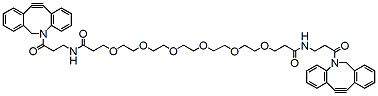
DBCO-PEG6-DBCO is a monodisperse click chemistry linker containing two terminal DBCO groups with hydrophilic PEG spacer arm. DBCO will react with azide-bearing compounds or biomolecules to form a stable triazole linkage without copper catalyst. PEG spacer arm can increase water solubility and membrane permability. Reagent grade, for research purpose. Please contact us for GMP-grade inquiries.
Detail
DBCO-PEG6-DBCO is a monodisperse click chemistry linker containing two terminal DBCO groups with hydrophilic PEG spacer arm. DBCO will react with azide-bearing compounds or biomolecules to form a stable triazole linkage without copper catalyst. PEG spacer arm can increase water solubility and membrane permability. Reagent grade, for research purpose. Please contact us for GMP-grade inquiries.
Other Products
DBCO-PEG4-triethoxysilane
Product Info
Document
Product Info
DBCO-PEG4-triethoxysilane is a PEG linker containing a triethoxysilane moiety and a DBCO group. Triethoxysilane is commonly used for surface modifications. DBCO group can react with azide-bearing compounds or biomolecules to form a stable triazole linkage without copper catalyst. The hydrophilic PEG chain increasse the water solubility of a compound in aqueous media. Reagent grade, for research purpose. Please contact us for GMP-grade inquiries.
Document
DBCO-PEG4-triethoxysilane is a PEG linker containing a triethoxysilane moiety and a DBCO group. Triethoxysilane is commonly used for surface modifications. DBCO group can react with azide-bearing compounds or biomolecules to form a stable triazole linkage without copper catalyst. The hydrophilic PEG chain increasse the water solubility of a compound in aqueous media. Reagent grade, for research purpose. Please contact us for GMP-grade inquiries.
The GetClone™ PCR Cloning Vector II is a positive selection system for high efficiency cloning of blunt end DNA or amplicons. This cloning vector contains a lethal gene which can be disrupted by ligation of a blunt end DNA insert into the cloning site. Only colonies with inserted vectors are able to propagate, eliminating the additional needs of IPTG and X-Gal for blue/white screening. This cloning vector includes ampicillin and kanamycin resistance genes that can meet the needs of most users.
Features
Cloning efficiency greater than 90%
IPTG and X-Gal are not required
Accepts a wide range of insert/vector ratios 0.5:1 to 12:1
Accepts insert size from 6 bp to 11 kb
The phosphorylation of PCR fragments is not required
Accepts blunt end amplicon or DNA fragment (not for sticky ends)
Ampicillin and kanamycin selection markers
Storage
-20°C for 24 months
Document
The GetClone™ PCR Cloning Vector II is a positive selection system for high efficiency cloning of blunt end DNA or amplicons. This cloning vector contains a lethal gene which can be disrupted by ligation of a blunt end DNA insert into the cloning site. Only colonies with inserted vectors are able to propagate, eliminating the additional needs of IPTG and X-Gal for blue/white screening. This cloning vector includes ampicillin and kanamycin resistance genes that can meet the needs of most users.
1.System optimization and adaptation:MIRA reagents have undergone a series of screenings of the entire system, types and concentrations of cofactors, and multiple optimizations of the production freeze-drying process. Based on the mastery of the components and processes, we can make adjustments according to customer needs to suit them methodology or project. 2.Diversified product forms:For example, we can provide reagents in different systems and forms (dry powder/microsphere/liquid), etc., to achieve personalized customized services according to customer needs. 3.Industrial application support: It has a 4,000-square-meter factory building to support customer projects in entrusting freeze-drying production and industrial application of the project.
Document
MIRA VS RPA,MIRA Advantages:
1.System optimization and adaptation:MIRA reagents have undergone a series of screenings of the entire system, types and concentrations of cofactors, and multiple optimizations of the production freeze-drying process. Based on the mastery of the components and processes, we can make adjustments according to customer needs to suit them methodology or project. 2.Diversified product forms:For example, we can provide reagents in different systems and forms (dry powder/microsphere/liquid), etc., to achieve personalized customized services according to customer needs. 3.Industrial application support: It has a 4,000-square-meter factory building to support customer projects in entrusting freeze-drying production and industrial application of the project.