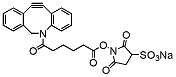
DBCO-Sulfo-NHS ester is a water-soluble sulfocated reagent containing DBCO moiety. It can be used for simple and efficient labeling of antibodies, proteins and any other primary amine-bearing macromolecules with DBCO moiety in 100% aqueous buffers. DBCO is commonly used for copper-free Click Chemistry reactions. Reagent grade, for research purpose. Please contact us for GMP-grade inquiries.
Detail
DBCO-Sulfo-NHS ester is a water-soluble sulfocated reagent containing DBCO moiety. It can be used for simple and efficient labeling of antibodies, proteins and any other primary amine-bearing macromolecules with DBCO moiety in 100% aqueous buffers. DBCO is commonly used for copper-free Click Chemistry reactions. Reagent grade, for research purpose. Please contact us for GMP-grade inquiries.
Introducing the SARS-CoV-2 Detection Kit – the perfect solution for quick and accurate COVID-19 infection testing. This revolutionary kit has been designed to detect the presence of SARS-CoV-2 in Nasopharyngeal swabs, providing you with a reliable and convenient way to determine whether individuals have been infected with the virus. With the ability to perform 48 tests per kit, our detection kit is the perfect solution for rapid and accurate testing.
Our detection kit is designed for maximum accuracy and reliability, with components that must be stored at -20°C to ensure optimal performance. Our convenient shipping process ensures that the kit arrives frozen and ready for use, so you can rest assured that you’ll have the results you need as quickly as possible.
The SARS-CoV-2 Detection Kit is the most reliable and accurate COVID-19 infection testing solution on the market. With its convenient packaging and easy-to-use design, our detection kit is the perfect solution for any medical facility looking to quickly and accurately test for the presence of SARS-CoV-2.
Keywords: Covid-19 Virus Detection Test Kit, Covid-19 Test Kit, Covid 19 Rapid Test Kit
Technical Parameters:
Parameter
Value
Product Name
SARS-CoV-2 DetectionORF1ab Gene NFO Kit
Manufacturer
Amp-future Company
Detection Limit
500-1000copies/µL
Sample Type
Nasopharyngeal Swab
Target Gene
ORF1ab Gene
Packaging
48 Tests/Box
Test Time
5-20mins
Kit Components
Primers, Probes, Enzymes, Buffers
Shipping
ice
Storage Temperature
-20°C
Applications:
Amp-future bio’s SARS-CoV-2 Detection Kit is a rapid test kit for the detection and identification of SARS-CoV-2 virus. This test kit is designed to detect the presence of SARS-CoV-2 virus in human sample materials, and it is suitable for detecting the virus in nasopharyngeal swab samples. It has a detection limit of 500-1000 copies per µL, and it is packaged with 48 tests per kit. The kit uses ORF1ab Genetarget gene for the detection of SARS-CoV-2 virus.
The Amp-future bio SARS-CoV-2 Detection Kit is an ideal solution for organizations and institutions looking for a rapid and reliable solution for the detection of SARS-CoV-2 virus. It can be used in healthcare settings, laboratories, and other research institutes to identify the presence of SARS-CoV-2 virus in human samples, and it can also be used in the diagnosis and treatment of COVID-19 patients. The kit is suitable for use in public health surveillance programs to monitor the spread of the virus, and it can also be used for the rapid diagnosis and monitoring of SARS-CoV-2 infections in high-risk areas.
The Amp-future bio SARS-CoV-2 Detection Kit is a reliable and cost-effective solution for the detection and identification of SARS-CoV-2 virus. It is manufactured in China, and it has been developed following the highest standards of quality assurance. This kit is an indispensable tool for organizations and institutions looking for a rapid and reliable solution for the detection of SARS-CoV-2 virus in human samples.
Support and Services:
At , our goal is to provide customers with the best SARS-CoV-2 Detection Kit available. To ensure customer satisfaction, we provide a variety of technical support and service options.
Customer Support: Our customer support representatives are available to answer any questions you may have about the SARS-CoV-2 Detection Kit, including its features, compatibility, and installation.
Online Documentation: Our online documentation provides detailed instructions on how to use the SARS-CoV-2 Detection Kit, as well as troubleshooting tips and other helpful information.
Warranty and Returns: We provide a limited warranty on our SARS-CoV-2 Detection Kit to protect our customers against manufacturer defects or malfunctions. If you experience any issues with your product, please contact us for assistance.
Software Updates: We regularly release software updates for the SARS-CoV-2 Detection Kit to ensure optimal performance. You can easily download and install the latest updates from our website.
If you have any questions or need further assistance, please contact us at and one of our representatives will be happy to help.
FAQ:
Q1: What is SARS-CoV-2 Detection Kit?
A1: SARS-CoV-2 Detection Kit is a product produced by Amp-future bio, which is originated from China. It is used for detecting the presence of SARS-CoV-2 virus in a sample.
Q2: What is the principle of SARS-CoV-2 Detection Kit?
A2: SARS-CoV-2 Detection Kit utilizes the PCR (polymerase chain reaction) technology to amplify small amounts of the virus’s genetic material, allowing it to be detected with high accuracy.
Q3: What type of sample can be tested with SARS-CoV-2 Detection Kit?
A3: SARS-CoV-2 Detection Kit is suitable for testing samples such as nasal swab, nasopharyngeal swab, sputum, saliva, throat swab and bronchoalveolar lavage fluid.
Document
Introducing the SARS-CoV-2 Detection Kit – the perfect solution for quick and accurate COVID-19 infection testing. This revolutionary kit has been designed to detect the presence of SARS-CoV-2 in Nasopharyngeal swabs, providing you with a reliable and convenient way to determine whether individuals have been infected with the virus. With the ability to perform 48 tests per kit, our detection kit is the perfect solution for rapid and accurate testing.
Our detection kit is designed for maximum accuracy and reliability, with components that must be stored at -20°C to ensure optimal performance. Our convenient shipping process ensures that the kit arrives frozen and ready for use, so you can rest assured that you’ll have the results you need as quickly as possible.
The SARS-CoV-2 Detection Kit is the most reliable and accurate COVID-19 infection testing solution on the market. With its convenient packaging and easy-to-use design, our detection kit is the perfect solution for any medical facility looking to quickly and accurately test for the presence of SARS-CoV-2.
Short term stability: 2-8oC, Long term stability: See individual component labels
Stability:
> 2 years under recommended storage conditions
Analyte:
D-Gluconate, D-Glucono-δ-lactone
Assay Format:
Spectrophotometer, Microplate, Auto-analyser
Detection Method:
Absorbance
Wavelength (nm):
340
Signal Response:
Increase
Linear Range:
0.8 to 50 µg of D-gluconic acid per assay
Limit of Detection:
0.792 mg/L
Reaction Time (min):
~ 6 min
Application examples:
Wine, meat, processed meat (e.g. additives), fruit juice, dairy products, pharmaceuticals, paper and other materials (e.g. biological cultures, samples, etc.).
Method recognition:
Methods based on this principle have been accepted by ISO, DIN and GOST
The D-Gluconic Acid/D-Glucono-δ-lactone test kit is suitable for the specific measurement and analysis of D-gluconic acid/D-gluconolactone in foods and beverages.
Note for Content: The number of manual tests per kit can be doubled if all volumes are halved. This can be readily accommodated using the MegaQuantTM Wave Spectrophotometer (D-MQWAVE).
Extended cofactors stability. Dissolved cofactors stable for > 1 year at 4oC.
All reagents stable for > 2 years after preparation
Very competitive price (cost per test)
Very rapid reaction
Mega-Calc™ software tool is available from our website for hassle-free raw data processing
Standard included
Suitable for manual, microplate and auto-analyser formats
Document
The D-Gluconic Acid/D-Glucono-δ-lactone test kit is suitable for the specific measurement and analysis of D-gluconic acid/D-gluconolactone in foods and beverages.
Nucleic acid testing (NAT) is the method of choice for detection and quantification of a wide range of micro organisms. Primerdesign manufactures and supplies high quality quantitative real-time PCR kits for the detection and simultaneous quantification of numerous significant pathogens . A copy number standard curve is provided for quantification and an the internal extraction template (DNA or RNA), controls for the quality of the nucleic acid extraction and eliminates false negative results.
The kit is designed with the broadest possible detection profile to ensure that all clinically relevant strains and subtypes are detected. Target sequences are selected by working with data from key opinion leaders in the field. Multiple sequence alignments and unprecedented real-time PCR expertise in design and validation ensure the best possible kit. Details of the target and priming specificity are included in the individual handbooks above.
Packaged, optimised and ready to use. Expect Better Data.
Document
Primer and probe mix (150 reactions) Reverse Transcription, target specific primers (RNA genome viruses only) Copy number standard curve (sufficient for multiple standard curves) Internal extraction control – Read through VIC channel* Endogenous control (150 tests) RNAse/DNAse free water *alternative fluorophores available on request