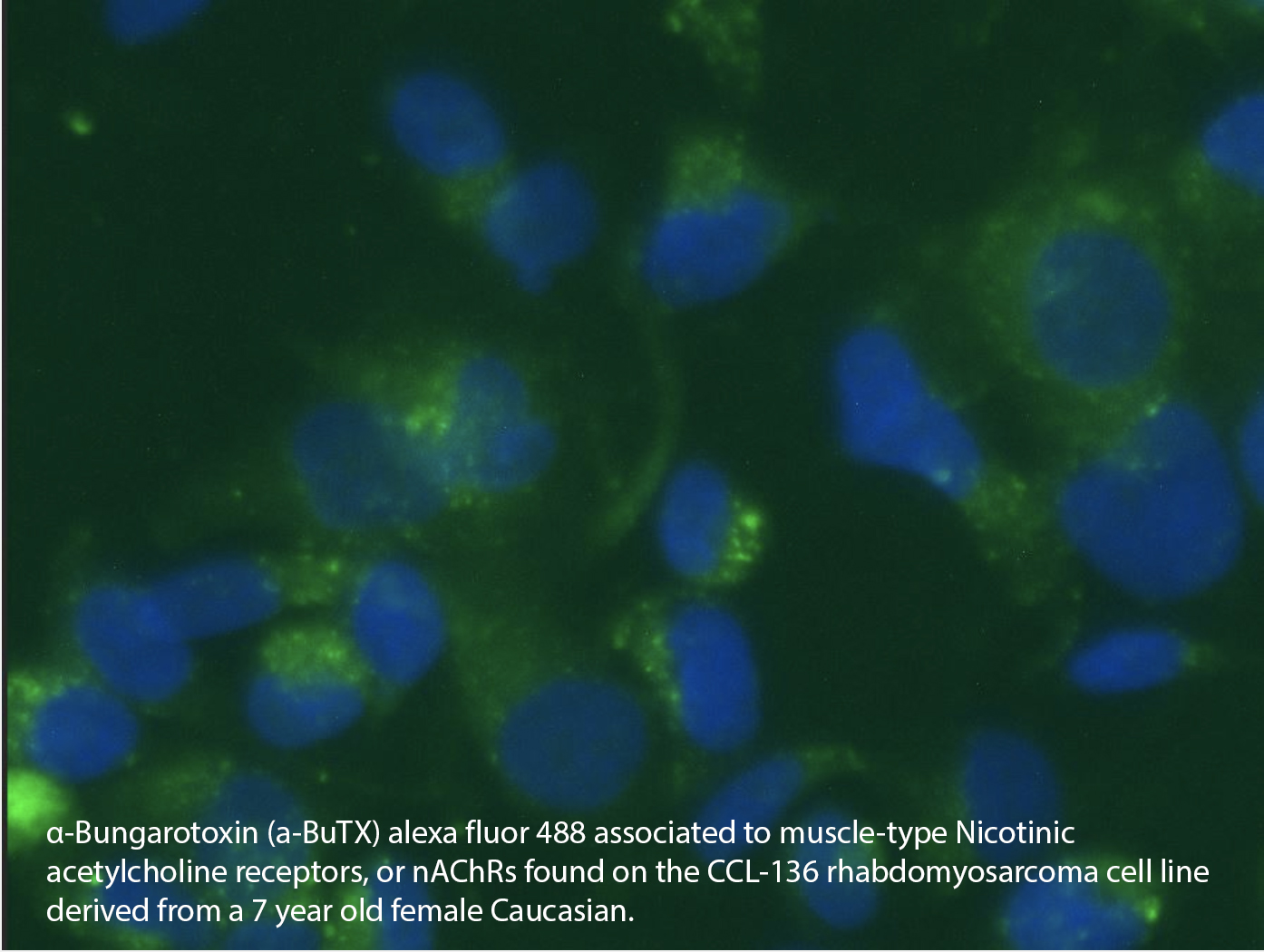
Cell membrane preparations containing nicotinic AChRs that are ligand-gated ion channels that form pores in cells plasma membranes, mediating fast signal transmission at synapses. Nicotinic AChRs are involved in a wide range of physiological processes, and can be either neuronal or muscle-type. The membrane preparations we have developed are suitable for receptor binding assays in which muscle type nicotinic AChRs are needed. The membranes are tested in several functional binding assays and quality testing criteria to meet binding specifications.
Other Products
[PS1001] FluoroStain™ Protein Fluorescent Staining Dye (Red, 1,000X), 1 ml x 5
Product Info
Document
Product Info
Description
The FluoroStain™ Protein Fluorescent Staining Dye (Red, 1000×) is designed to substitute the common Coomassie Blue protein staining method, offering greater sensitivity and ease of operation. Unlike Coomassie Blue stain, the FluoroStain Protein Fluorescent Staining Dye binds to protein with high specificity, making destaining process an option rather than a requirement. With further reduction of background signals via destaining process, the FluoroStain™ is capable of achieving detection level parallel to silver staining without specialized imaging equipment, making it one of the most sensitive dyes available. In addition to its remarkable sensitivity, the FluoroStain™ Protein Fluorescent Staining Dye (Red, 1000×) brings a more reliable and safer user experience, since the stained gel can be visualized with blue-light illumination, avoiding the risk of skin/ eye damage caused by UV light. For best result, we suggest using B-BOX™ Blue Light LED epi-illuminator to visualize and analyze the gel stained with FluoroStain Protein Fluorescent Staining Dye (Red, 1000×). The FluoroStain™ Protein Fluorescent Staining Dye is compatible to the analysis of mass spectra, i.e. LC-MS/MS, MALDI-TOF, etc.
Spectral Characteristics
When it is bound with bovine serum albumin (BSA), the fluorescent emission of FluoroStain Protein Fluorescent Staining Dye can be excited by UV and blue light sources, with excitation peaks around 369 and 517 nm and emission at 605 nm. In absence of BSA, FluoroStain Protein Fluorescent Staining Dye shows ignorable fluorescence as compared with protein-bound form, therefore giving a clear background for photographic analysis.
These spectral characteristics made this fluorescent dye compatible with a wide variety of gel reading facilities, including UV/ blue light epi- and transilluminator, argon laser and mercury-arc lamp excitation gel scanners.
Storage
Protected from light -20°C for 24 months
Document
The FluoroStain™ Protein Fluorescent Staining Dye (Red, 1000×) is designed to substitute the common Coomassie Blue protein staining method, offering greater sensitivity and ease of operation. Unlike Coomassie Blue stain, the FluoroStain Protein Fluorescent Staining Dye binds to protein with high specificity, making destaining process an option rather than a requirement. With further reduction of background signals via destaining process, the FluoroStain™ is capable of achieving detection level parallel to silver staining without specialized imaging equipment, making it one of the most sensitive dyes available. In addition to its remarkable sensitivity, the FluoroStain™ Protein Fluorescent Staining Dye (Red, 1000×) brings a more reliable and safer user experience, since the stained gel can be visualized with blue-light illumination, avoiding the risk of skin/ eye damage caused by UV light. For best result, we suggest using B-BOX™ Blue Light LED epi-illuminator to visualize and analyze the gel stained with FluoroStain Protein Fluorescent Staining Dye (Red, 1000×). The FluoroStain™ Protein Fluorescent Staining Dye is compatible to the analysis of mass spectra, i.e. LC-MS/MS, MALDI-TOF, etc.
Isolate total DNA and RNA from all microorganisms found in water, including bacteria, fungi and algae
RNA and DNA are both column purified simultaneously using the same column
Elution contains concentrated DNA and RNA without the need for further precipitation
Complete RNA (including microRNA) without phenol
Isolated RNA and DNA are of high quality and integrity for all downstream applications
Purification is based on spin column chromatography that uses Norgen’s proprietary resin separation matrix
These kits provide a convenient and rapid method for the isolation of microorganisms from water samples. The kits allows for the rapid isolation and purification of total RNA and DNA simultaneously from the microorganisms found in different types of water samples. The total RNA and DNA (including genomic DNA) are isolated from all the microorganisms found in the water, including bacteria, fungi and algae without the use of any inhibitory organic substances The kit purifies genomic DNA, and all sizes of RNA, from large mRNA and ribosomal RNA down to microRNA (miRNA) and small interfering RNA (siRNA). The purified RNA and DNA are highly concentrated, and can be used directly in a number of downstream applications including PCR, qPCR, RT-PCR, qRT-PCR, Northern blotting, Southern blotting and sequencing reactions.
Water RNA/DNA Purification Kit (Spin Column + Filters Kits)
These kits are available with 0.45 μm or 0.22 μm filter formats for capturing microorganisms present in the water.
Storage Conditions and Product Stability All solutions should be kept tightly sealed and stored at room temperature. This kit is stable for 2 years from the date of shipment.
Propargyl-PEG2-acid is a linker consisting of propargyl and carboxylic acid functional groups. In the presence of activators (e.g. EDC, or HATU), the carboxylic acid reacts with primary amine to form a stable amide bond. The propargyl group reacts with azide group in biomolecules to yield a stable triazole linkage. Reagent grade, for research purpose. Please contact us for GMP-grade inquiries.
Document
Propargyl-PEG2-acid is a linker consisting of propargyl and carboxylic acid functional groups. In the presence of activators (e.g. EDC, or HATU), the carboxylic acid reacts with primary amine to form a stable amide bond. The propargyl group reacts with azide group in biomolecules to yield a stable triazole linkage. Reagent grade, for research purpose. Please contact us for GMP-grade inquiries.