[DL1000] ExcelDye™ 6X DNA Loading Dye, Orange, 5 ml x 2
Facebook
X
Pinterest
Email
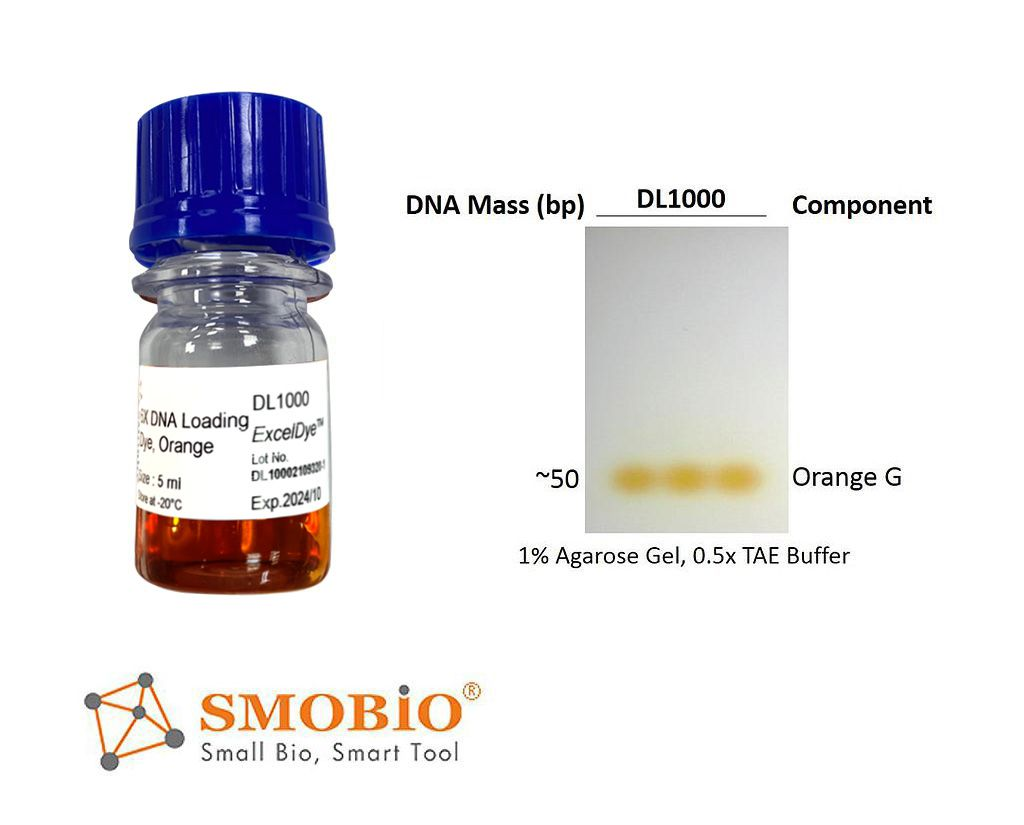
The ExcelDye™ 6× DNA Loading Dye (Orange) is pre-mixed buffer for tracking the DNA sample during the electrophoresis on agarose or polyacrylamide gels. It contains one dye (Orange G) for tracking the DNA migration. The Orange G migrates at approximately 30 bp on a standard 2% TAE agarose gel (50 bp on 1% TAE agarose gel). The included glycerol keeps the DNA at the bottom of the well and the presence of EDTA chelates divalent metal ions to prevent the process of metal-dependent nuclease.
Detail
Description
The ExcelDye™ 6× DNA Loading Dye (Orange) is pre-mixed buffer for tracking the DNA sample during the electrophoresis on agarose or polyacrylamide gels. It contains one dye (Orange G) for tracking the DNA migration. The Orange G migrates at approximately 30 bp on a standard 2% TAE agarose gel (50 bp on 1% TAE agarose gel). The included glycerol keeps the DNA at the bottom of the well and the presence of EDTA chelates divalent metal ions to prevent the process of metal-dependent nuclease.
Composition
0.15% Orange G
10 mM Tris-HCl (pH 8.0)
60% glycerol
60 mM EDTA
Storage
4°C for 12 months -20°C for 36 months
Other Products
endo-BCN-PEG8-PFP ester
Product Info
Document
Product Info
endo-BCN-PEG8-PFP ester is a PEG linker featuring a BCN group and a PFP ester. BCN is a click chemistry handle used to react with azides on target molecules while the PFP is a good leaving group which is readily displaced by amines to form amides.
Document
endo-BCN-PEG8-PFP ester is a PEG linker featuring a BCN group and a PFP ester. BCN is a click chemistry handle used to react with azides on target molecules while the PFP is a good leaving group which is readily displaced by amines to form amides.
The Opentrons Flex Waste Chute GEN1 occupies position D3 and is used to accept waste such as tips, tip racks, and plates in high volumes. The gripper will pick up the consumable and dispose it into the chute based on your workflow needs. The waste chute is neccesary for all high-throughput workflows and can be paired with the Opentrons Flex Deck Expansion Set to maximize the throughput capabilities of the Opentrons Flex. The following consumables can disposed of into the waste chute:
– NEST 2 mL Deep Well Plate, V Bottom
– Opentrons Tough 0.2 mL 96-Well PCR Plate, Full Skirt
– NEST 96 well Plate Flat
– All Opentrons Flex tip racks
Document
The Opentrons Flex Waste Chute GEN1 occupies position D3 and is used to accept waste such as tips, tip racks, and plates in high volumes. The gripper will pick up the consumable and dispose it into the chute based on your workflow needs. The waste chute is neccesary for all high-throughput workflows and can be paired with the Opentrons Flex Deck Expansion Set to maximize the throughput capabilities of the Opentrons Flex. The following consumables can disposed of into the waste chute:
– NEST 2 mL Deep Well Plate, V Bottom
– Opentrons Tough 0.2 mL 96-Well PCR Plate, Full Skirt