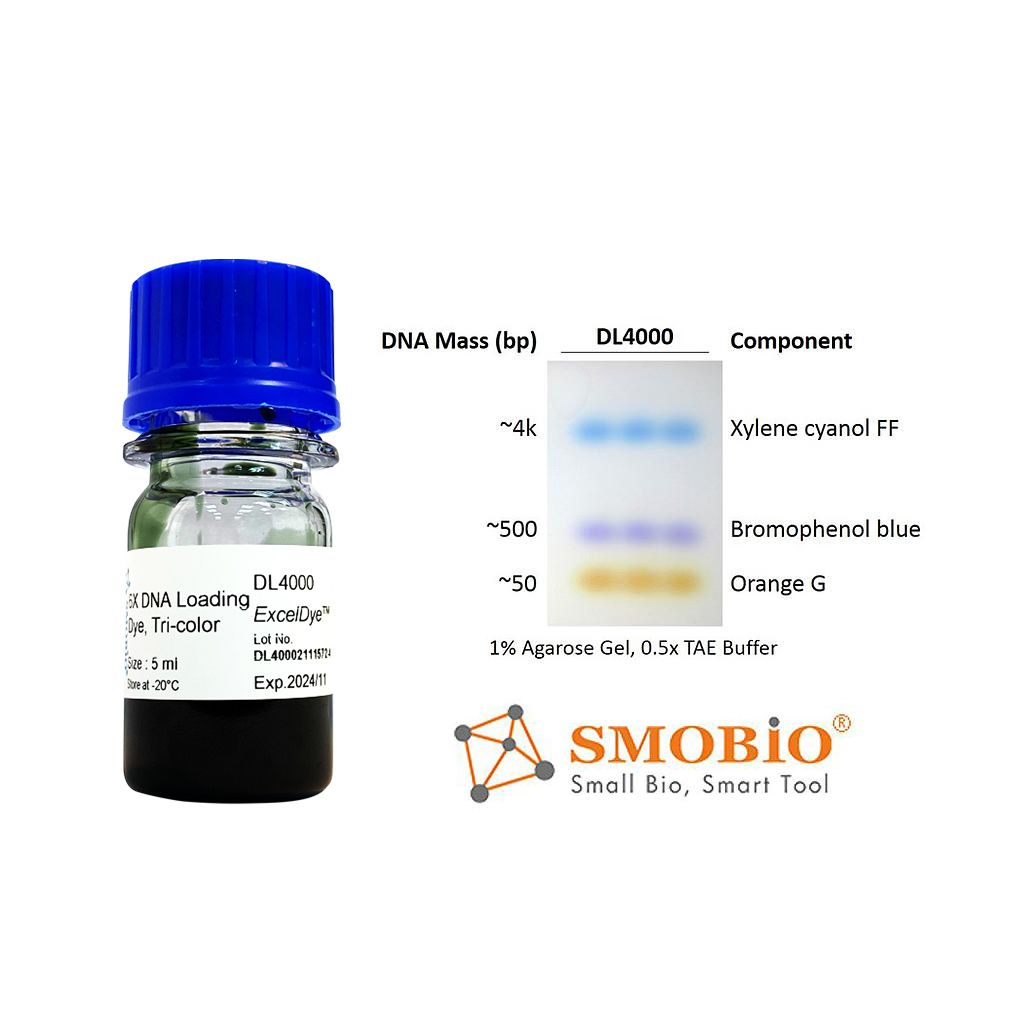
[DL4000] ExcelDye™ 6X DNA Loading Dye, Tri-color, 5 ml x 2
Facebook
X
Pinterest
Email
The ExcelDye™ 6× DNA Loading Dye (Tri-Color) is pre-mixed buffer for tracking the DNA sample during the electrophoresis on agarose or polyacrylamide gels. It contains three dyes (Xylene cyanol FF, Bromophenol blue, Orange G) for tracking the DNA migration. The Xylene cyanol FF, Bromophenol blue and Orange G migrate at approximately 800 bp, 150 bp and 30 bp on a standard 2% TAE agarose gel respectively (4,000 bp, 500 bp and 50 bp on 1% TAE agarose gel respectively). The included glycerol keeps the DNA at the bottom of the well and the presence of EDTA chelates divalent metal ions to prevent the process of metal-dependent nuclease.
Detail
Description
The ExcelDye™ 6× DNA Loading Dye (Tri-Color) is pre-mixed buffer for tracking the DNA sample during the electrophoresis on agarose or polyacrylamide gels. It contains three dyes (Xylene cyanol FF, Bromophenol blue, Orange G) for tracking the DNA migration. The Xylene cyanol FF, Bromophenol blue and Orange G migrate at approximately 800 bp, 150 bp and 30 bp on a standard 2% TAE agarose gel respectively (4,000 bp, 500 bp and 50 bp on 1% TAE agarose gel respectively). The included glycerol keeps the DNA at the bottom of the well and the presence of EDTA chelates divalent metal ions to prevent the process of metal-dependent nuclease.
Short term stability: 2-8oC, Long term stability: See individual component labels
Stability:
> 1 year under recommended storage conditions
Analyte:
L-Glutamic Acid, MSG
Assay Format:
Spectrophotometer, Microplate, Auto-analyser
Detection Method:
Absorbance
Wavelength (nm):
492
Signal Response:
Increase
Linear Range:
0.4 to 20 µg of L-glutamic acid per assay
Limit of Detection:
0.21 mg/L
Reaction Time (min):
~ 8 min
Application examples:
Fruit and vegetables (e.g. tomato), processed fruit and vegetables (e.g. tomato puree / juice, ketchup, soy sauce), condiments, processed meat products (e.g. extracts, bouillon and sausages), soup, pharmaceuticals and other materials (e.g. biological cultures, samples, etc.).
Method recognition:
Methods based on this principle have been accepted by ISO, GOST and NMKL
The L-Glutamic Acid test kit is a simple, reliable, rapid and accurate method for the measurement and analysis of L-glutamate (MSG) in foodstuffs.
Note for Content: The number of manual tests per kit can be doubled if all volumes are halved. This can be readily accommodated using the MegaQuantTM Wave Spectrophotometer (D-MQWAVE).
Cluster of differentiation 2 (CD2) is a useful early T-cell lineage restricted antigen that is present in T-cell differentiation. As a pan-T-cell marker, CD2 staining is used for recognizing practically all normal T-cells, but may be deleted in some T-cell neoplasms. Since CD2 is present in most precursor and mature T-cell leukemias and lymphomas, it is useful in the evaluation of lymphoid malignancies. By using CD2 and CD25 staining, the recognition of systemic mastocytosis and mastocytic leukemia is supported.
The Kit provides fast purification of high-quality RNA from paxigene Blood RNA Tube using silica-membrane spin columns. RNA purified using the HiPure System is ready for applications such as RT-PCR, Northern blotting, poly A+ RNA (mRNA) purification, nuclease protection, and in vitro translation.
The Kit is for the purification of total RNA from 2.5 ml human whole blood collected in a PAXgene Blood RNA Tube. Purification begins with a centrifugation step to pellet nucleic acids in the PAXgene Blood RNA Tube. The pellet is washed and resuspended, and incubated in optimized buffers together with proteinase K. DNA wash The lysate is passed through a DNA Mini column. Ethanolis added to adjust binding conditions, and the lysate is applied to a column.RNA is selectively bound to the silica membrane as contaminants pass through. Remaining contaminants are removed in several efficient wash steps. Between the first and second wash steps, the membrane is treated with DNase I to remove trace amounts of bound DNA. After the wash steps, RNA is eluted in elution buffer and heat-denatured.
Advantages
High quality – high purity total RNA can be directly used in various sensitive downstream applications
Fast – isolation of several samples can be completed in 40 minutes by using column purification method
Safety – no phenol chloroform extraction required
Sensitive – direct lysis of blood, plasma and other samples without separation of leukocytes
Kit Contents
Contents
R416802
R416803
Purification Times
10 Preps
50 Preps
HiPure RNA Mini Columns I
10
50
gDNA Filter Mini Columns
10
50
2ml Collection Tubes
30
150
RNase Free Water
60 ml
250 ml
Buffer MBR1
10 ml
30 ml
Buffer MBR2
5 ml
15 ml
Buffer RW1
15 ml
60 ml
Buffer RW2*
6 ml
20 ml
Proteinase K
12 mg
50 mg
Protease Dissolve Buffer
1.8 ml
5 ml
DNase I
120 µl
600 µl
DNase Buffer
6 ml
30 ml
Storage and Stability
Proteinase K should be stored at 2–8°C upon arrival. DNase I should be stored at -20°C. However, short-term storage (DNase I up to 1 weeks, Proteinase K up to 8 weeks) at room temperature (15–25°C) does not affect their performance. The remaining kit components can be stored at room temperature (15–25°C) and are stable for at least 18 months under these conditions.
Experiment Data
Document
The Kit provides fast purification of high-quality RNA from paxigene Blood RNA Tube using silica-membrane spin columns. RNA purified using the HiPure System is ready for applications such as RT-PCR, Northern blotting, poly A+ RNA (mRNA) purification, nuclease protection, and in vitro translation.