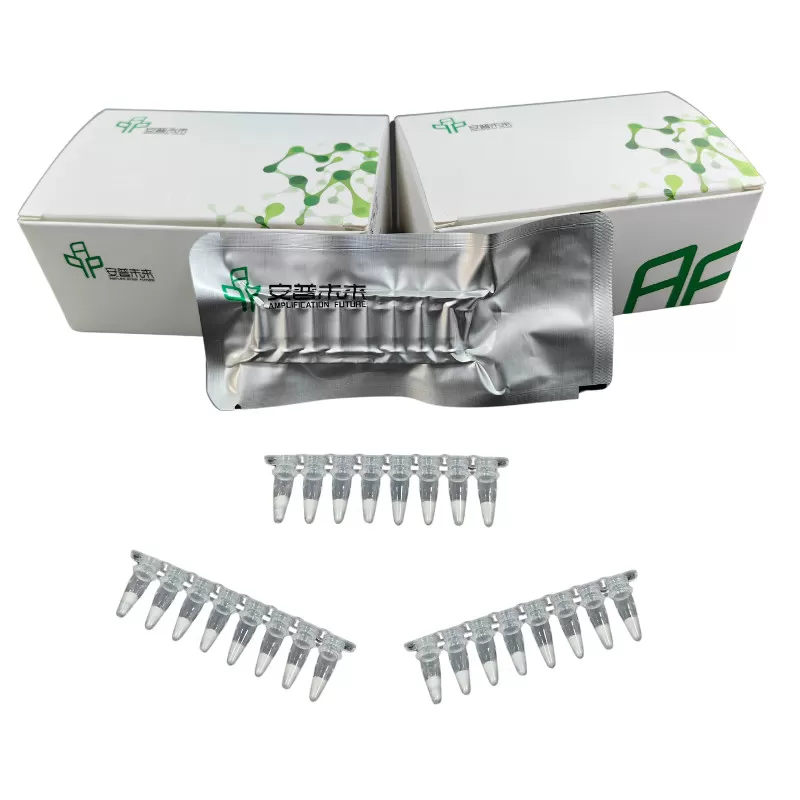
Storage term: stored at ≤-20℃,keep away from light, avoid heavy weight and repeated freezing and thawing.
Term of Validity: 14 months
Isothermal nucleic acid Principle Summary
The kit is based on room and constant temperature nucleic acid rapid amplification technology, its principle is that at room and constant temperature, the recombinase and primer form a protein/single-stranded nucleotide complex Rec/ssDNA, and invade the double-stranded DNA template with the help of auxiliary proteins and single-stranded binding protein SSB; then form a D-loop region at the invasion point and start to scan the DNA duplex, after finding the target region complementary to the primer and disintegration of the complex Rec/ssDNA, the polymerase also binds to the 3′ end of the primer to start the chain extension. The kit relies on the role of NFO enzyme and adds the designed specific molecular probes according to the template, and get the result by colloidal gold technology (sandwich method).
Technical Parameters:
Parameters
Details
Product Name
DNA Isothermal Amplification Kit NFO
Manufacturer
Amp-future
Storage Temperature
-20°C
Kit Components
Enzymes, Buffers ,Reagents
Packaging
48 Tests/box
Detection Limit
500-1000copies/µL
Shipping
ICE
Test Time
5-20mins
Isothermal nucleic acid Product Features
1/ High sensitivity and specificity, short reaction time.
2/ The reagent form is freeze-dried, stable and easy to operate.
3/ The reaction can be operated by metal bath and water bath pot without purchasing expensive PCR apparatus.
Isothermal nucleic acid Applications
Suitable for DNA isothermal rapid amplification kit(NFO type)
Primer: Require pair of nucleotide primers with the length of 25-35 bp.
DNA basic kit reaction temperature is 39 to 42℃ and time is 5-20 minutes.
Notes
1/ Please avoid nucleic acid contamination and set blank control during reaction due to the high sensitivity of the kit.
2/ Please take out the required quantity of MIRA reaction units for the experiment, and put the rest under storage conditions when performing the experiment.
MutL Homolog 1 (MLH1) is a protein involved in the mismatch-repair pathway. This protein is commonly associated with hereditary non-polyposis colorectal cancer, as the MLH1 gene is frequently mutated in patients with this cancer. Studies have shown MLH1 to be deficient in a high percentage of patients with microsatellite instability, as well as endometrial and ovarian cancers. Use of Anti-MLH1 is optimized when paired in an IHC panel with MSH6, MSH2, and PMS2. Anti-MLH1 is useful in the detection of MLH1 in a number of normal and neoplastic tissues, and for identifying a loss of MLH1 in tumors that are microsatellite-unstable.
For the isolation of Listeria spp. from food and environmental specimens.
Principle and Interpretation
Tryptone, proteose peptone, meat extract, yeast paste powder provide nitrogen sources, vitamins, amino acids, and growth factors; sodium chloride can maintain a balanced osmotic pressure; sodium dihydrogen phosphate and potassium dihydrogen phosphate as buffering agents; aesculin are fermentable sugars; lithium chloride and other antibiotics can inhibit Gram negative bacteria and most Gram positive bacteria.
Formulation
Ingredients
/liter
Enzymatic Digest of Animal Tissues
5.0g
Enzymatic Digest of Casein
5.0g
Meat extract
5.0g
Yeast extract
5.0g
Sodium chloride
20.0g
Disodium hydrogen phosphate dihydrate
12.0g
Potassium dihydrogen phosphate
1.35g
Aesculin
1.0g
Lithium chloride
3.0g
pH7.2±0.2 at 25°C
Preparation
Dissolve 57.4g in 1 litre of distilled water. Mix well and distribute into final containers. Sterilize by autoclaving at 121°C for 15 minutes. Then cool to 50°C,and add one Supplement(SR0120) per 225mL of base to prepare Half-Fraser Broth.
Quality Control
Cultural characteristics observed after incubation at 29-31°C for 22~26 hours
Quality control strains
Growth
Characteristics
Listeria monocytogenes ATCC19115
>20 cfu On PALCAM
Gray to black colony count with black halo
Escherichia coli ATCC25922
< 100 colonies on TSA
Inhibition
Enterococcus faecalis ATCC29212
Storage and Shelf Life
2-30℃,Keep container tightly closed, avoid direct sunlight.
Use before expiry date on the label.
Precautions
1. When weighing the dehydrated medium, please wear masks to avoid causing respiratory system discomfort
2. Keep container tightly closed after using to prevent clumping.
Waste Disposal
Microbiological contamination was disposed by autoclaving at 121°C for 30 minutes.
Document
Intended Use For the isolation of Listeria spp. from food and environmental specimens. Principle and Interpretation Tryptone, proteose peptone, meat extract, yeast paste powder provide nit……
AAV Purification from any input – cell fraction or media fraction
High AAV recovery, up to 90%
No specialized equipment needed
Purification from a variety of AAV serotypes (including AAV6 and AAV9)
Yields highly active AAV for in vivo and in vitro experiments
Purification is based on spin column chromatography that uses Norgen’s resin separation matrix
Recombinant adeno-associated virus (AAV) vectors are highly promising tools for both in vitro and in vivo gene transfer. Norgen’s AAV Purification Kits provide fast and simple procedures for concentrating and purifying AAV vectors from cell lysate and cell culture media. Purification is based on precipitation onto Norgen Biotek’s proprietary resin. Contaminating cellular debris is largely removed from the sample via a centrifugation step, while contaminating DNA and RNA is reduced using enzymatic digestion. AAV vector purified in this manner is highly active for use in in vitro and in vivo transduction experiments.
AAV Purification Kit
Norgen’s AAV Purification Kit contains sufficient materials for 15 preparations (33.5 mL per prep of supernatant (SN) or a total of 500 mL of supernatant input). Approximately 1 mL of cell pellet can be purified per prep, up to a maximum of 15 mL of cell pellet in total for the entire kit. Up to 33X sample concentration.
AAV Purification Mini Kit
Each spin column is able to concentrate and purify AAV from 0.5-8 mL of cell pellet, cell culture media, or cells and culture media mixed together. Up to 50X sample concentration. AAV vector purified in this manner is highly active for use in in vitro transduction experiments, and is eluted into a small volume (200 µL). Preparation time for 4 samples is 1.5 hours, with 45 minutes of hands-on time.
AAV Purification Midi Kit
Each spin column is able to concentrate and purify AAV from 8 mL up to 45 mL of input consisting of cell pellet, cell culture media, or cells and culture media mixed together. Up to 50X sample concentration. AAV vector purified in this manner is highly active for use in in vitro transduction experiments, and is eluted into a small volume (1 mL). The kit may be used to purify up to 8 x 25 mL or 4 x 45 mL of samples using the included columns. Preparation time for 4 samples is approximately 2 to 2.5 hours, with 1.5 hours of hands on time.
AAV Purification Maxi Kit (Slurry Format)
Each spin column is able to concentrate and purify AAV from 45 mL to 90 mL of input consisting of cell pellet, cell culture media, or cells and culture media mixed together. Up to 200X sample concentration. AAV vector purified in this manner is highly active for use in in vitro transduction experiments, and is eluted into a small volume (1-10 mL) using the optional concentration step. The kit may be used to purify up to 1 x 900 mL samples or 10 x 45-90 mL samples using the included columns. Preparation time for 1 x 900 mL sample is approximately 2.5 to 3.5 hours, with an optional concentration step requiring an additional 30 min.
At least 5 x 10¹⁰ AAV particles as determined by qPCR
AAV Vector Serotype
AAV6, AAV9 and others
Input Type
Cells, media
Input Volume (AAV supernatant)
1 – 33.5 mL SN per prep (500 mL SN in total)
Input Volume (AAV cell pellet)
1 mL cell pellet per prep (15 mL in total)
Time to Complete Purifications
2.5 to 4.5 hours with 1 hour hands on time
In vivo transduction
Yes
Storage Conditions and Product Stability
HL-SAN Nuclease should be stored at -20°C upon arrival. Elution Buffer O should be stored tightly capped at 4°C upon arrival. All other solutions should be kept tightly sealed and stored at room temperature. Once opened, the solutions should be stored at 4°C. This kit is stable for 2 years after the date of shipment.
Component
Cat. 66100 (15 preps)
Cat. 63200 (20 preps)
Cat. 63300 (4-8 preps)
Cat. 63250 (1-10 preps)
Lysis Buffer S
5.5 mL
5.5 mL
5.5 mL
20 mL
DNAse I
–
2 x 25 uL
2 x 25 uL
210 μL
RNAse A
–
60 μL
60 μL
240 μL
HL-SAN Nuclease
102 μL
–
–
–
Binding Buffer A
20 mL
4 mL
4 mL
2 x 8 mL
Purification Solution C
60 mL
–
–
–
Purification Solution D
130 mL
–
–
–
Wash Solution C
2 x 130 mL
60 mL
60 mL
3 x 60 mL
Slurry E
12.5 mL
–
–
2 x 14.5 mL
Elution Buffer O
66 mL
8.5 mL
8.5 mL
66 mL
Protein Neutralizer
4 mL
4 mL
4 mL
4 mL
Spin Columns
–
20
–
–
Mini Spin Columns
–
20
–
–
Midi Spin Columns (grey contents) with Collection Tubes
–
–
8
10
Midi Spin Columns (white contents) with Collection Tubes
–
–
8
–
Maxi Spin Columns (grey contents) with Collection Tubes
–
–
–
10
Maxi Spin Columns (white contents) with Collection Tubes