As specialists for DNA polymerases, we offer our services to you: DNA polymerase activity test (sequencing PAGE or real-time PEx) DNA polymerase purity (SDS-page) DNA polymerase functionality tests (PCR, PEx, LAMPs, etc) DNA polymerase contaminants (DNA, RNA, DNase, RNAse)
Detail
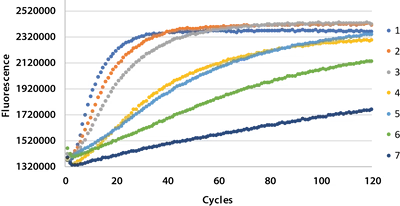
DNA polymerase activity tests and QC
As specialists for DNA polymerases, we offer our services to you:
DNA polymerase activity test (sequencing PAGE or real-time PEx)
DNA polymerase purity (SDS-page)
DNA polymerase functionality tests (PCR, PEx, LAMPs, etc)
DNA polymerase contaminants (DNA, RNA, DNase, RNAse)
Pigeon Circovirus Livestock Disease Kit For Efficient Diagnosis
Product Info
Document
Product Info
Product Description
Livestock Disease Analysis Pigeon Circovirus Kit For Efficient Diagnosis
Product Description:
The Livestock Disease Kit is a reliable and easy-to-use test kit designed to detect the presence of diseases in livestock, such as cattle, sheep, goats, pigs and horses. The kit has been designed to detect diseases with high accuracy and sensitivity. Also it requires only a small sample volume of 50 μl, making it highly efficient and cost-effective. It is also suitable for a range of canine dog test kit applications, providing fast and accurate results.The reliable detection results make it a reliable and cost-effective solution for farmers and veterinarians looking to diagnose livestock diseases quickly and accurately.
Amp-future bio Livestock Disease Kit is an innovative animal health care product designed to detect and diagnose livestock diseases. Developed by a Chinese research team, this kit is a simple and reliable solution to test and treat livestock diseases. With its detection limit of 0.1 ng/ml, users can obtain accurate results quickly and accurately. The test time takes from 5-20 minutes, and the kit typically contains 48 tests/kit. Furthermore, it is easy to store with its cold storage temperature of -20°C.
The Amp-future bio Livestock Disease Kit provides an innovative solution for animal health care. It is an essential product for veterinary professionals, pet owners, and animal health researchers to detect and diagnose livestock diseases. With its simple and reliable detection and diagnosis, this kit is a must-have for anyone who wants to ensure the health of their animals.
Support and Services:
Livestock Disease Kit Technical Support and Services
We provide technical support and services for our Livestock Disease Kit. We are committed to helping you get the most out of your product and ensuring your satisfaction with our products and services.
Our technical support staff is available to answer any questions you may have about the product.
We offer online tutorials and user guides to help you understand the product better.
We provide technical assistance to help troubleshoot any issues you may be having with the product.
We offer a warranty on our products.
If you have any questions or need technical support, please do not hesitate to contact us. We are here to help you make the most of your Livestock Disease Kit.
FAQ:
Q: What diseases can Livestock Disease Kit detect? A: Livestock Disease Kit can detect different infectious diseases, such as Foot and Mouth Disease, Bluetongue Disease, Bovine Viral Diarrhea.
Q: How does Livestock Disease Kit work? A: Livestock Disease Kit uses advanced MIRA technology to amplify the target DNA/RNA targent sequences , and detect the disease by analyzing the amplified sequences.
Q: How long does it take to get results from Livestock Disease Kit? A: Livestock Disease Kit can give a result within 5-20 mins.
Q: What type of sample is suitable for Livestock Disease Kit? A: Livestock Disease Kit is suitable for blood, serum, and tissue samples.
Q: Does Livestock Disease Kit require professional equipment? A: No, Livestock Disease Kit does not require any professional equipment,can use with our isothermal equipment or pcr machine
Document
The Livestock Disease Kit is a reliable and easy-to-use test kit designed to detect the presence of diseases in livestock, such as cattle, sheep, goats, pigs and horses. The kit has been designed to detect diseases with high accuracy and sensitivity. Also it requires only a small sample volume of 50 μl, making it highly efficient and cost-effective. It is also suitable for a range of canine dog test kit applications, providing fast and accurate results.The reliable detection results make it a reliable and cost-effective solution for farmers and veterinarians looking to diagnose livestock diseases quickly and accurately.
NGS DNA Fragmentation & Library Prep Kit (illumina and MGI Platforms)
Product Info
Document
Product Info
The NGS DNA Fragmentation & Library Prep Kit (illumina and MGI Platforms) was developed for construction of high quality libraries for next generation sequencing. The kit uses intact genomic DNA (EDTA-free DNA or DNA resuspended in TE buffer) as input DNA without an additional DNA fragmentation step. Our technology provides a fast and simple workflow. DNA libraries can be generated around 2 hours with only 10 min hands-on time. Library multiplexing is possible.
NGS DNA Fragmentation & Library Prep Kit Workflow
The incorporation of DNA fragmentation in the kit makes it possible to directly use intact genomic DNA as input DNA without the need of mechanical DNA shearing or enzymatic DNA fragmentation. The NGS DNA Fragmentation & Library Prep Kit does not generate sequencing bias as compared to library using mechanical sheared DNA as input. Sequence coverage is also consistent between enzymatic shearing and mechanical shearing. The library size is inversely correlated with the incubation time of step 1 at 20°C.
Three index types are available for the kit of the illumina platform:
Non-index (Cat.# 30026): Libraries do not have index.
Index (Cat.# 30028): Each of the index primers contains a unique index sequence of 6 bases. Library multiplexing for 48 samples is possible. Index information can be downloaded here.
Unique dual index (Cat.# 30030): Library multiplexing for 96 samples is possible. With the unique features of our 4-Base Difference Index System, the index sequence is 8-base long and each index has 4 bases different from others. Our unique dual index primers effectively identify sequencing errors such as index hopping, mis-assignment of reads, and de-multiplexing errors etc. The unique dual index primers set consists of 96 pre-mixed unique pairs of index primers. Index information can be downloaded here.
Indexes are available for the MGI platform kits (Cat.# 34028).
Kit features:
1.5-hour protocol from intact genomic DNA to NGS library
Intact genomic DNA as input, DNA fragmentation is not needed.
Works with both EDTA-free DNA and DNA resuspended in TE buffer
Library conversion efficiency: 100 ng, 300 ng and 500 ng of intact genomic DNA were used as input.
The library size is inversely correlated with the incubation time of step 1 at 20°C.
NGS data comparison: enzymatic shearing versus mechanical shearing
Enzymatic shearing • DNA shearing and library prep: BioDynami NGS DNA Fragmentation & Library Prep Kit Mechanical shearing • DNA shearing: Covaris sonication • Library prep: BioDynami NGS DNA Library Prep Kit.
Document
The NGS DNA Fragmentation & Library Prep Kit (illumina and MGI Platforms) was developed for construction of high quality libraries for next generation sequencing. The kit uses intact genomic DNA (EDTA-free DNA or DNA resuspended in TE buffer) as input DNA without an additional DNA fragmentation step. Our technology provides a fast and simple workflow. DNA libraries can be generated around 2 hours with only 10 min hands-on time. Library multiplexing is possible.
Cell Culture Plate provide excellent smoothness and uniformity based on accurate molding technology. By such property, clear view can be available when examine with a microscope.
Specifications: 6wells
12wells, 24wells., 48wells, 96wells
PRODUCT FEATURES
The product is made of medical grade USP CLASS VI polymer polystyrene
The product is made under a 100,00- class dust-free manufacturing site
Two kinds of product line up are providing.
For adherent cell culture: Initial adherence and proliferative property of cells via hydrophilic surface treatment.
For suspension cell culture: The surface is resistant to cell adherence, which minimizes damage or loss of cell.
Gamma radiation sterilization
Non-Pyrogenic, DNase/Rnase free.
Document
Cell Culture Plate provide excellent smoothness and uniformity based on accurate molding technology. By such property, clear view can be available when examine with a microscope.