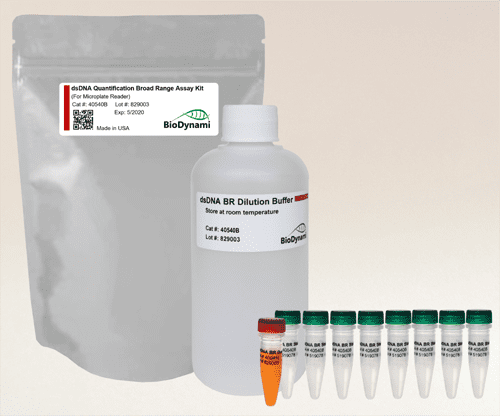
The dsDNA Quantification Broad Range Kit and dsDNA Quantification High Sensitivity Kit are developed for double stranded DNA quantification using microplate readers. The DNA Quantification BR kit includes BR Dye, BR Dilution Buffer, and BR DNA Standards. The DNA Quantification HS kit includes HS Dye, HS Dilution Buffer, and HS DNA Standards. Simply dilute the Dye with the Dilution Buffer, add DNA sample, then read the concentration using microplate reader. The BR assay is accurate in the linear range from 4 to 1000 ng and the HS assay is accurate in the linear range from 0.2 to 100 ng. Both kits are highly selective for double-stranded DNA over RNA.
The Quantification Kits have several advantages over traditional DNA quantitation such as sensitivity, stability, and tolerance of contaminants.
Both kits reduce the cost of DNA quantification by 60% as compared to other brands.
Selectivity and sensitivity of the kits
Save 60% of the costs.
The performance of the kit is nearly identical to that of Thermo Fisher’s kit (figure below).
Comparison of BioDynami dsDNA Quantification Broad Range Kit with Thermo Fisher kit.
Comparison of BioDynami dsDNA Quantification High Sensitivity Kit with Thermo Fisher kit.
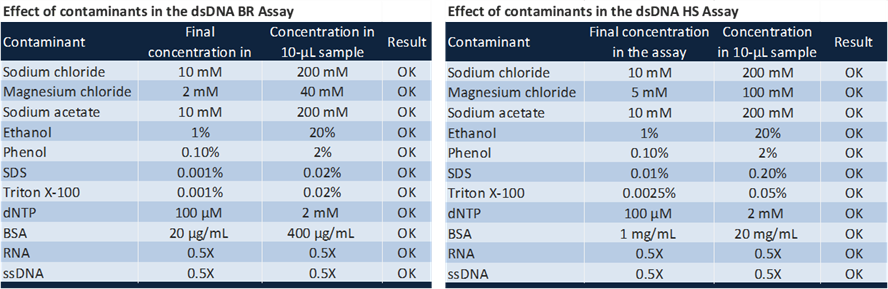
Common contaminants such as salts, free nucleotides, solvents, detergents, RNA, single stranded DNA, or protein are well tolerated in the assay (Table 1).
Nucleic acid testing (NAT) is the method of choice for detection and quantification of a wide range of micro organisms. Primerdesign manufactures and supplies high quality quantitative real-time PCR kits for the detection and simultaneous quantification of numerous significant pathogens . A copy number standard curve is provided for quantification and an the internal extraction template (DNA or RNA), controls for the quality of the nucleic acid extraction and eliminates false negative results.
The kit is designed with the broadest possible detection profile to ensure that all clinically relevant strains and subtypes are detected. Target sequences are selected by working with data from key opinion leaders in the field. Multiple sequence alignments and unprecedented real-time PCR expertise in design and validation ensure the best possible kit. Details of the target and priming specificity are included in the individual handbooks above.
Packaged, optimised and ready to use. Expect Better Data.
Document
Exceptional value for money Rapid detection of all clinically relevant subtypes Positive copy number standard curve for quantification Highly specific detection profile High priming efficiency Broad dynamic detection range (>6 logs) Sensitive to < 100 copies of target
Accurate controls to confirm findings
150 reactions
Simultaneous isolation of both host DNA and microbial DNA (universal protocol)
Fully compatible with Norgen’s Stool Nucleic Acid Collection and Transport Tubes
Eliminates PCR inhibitors including humic acids
High quality DNA for sensitive downstream applications including PCR, qPCR, Sequencing and microarray
96-Well and Magnetic Bead System formats also available
These kits provide a convenient and rapid method to isolate total DNA from fresh, frozen and preserved stool samples, including those preserved using Norgen’s Stool Nucleic Acid Collection and Preservation Tubes (Cat. 45660). The universal protocol conveniently allows for the isolation of total genomic DNA from all the various microorganisms and host cells found in the stool sample simultaneously. Purifies the DNA with high yields and molecular weights of up to 50 kb plus. The purified DNA can be used with a number of downstream applications.
Stool DNA Isolation Kit (Spin Column)
Universal method to detect microorganism and host cell DNA simultaneously in stool samples. Eliminates PCR inhibitors including all traces of humic acid using a combination of chemical and physical homogenization and lysis. A simple and rapid spin column procedure is then used to further purify the DNA. The purified DNA is of the highest quality and is fully compatible with all downstream applications such as PCR, qPCR, NGS and microarrays since all humic acid substances and other PCR inhibitors are removed during the isolation process.
Stool DNA Isolation 96-Well Kit (High Throughput)
Fast and easy high throughput processing using centrifugation. Eliminates PCR inhibitors including all traces of humic acid using a combination of chemical and physical homogenization and lysis. A simple and rapid spin column procedure is then used to further purify the DNA. The purified DNA is of the highest quality and is fully compatible with all downstream applications such as PCR, qPCR, NGS and microarrays since all humic acid substances and other PCR inhibitors are removed during the isolation process.
Stool DNA Isolation Kit (Magnetic Bead System)
Fast and easy processing using a magnetic bead system. Robust lysis system (chemical lysis combined with a mechanical homogenization).
Stool DNA Isolation 96-Well Kit (High Throughput Magnetic Bead System)
This kit provides fast and easy processing using a magnetic bead system, and a robust lysis system (chemical lysis combined with a mechanical homogenization). High throughput and compatible with an automation robotic system.
Free Download
Extracting Biological Insights from Stool
Tips and tricks for isolating high yield and quality DNA, RNA, miRNA and EV’s from fecal samplesDownload for Free
200 mg (fresh/frozen stool) or 400 μL (preserved stool)
Type of Stool Processed
Frozen, fresh or preserved stool
Format
Spin Column
Maximum Column Binding Capacity
50 μg
Maximum Column Loading Volume
650 μL
Elution Volume
50 μL
Time to Complete 10 Purifications
30 minutes
Applications
PCR, qPCR, Southern Blot Analysis, Sequencing, Microarray Analysis.
Storage Conditions and Product Stability All solutions should be kept tightly sealed and stored at room temperature. This kit is stable for 2 years after the date of shipment.
Mastitis is the single most costly disease of dairy cattle resulting in the reduction of milk yield and quality. The inflammation of the utter is mainly caused by infection of various bacteria. Streptococcus dysgalactiae, a Lancefield group C α-hemolytic gram-positive bacteria, is a common pathogen in subclinical and clinical mastitis causing substantial economic losses in dairy herds. Streptococcus dysgalactiae has been isolated from infected mammary glands and teat injuries and is transmitted primarily during milking. However, detection of S. dysgalactiae in other cow tissues such as tonsils, mouth and vagina, and occurrence of S. dysgalactiae mastitis during the non-lactating period in herds, suggests that the organism also behaves as an environmental pathogen.
Storage Conditions and Product Stability All kit components can be stored for 2 years after the date of production without showing any reduction in performance.
All kit components should be stored at -20°C upon arrival. Repeated thawing and freezing (> 2 x) of the Master Mix and Positive Control should be avoided, as this may affect the performance of the assay. If the reagents are to be used only intermittently, they should be frozen in aliquots.