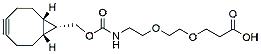
endo-BCN-PEG2-acid is a PEG linker containing a BCN group and a terminal carboxylic acid. The BCN group can react with azide-tagged biomolecules. The terminal carboxylic acid can react with primary amine groups in the presence of activators (e.g. EDC, or HATU) to form a stable amide bond. Reagent grade, for research purpose. Please contact us for GMP-grade inquiries.
Detail
endo-BCN-PEG2-acid is a PEG linker containing a BCN group and a terminal carboxylic acid. The BCN group can react with azide-tagged biomolecules. The terminal carboxylic acid can react with primary amine groups in the presence of activators (e.g. EDC, or HATU) to form a stable amide bond. Reagent grade, for research purpose. Please contact us for GMP-grade inquiries.
Other Products
Cat.# 20107S, 20107L: Size range 500-1000 bp
Product Info
Document
Product Info
The series of DNA Size Selection Kits (Magnetic Beads) were developed for DNA size selection using magnetic beads. A total of 11 kits are available, with different selection ranges spanning from 50 bp to over 10 kb. The kits provide a simple and quick approach for the enrichment of a specific range of DNA fragments. The kit workflow allows double-sided or single-sided size selection for specific size cutoffs.
Gel images of different ranges of size selection. Sheared human genomic DNA was used as input.
.
DNA size selection is a selective capture of DNA fragments of a specific range of size for next-generation sequencing (NGS) library preparations, PCR, ChIP assay, DNA ligations, endonuclease digestions, adapter removal, and other genomics and molecular biology applications. DNA size selection is preferred after NGS library prep in most of the cases. The NGS library preparation is related to the quality of the sequencing data. Precise NGS library size selection can increase sequencing efficiency, improve data quality, and reduce costs.
There are two types of sequencing technologies: short-read sequencing and long-read sequencing. Short-read sequencing uses DNA libraries that contain small insert DNA fragments of similar sizes, usually several hundred base pairs. The sequencing efficiency can be improved if the DNA size selection is in the right range. Cat.# 20104S and 20104L are the best kits for NGS library size selection of illumina paired-end 100 (PE100) sequencing with 100-200 bp library inserts; Cat.# 20105S and 20105L are the best kits for NGS library size selection of illumina paired-end 150 (PE150) sequencing with 150-300 bp library inserts; and Cat.# 20106S and 20106L are the best kits for NGS library size selection of illumina paired-end 300 (PE300) sequencing with 300-600 bp library inserts.
Long-read sequencing uses a large DNA fragment as input and makes very long reads. Usually, library size selection is preferred to remove smaller fragments. Cat.# 20110S and 20110L are the best kits for long-read sequencing size selection with DNA sizes >5 kb, and Cat.# 20111S and 20111L are the best kits for long-read sequencing size selection with DNA sizes >10 kb.
The magnetic beads technology uses paramagnetic particles, also known as SPRI (Solid Phase Reversible Immobilization) beads, to bind DNA reversibly and selectively. DNA fragments can be size-selected and purified by changing the properties of the magnetic beads or SPRI beads. The magnetic beads can easily separate the beads-binding DNA from the contaminants and unwanted components in the samples. The samples after DNA size selection are free of contaminants such as buffer components, enzymes, proteins, salts, dNTPs, primers, and adapters. Our proprietary magnetic beads reagents improve yield, selectivity, and reproducibility.
Specific DNA fragments at a certain length range can be purified simply using magnetic separation with different beads components, avoiding tedious and time-consuming gel extraction and column-based purification. The magnetic beads method is popular for common DNA size selection, including library size selection. The first beads-binding step, referred to as the right-side clean-up, removes large DNA fragments. The large DNA fragments are bound to the beads and are discarded. The desired DNA fragments in the supernatant are transferred to a new well, and new beads are added to the supernatant for the second beads-binding, referred to as the left-side clean-up. The double-size selected DNA fragments are eluted after ethanol rinsing.
DNA size selection with dual clean-ups.
.
A single clean-up is needed for DNA size selection with large fragments. In this case, only the large DNA fragments are bound to the beads. The selected larger DNA fragments are eluted after ethanol rinsing.
DNA size selection with single clean-up for >5 kb and >10 kb DNA.
.
Features of DNA size selection and library size selection
High specificity and high recovery of size selection
11 selection ranges are available, including 5 ranges for NGS library size selection
50-100 bp
100-200 bp
200-500 bp
250-350 bp: ideal for illumina PE100 sequencing
300-450 bp: ideal for illumina PE150 sequencing
450-750 bp: ideal for illumina PE300 sequencing
500-1000 bp
1-3 kb
1-5 kb
>5 kb: ideal for long-read sequencing
>10 kb: ideal for long-read sequencing
Fast and simple
20-min protocol
No gel purification required
No columns required
No centrifugation required
Efficient removal of contaminants and unwanted components
Produced by reverse osmosis, ion-exchange, electro-deionization, ultrafiltration, UV treatment (UVC & 185 nm), 0.1 μm membrane filtration
Nuclease-free, protease-free, endotoxin-free
Suitable for molecular biology applications (qPCR, NGS etc.)
Suitable for cell culture applications
Produced in an ISO certified GMP laboratory
Water system is routinely monitored for compliance with QC standards
The Norgen water purification system has been designed in conjunction with experts from Millipore Sigma. The Ultrapure NFW is purified in a two-stage process. The first stage, to produce type II water, includes pre-treatment with activated charcoal and polyphosphate, this water then undergoes reverse osmosis, electro-deionization and ion exchange to remove contaminants as well as UV treatment for disinfection. The Pure water then flows to a second system in a clean room with an additional 4 layers of purification. After passing through an additional ion exchange column, the water is then subjected to Ultrafiltration to remove particulates, bacteria, & ionic contaminants down to trace level, the water is then treated with UV light (182 nm wavelength) to break down organic matter. Lastly a second Ultrafilter for the production of pyrogen-, nuclease- and bacteria-free water at 18.2 MΩ. This water is of utmost purity and suitable for direct use in molecular biology applications such as qPCR and NGS, as well as cell culture and other applications.
Product Specifications
pH
n/a (highly pure water does not contain enough ions for an exact pH determination.)
Recommended Storage
Room Temperature
Grade
Ultrapure (ASTM Type I)
Biological Activity
DNase-, RNase-, Protease-, Endotoxin- Free
TOCs
< 50 ppb
Resistivity
> 18 MΩ-cm
Treatment
Not DEPC-Treated
Quantity
100 mL, 500 mL, 1000 mL
Purification Methods
Activated charcoal, polyphosphate, reverse osmosis, electro-deionization, ion exchange, UV, ultrafiltration
Shipping Conditions
Room Temperature
Details
Applications For use in any molecular biology application
Storage Conditions Norgen’s Nuclease-Free Water should be stored at room temperature. Storage at +4°C or -20°C is optional.
Precautions and Disclaimers This product is designed for research purposes only. It is not intended for human or diagnostic use.
HiPure FFPE RNA Kit supplies a simple and rapid RNA extraction for Formalin-fixed, paraffin-embedded (FFPE) tissue and sections samples. This kit is based on silica gel column purification technology, no phenol-chloroform extraction or alcohol precipitation. The whole extraction only takes 30 minutes (not including digestion time). RNA can be directly used for downstream applications such as RT-PCR, Northern blot, vitro translation and other experiments.
Details
Specifications
Features
Specifications
Main Functions
Isolation total RNA from FFPE tissue and section samples (with DNase)
Applications
RT-PCR, quantitative RT-PCR, Northern hybridization, Poly A purification, nucleic acid protection and in vitro translation
Purification method
Mini spin column
Purification technology
Silica technology, DNase
Process method
Manual (centrifugation or vacuum)
Sample type
FFPE tissue sample
Sample amount
6mg
Yield
20μg
Elution volume
≥10μl
Time per run
≤60 minutes
Liquid carrying volume per column
800µl
Binding yield of column
100µg
Principle
This product is based on silica column purification. Remove paraffin by Buffer DPS. Sample lysis with proteinase K digestion requires only 15 minutes. After lysis, samples are incubated at 80ºC for 15 minutes. Transfer to an adsorption column and RNA is adsorbed on the membrane, while protein is not adsorbed and is removed with filtration. After washing proteins and other impurities, RNA was finally eluted with low-salt buffer.
Advantages
High quality – high purity total RNA can be directly used in various sensitive downstream applications
Fast – several samples can be extracted in 60 minutes by column method
Safe – no phenol chloroform extraction required
Sensitive – RNA can be recovered at the level of PG
Efficient DNA removal – unique method to effectively remove genomic DNA
Kit Contents
Contents
R414402
D414403
Purification Times
50 Preps
250 Preps
HiPure RNA Micro Columns
50
250
2ml Collection Tubes
50
250
Buffer DPS
60 ml
250 ml
Buffer FRL
15 ml
60 ml
Buffer RLC
15 ml
60 ml
Buffer RWC*
10 ml
50 ml
Buffer RW2*
20 ml
2 x 50 ml
DNase I
600 µl
5 x 600 µl
DNase Booster Buffer
1.5 ml
6 ml
Protease Dissolve Buffer
1.8 ml
10 ml
Proteinase K
24 mg
120 mg
RNase Free Water
10 ml
20 ml
Storage and Stability
Proteinase K should be stored at 2–8°C upon arrival. DNase I should be stored at -20°C. However, short-term storage (DNase I up to 1 weeks, Proteinase K up to 8 weeks) at room temperature (15–25°C) does not affect their performance. The remaining kit components can be stored at room temperature (15–25°C) and are stable for at least 18 months under these conditions.
Experiment Data
Document
HiPure FFPE RNA Kit supplies a simple and rapid RNA extraction for Formalin-fixed, paraffin-embedded (FFPE) tissue and sections samples. This kit is based on silica gel column purification technology, no phenol-chloroform extraction or alcohol precipitation. The whole extraction only takes 30 minutes (not including digestion time). RNA can be directly used for downstream applications such as RT-PCR, Northern blot, vitro translation and other experiments.