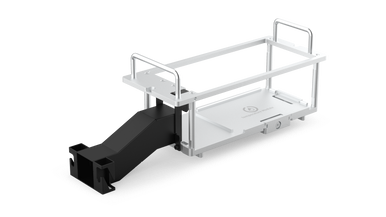
Flex Temperature Module Caddy and Calibration Adapter
Facebook
X
Pinterest
Email
The Flex caddy allows the Temperature Module GEN2 to be installed on the Opentrons Flex deck and sit below the deck, enabling below-deck cable routing and labware placed on top of modules to remain closer to the deck surface. The calibration adapter is used to calibrate the location of the Temperature Module. Caddies and calibration adapters are specific to the type of module.
Note: This item does not include the Temperature Module. The module is available with or without the Flex Caddy and Calibration tool: Temperature Module GEN2
Detail
The Flex caddy allows the Temperature Module GEN2 to be installed on the Opentrons Flex deck and sit below the deck, enabling below-deck cable routing and labware placed on top of modules to remain closer to the deck surface. The calibration adapter is used to calibrate the location of the Temperature Module. Caddies and calibration adapters are specific to the type of module.
Note: This item does not include the Temperature Module. The module is available with or without the Flex Caddy and Calibration tool: Temperature Module GEN2
Other Products
Propargyl-PEG3-acid
Product Info
Document
Product Info
Propargyl-PEG3-acid is a reagent with an alkyne group and a carboxylic acid. The terminal carboxylic acid can form amide bond with primary amines (activation is needed). The alkyne can form triazole linkage with azide containing molecules via copper catalyzed reactions. Reagent grade, for research purpose. Please contact us for GMP-grade inquiries.
Document
Propargyl-PEG3-acid is a reagent with an alkyne group and a carboxylic acid. The terminal carboxylic acid can form amide bond with primary amines (activation is needed). The alkyne can form triazole linkage with azide containing molecules via copper catalyzed reactions. Reagent grade, for research purpose. Please contact us for GMP-grade inquiries.
NGS Library Quantification Standards With PCR Primers (Ion Torrent Platform)
Product Info
Document
Product Info
The NGS Library Quantification Standards with PCR Primers (for Ion Torrent platform) were developed for quantifying the library concentration for ion torrent sequencing platform. Quantification of the library of the fully ligated libraries is important for the quality of the sequencing outcome. Optimal library concentration can increase sequencing yield. Poor library concentration results in bad emPCR, which can lead to low sequencing capacity.
QPCR is the best method for library quantification. Our reagent only amplifies library molecules that will be used for subsequent emPCR, and is optimized for amplification of various samples. Our reagent is compatible with commercial SYBR Green based QPCR reagents. Quantification of library concentration is achieved by comparison with a standard curve generated from DNA Standards.
The kit comprises DNA Standards (six 10-fold dilutions) and a primer mix.
NGS Library Quantification Standards with PCR Primers (Ion Torrent platform): real time quantitative PCR curve of the standards.
Document
The NGS Library Quantification Standards with PCR Primers (for Ion Torrent platform) were developed for quantifying the library concentration for ion torrent sequencing platform. Quantification of the library of the fully ligated libraries is important for the quality of the sequencing outcome. Optimal library concentration can increase sequencing yield. Poor library concentration results in bad emPCR, which can lead to low sequencing capacity.
Bis-propargyl-PEG13 comprises two propargyl groups which can form triazole linkages with azide-bearing compounds or biomolecules in copper catalyzed Click Chemistry reactions. The hydrophilic PEG units help improve the solubility of the molecule in aqueous media. Reagent grade, for research purpose. Please contact us for GMP-grade inquiries.
Document
Bis-propargyl-PEG13 comprises two propargyl groups which can form triazole linkages with azide-bearing compounds or biomolecules in copper catalyzed Click Chemistry reactions. The hydrophilic PEG units help improve the solubility of the molecule in aqueous media. Reagent grade, for research purpose. Please contact us for GMP-grade inquiries.