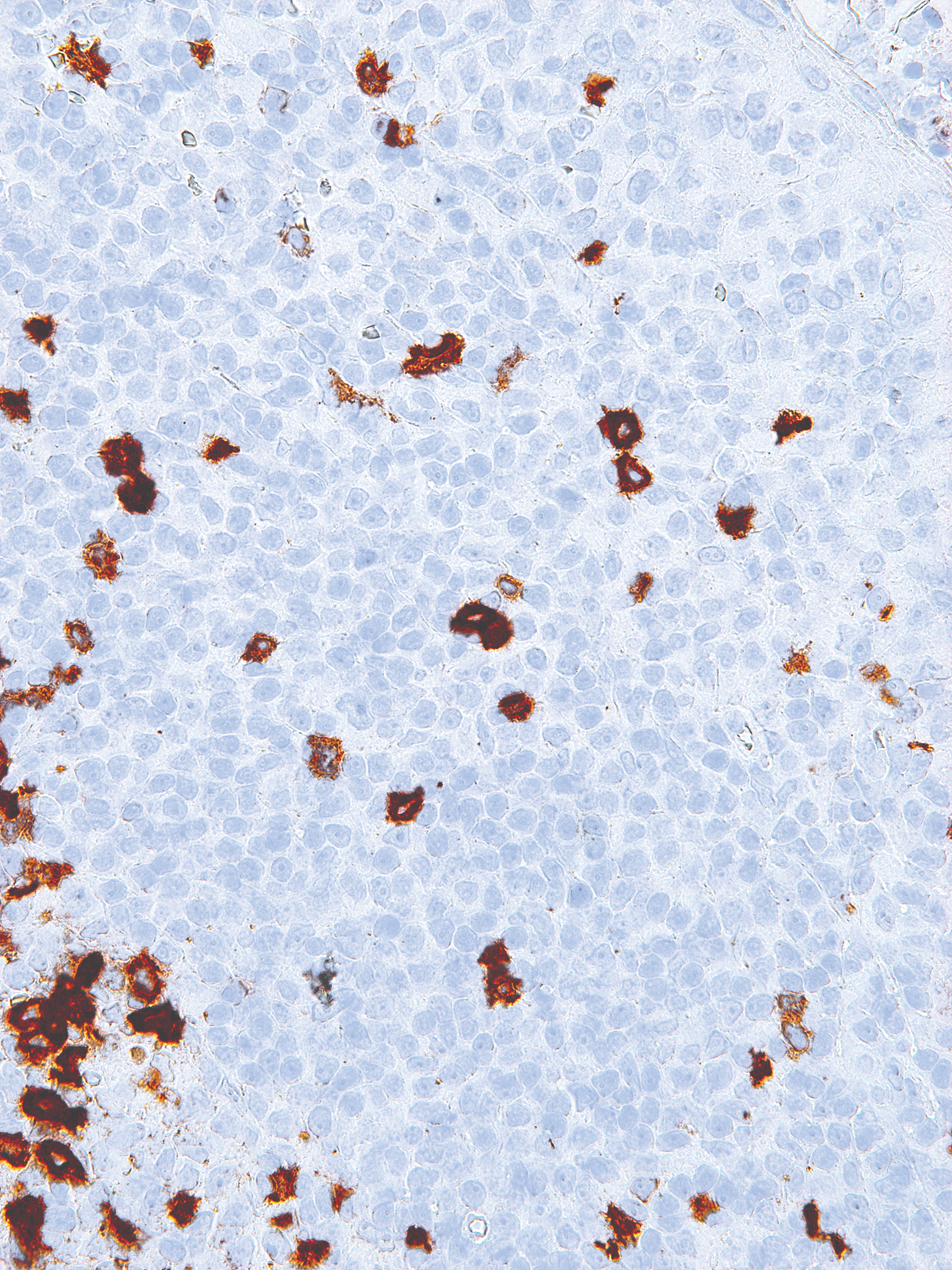
Cluster of differentiation 57 (CD57), also known as NK-1, is an antigen detectable in natural killer cells, some T-lymphocytes and normal peripheral blood mononuclear cells, myeloid cells, and a variety of polypeptides, lipids, and chondroitin sulfate proteoglycans. CD57 is indicated as a marker for tumors of neuroendocrine origin, including pheochromocytomas, paragangliomas, carcinoid tumor, and medulloblastomas, as well as various neural tumors including neuromas, neurofibromas, schwannomas, and granular cell tumors. CD57 is also detectable in ganglioneuroma and prostate carcinoma. Anti-CD57 is used to distinguish nodular lymphocyte-predominant Hodgkin’s lymphoma from T-cell/histiocyte-rich large B-cell lymphoma, nodular sclerosis Hodgkin’s disease, and follicular lymphoma.
Norgen’s EXTRAClean Urine Cell-Free Circulating RNA Purification Kits provide a fast, reliable, reproducible, and simple procedure for isolating circulating RNA and exosomal RNA from various urine inputs ranging from 250 μL and up to 30 mL. The purified RNA is of the highest integrity, and can be used in a number of downstream applications including real-time PCR, reverse transcription PCR, Northern blotting, RNase protection and primer extensions, and expression array assays.
EXTRAClean Cell-Free Circulating RNA Purification Mini Kit:
For sample volumes ranging from 250 μL to 2 mL
EXTRAClean Cell-Free Circulating RNA Purification Midi Kit:
For sample volumes ranging from 2mL to 10mL. The first column will handle the large volume input of urine that is followed by a concentration on a mini column for a final elution of 50 μL to 100 μL
EXTRAClean Cell-Free Circulating RNA Purification Maxi Kit:
For sample volumes ranging from 10 mL to 30 mL. The first column will handle the large volume input of urine that is followed by a concentration on a mini column for a final elution of 50 μL to 100 μL.
Figure 1 / 3
Click for expanded view
| Kit Specifications | |
|---|---|
| Sample Type | Fresh or frozen urine |
| Sample Volume Range | 250 μL to 2mL |
| Minimum Elution Volume | 50 μL |
| Maximum Elution Volume | 100 μL |
| Time to Complete 10 Purifications | 25–30 minutes |
| Size of RNA Purified | All sizes, including miRNA and small RNA (< 200 nt) |
| Average Yields ¥ | Variable depending on specimen |
¥Please check page 5 of protocol for average urine yields and common RNA quantification methods.
All buffers should be kept tightly sealed and stored at room temperature. These kits are stable for 2 years after the date of shipment. It is recommended to warm Lysis Buffer A for 20 minutes at 60°C if any salt precipitation is observed.
| Component | Mini (Cat. 72900) | Midi (Cat. 72910) | Maxi (Cat. 72920) |
|---|---|---|---|
| Binding Solution K | 25 mL | 75 mL | 1 x 75 mL 1 x 25 mL |
| Lysis Buffer A | 30 mL | 20 mL | 20 mL |
| Wash Solution A | 18 mL | 18 mL | 18 mL |
| Elution Solution A | 6 mL | 6 mL | 6 mL |
| Collection Tubes | 50 | 20 | 10 |
| Elution Tubes (1.7 mL) | 50 | 20 | 10 |
| EXTRAClean Mini Spin Columns | 50 | 20 | 10 |
| EXTRAClean Midi Spin Columns | – | 20 | – |
| EXTRAClean Maxi Spin Columns | – | – | 10 |
| Product Insert | 1 | 1 | 1 |
Parvovirus B19 was the first known human virus in the family of Parvoviruses. B19 is a non-enveloped, icosahedral virus that contains a single-stranded linear DNA genome. It is classified as an erythrovirus because of its capability to invade red blood cell precursors in the bone marrow. B19 virus causes a childhood rash called fifth disease or erythema infectiosum which is commonly called “slapped cheek” syndrome due to the appearance of erythema across the cheeks. The virus is primarily spread by infected respiratory droplets, but some cases of blood-borne transmission have been reported. Parvovirus infection in pregnant women is associated with hydrops fetalis due to severe fetal anemia, sometimes leading to miscarriage or stillbirth. The risk of fetal loss is about 10% if infection occurs before week 20 of pregnancy. There is also some evidence that intrauterine Parvovirus B19 infection leads to developmental abnormalities in childhood. Due to the serious nature of the virus, methods for its rapid diagnosis are desirable.
Parvo B19 TaqMan PCR Kit, 100 reactions
Parvo B19 TaqMan PCR Probe/Primer Set and Controls, 100 reactions
Figure 1 / 3
Click for expanded view
Storage Conditions and Product Stability
All kit components can be stored for 2 years after the date of production without showing any reduction in performance.
All kit components should be stored at -20°C upon arrival. Repeated thawing and freezing (> 2 x) of the Master Mix and Positive Control should be avoided, as this may affect the performance of the assay. If the reagents are to be used only intermittently, they should be frozen in aliquots.
| Component | Cat. TM39650 (100 preps) | Cat. TM39610 (100 preps) |
|---|---|---|
| MDx TaqMan 2X PCR Master Mix | 2 x 700 μL | – |
| Parvovirus B19 Primer & Probe Mix | 280 μL | 280 μL |
| Parvovirus B19 Positive Control | 150 μL | 150 μL |
| Nuclease-Free Water (Negative Control) | 1.25 mL | 1.25 mL |
| Product Insert | 1 | 1 |
Usages:
For differentiation of enterobacteriaceae.
Principle:
Peptone, beef extract powder and yeast extract powder provide nitrogen, vitamins, minerals; lactose, dextrose into fermentable sugars, which produce acid when measured by the phenol red indicator, acid yellow, basic red; thiosulfate sodium can be reduced to some bacteria to hydrogen sulfide, to produce a black iron sulfide and iron salts; sodium chloride to maintain osmotic equilibrium; agar as medium coagulant.
Formulation(per liter):
Peptone 20g
Beef extract powder 3g
Yeast extract powder 3g
Lactose 10g
Dextrose 1g
Sodium chloride 5g
Ferric ammonium citrate 0.5g
Sodium thiosulfate 0.5g
Agar 12g
Phenol red 0.05g
Final pH 7.4 ± 0.2
How to use:
1.Suspend 54.5g in 1L of distilled water , stirring heated to boiling ,autoclave at 121 for 15 minutes.
2.Diluted and treated samples.
Quality control:
| Item | The name and number of strain | Growth | Colony Color |
| 1 | Escherichia coli ATCC25922 | Good | A/A |
| 2 | Proteus CMCC (B) 49027 | Good | K/A |
| 3 | Salmonella typhimurium CMCC (B) 50115 | Good | K/A |
“A”Acid , “K” Alkality
Storage: Keep container tightly closed, store in a cool, dry place, away from bright light. Storage period of 3 years.
500g