
Description
Specifications
| Clone | IHC583 |
| Source | Mouse Monoclonal |
| Positive Control | Breast Carcinoma, Urothelial Carcinoma |
| Dilution Range | 1:200 |

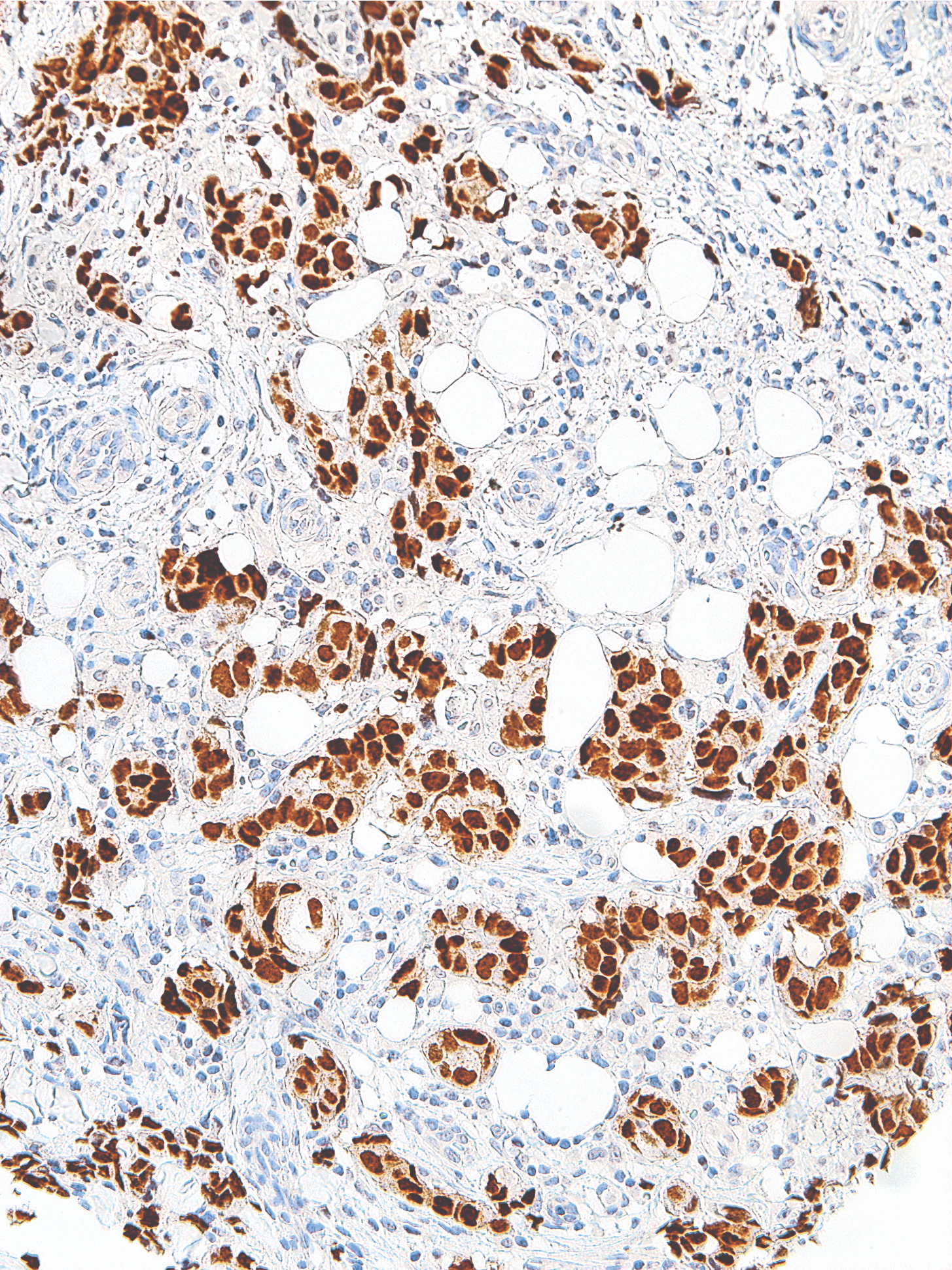
| Clone | IHC583 |
| Source | Mouse Monoclonal |
| Positive Control | Breast Carcinoma, Urothelial Carcinoma |
| Dilution Range | 1:200 |

Peelable heat sealing foil which is suitable for low temperature storage, high temperature uses and PCR.

Dde Biotin-PEG4-alkyne is useful for introducing a biotin moiety to azide-containing molecules using Cu(I)-catalyzed Click Chemistry. The hydrophilic spacer arm provides better solubility to the labeled molecules in aqueous media. Dde protecting group allows efficient release of captured biotinylated molecules from streptavidin under mild conditions with hydrazine. Reagent grade, for research purpose. Please contact us for GMP-grade inquiries.

Dde Biotin-PEG4-alkyne is useful for introducing a biotin moiety to azide-containing molecules using Cu(I)-catalyzed Click Chemistry. The hydrophilic spacer arm provides better solubility to the labeled molecules in aqueous media. Dde protecting group allows efficient release of captured biotinylated molecules from streptavidin under mild conditions with hydrazine. Reagent grade, for research purpose. Please contact us for GMP-grade inquiries.

Bioprocessing with Salt Active Nucleases – High Salt Conditions
For SAN HQ, SAN HQ ELISA Kit, and now SAN HQ GMP
SAN HQ GMP is biochemically identical to SAN HQ but produced under GMP conditions.
Salt Active Nuclease High Quality (SAN HQ) is a Bioprocessing Grade nuclease developed as the most efficient solution for removal of both single and double stranded DNA and RNA at high salt conditions.
This nonspecific endonuclease has peak activity at salt concentrations between 400 – 700 mM (Fig. 1)
Non-enveloped viruses like Adenoviruses and Adeno-Associated Viruses (AAV’s) are inherently more robust with two distinct advantages: 1) They exhibit higher tolerance to additives like salt and detergents and 2) their production often involves the lysis of host cells, allowing for harvesting non-secreted vectors.
For Adeno-Associated Viruses (AAVs), which are often harvested from crude cell lysate, the high salt tolerance of SAN HQ is particularly beneficial. Salt is typically added to such lysates to reduce viral aggregation, facilitating more effective nuclease action to digest residual DNA.
SAN HQ’s is engineered for optimum activity in these high salt environments ensuring that you achieve unparalleled DNA removal without compromising the integrity of these robust viral vectors.
In bioprocessing, the primary role of a nuclease is to efficiently digest and fragment host-cell DNA into sufficiently small pieces, facilitating its removal during downstream processing. While most nucleases can effectively degrade naked DNA into tiny fragments under optimal conditions—as demonstrated by M-SAN HQ and SAN HQ, which can digest dsDNA into fragments smaller than 6 nt—the reality in bioprocessing is more complex. (See fig. 5)
The DNA targeted for removal often exists as chromatin, embedded in a complex matrix containing remnants of the lysed host cell as well as large amounts of the therapeutic product.The product may or may not have an affinity for the chromatin you aim to remove.
High salt is often applied to mitigate issues like aggregation. The real challenge lies in a nuclease’s ability to efficiently fragment chromatin under these more complicated, high-salt, conditions—not merely degrading naked DNA under ideal circumstances.
SAN HQ ELISA kit is developed for the detection and quantification of SAN HQ and SAN HQ GMP. The kit is designed as a classical sandwich ELISA, with two monoclonal antibodies specific towards SAN HQ nuclease (fig 6).
For SAN HQ, SAN HQ ELISA Kit, and now SAN HQ GMP
SAN HQ GMP is biochemically identical to SAN HQ but produced under GMP conditions.