
Description
Specifications
| Clone | IHC053 |
| Source | Mouse Monoclonal |
| Positive Control | Colon Carcinoma |
| Dilution Range | 1:200 |
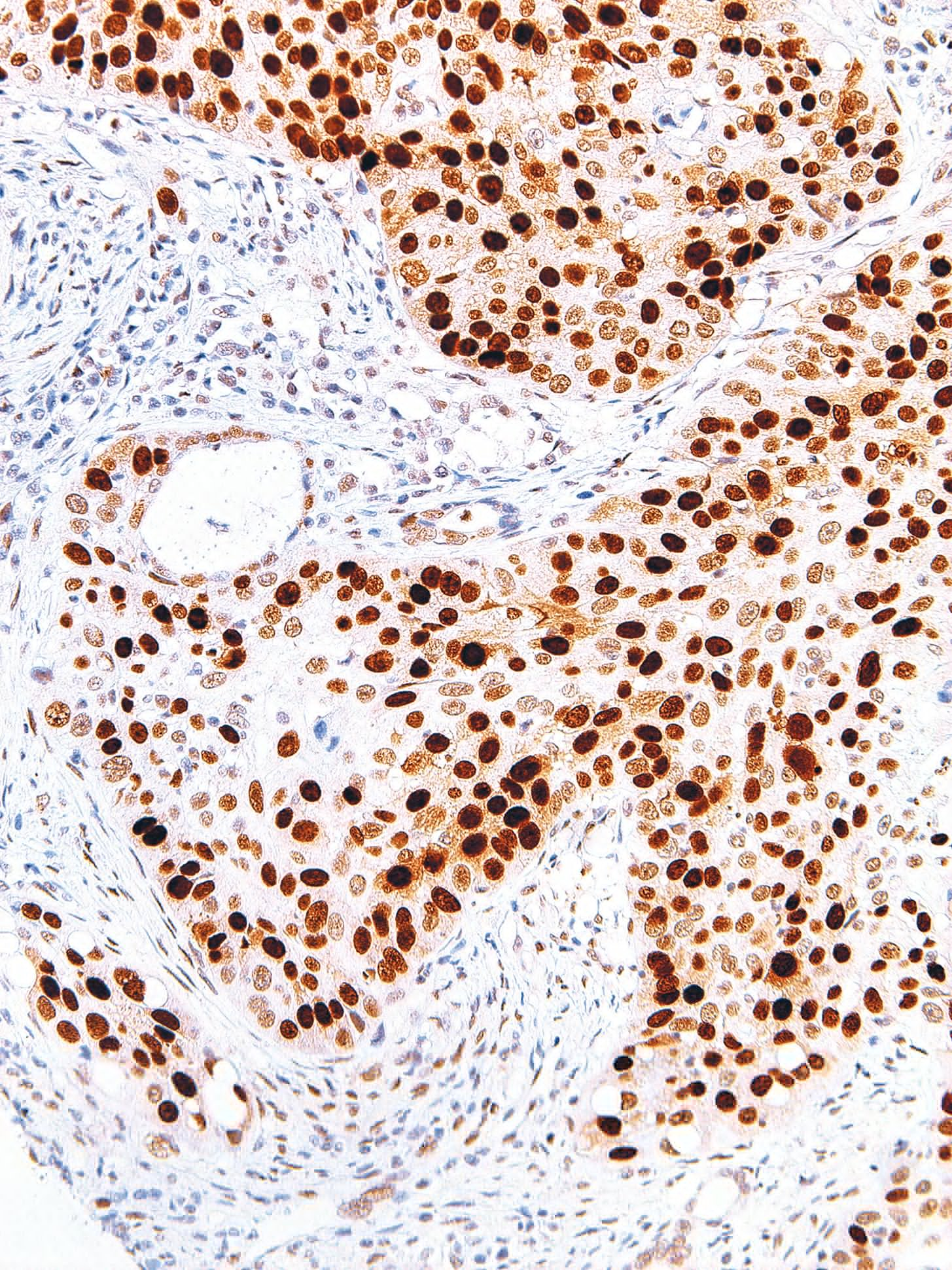
p53, also known as tumor protein 53 or TP53, is a tumor suppressor and transcription factor that functions in a number of anti-cancer activities including DNA repair, cell-cycle arrest, and apoptosis in response to DNA damage or other stressors. Mutations in p53 are linked to a number of malignant tumors, including those of the breast, ovarian, bladder, colon, lung, and melanoma. Anti-p53 staining has been used to detect intratubular germ cell neoplasia, and also to distinguish between uterine serous carcinoma and endometrioid carcinoma.

| Clone | IHC053 |
| Source | Mouse Monoclonal |
| Positive Control | Colon Carcinoma |
| Dilution Range | 1:200 |
Propargyl-PEG14-t-butyl ester consists of a propargyl group and a t-butyl protected carboxyl group. The propargyl group can be used in copper catalyzed Click Chemistry to yield a stable triazole linkage with azides. The t-butyl group can be hydrolyzed in acidic conditions. The hydrophilic PEG units help the molecule to have better solubility in aqueous environment. Reagent grade, for research purpose. Please contact us for GMP-grade inquiries.
K-AVCHO
SKU: 700004267
100 Assays of each per kit
| Content: | 100 assays of each per kit |
| Shipping Temperature: | Ambient |
| Storage Temperature: | Short term stability: 2-8oC, Long term stability: See individual component labels |
| Stability: | > 2 years under recommended storage conditions |
| Analyte: | Available Carbohydrates, Dietary Fiber |
| Assay Format: | Spectrophotometer |
| Detection Method: | Absorbance |
| Wavelength (nm): | 340 |
| Signal Response: | Increase |
| Linear Range: | 4 to 80 μg of D-glucose, D-fructose or D-galactose per assay |
| Limit of Detection: | 1.475 g/100 g |
| Reaction Time (min): | ~ 5 h |
| Application examples: | Food ingredients, food products and other materials. |
| Method recognition: | AOAC Method 2020.07 |
The Available Carbohydrates Assay Kit method is suitable for the determination of available carbohydrates (AVCHO) comprising *total digestible starch (TDS) plus maltodextrins, sucrose, D-glucose, D-fructose and lactose. New Improved method receiving ‘First Action’ status: AOAC 2020.07. This method is designed to simulate in vivo conditions in the human small intestine (i.e. a 4 h incubation time with PAA + AMG) in parallel with recent advances in Dietary Fiber (DF) methodology (K-RINTDF: AOAC Method 2017.16) and in accordance with the new (physiological based) definition of DF announced by Codex Alimentarius in 2009. Also, sucrose is hydrolysed with a specific “sucrase” enzyme which (unlike invertase which has been used traditionally for this reaction) has no action on fructo-oligosaccharides (FOS).
* Total digestible starch (TDS) is defined as starch that is digested in a 4 h period and is part of the carbohydrate that is available for digestion and absorption in the human small intestine.
See our full range of dietary fiber assay kits.
The Available Carbohydrates Assay Kit method is suitable for the determination of available carbohydrates (AVCHO) comprising *total digestible starch (TDS) plus maltodextrins, sucrose, D-glucose, D-fructose and lactose. New Improved method receiving ‘First Action’ status: AOAC 2020.07. This method is designed to simulate in vivo conditions in the human small intestine (i.e. a 4 h incubation time with PAA + AMG) in parallel with recent advances in Dietary Fiber (DF) methodology (K-RINTDF: AOAC Method 2017.16) and in accordance with the new (physiological based) definition of DF announced by Codex Alimentarius in 2009. Also, sucrose is hydrolysed with a specific “sucrase” enzyme which (unlike invertase which has been used traditionally for this reaction) has no action on fructo-oligosaccharides (FOS).