
Description
Specifications
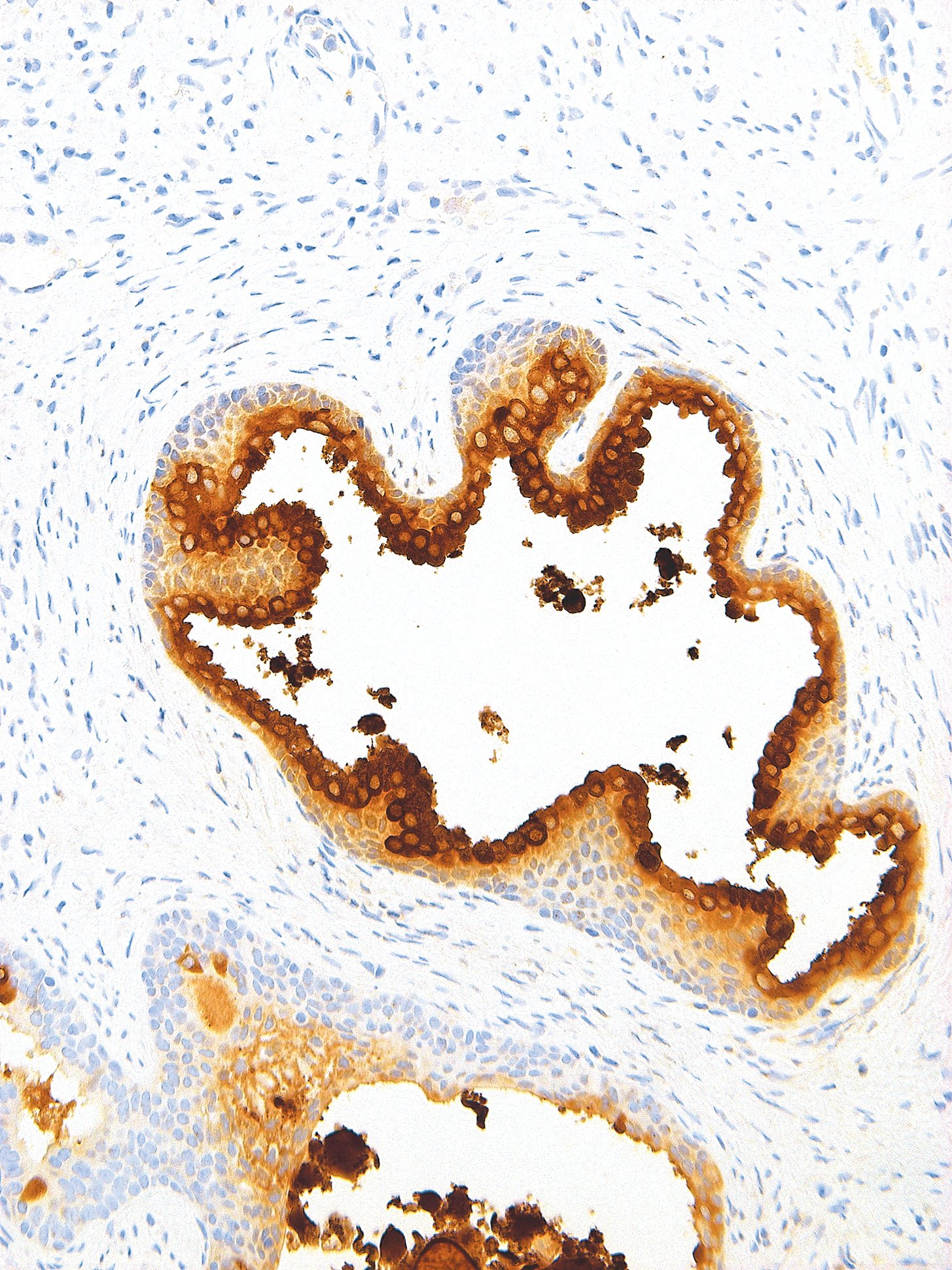
| Clone | IHC654 |
| Source | Mouse Monoclonal |
| Positive Control | Prostate, Prostate Carcinoma |
| Dilution Range | 1:200 |

| Clone | IHC654 |
| Source | Mouse Monoclonal |
| Positive Control | Prostate, Prostate Carcinoma |
| Dilution Range | 1:200 |

Alkyne-PEG2-iodide is a crosslinker containing a propargyl group and an iodine group. The propargyl group can form triazole linkage with azide-bearing compounds or biomolecules via copper catalyzed Click Chemistry reactions. Iodine (I) is a very good leaving group for nucleophilic substitution reactions. The hydrophilic PEG spacer increases solubility in aqueous media. Reagent grade, for research use only.

Alkyne-PEG2-iodide is a crosslinker containing a propargyl group and an iodine group. The propargyl group can form triazole linkage with azide-bearing compounds or biomolecules via copper catalyzed Click Chemistry reactions. Iodine (I) is a very good leaving group for nucleophilic substitution reactions. The hydrophilic PEG spacer increases solubility in aqueous media. Reagent grade, for research use only.


Magen’s HiPure columns are prepared by high quality glass fiber filter membrane as raw materials through membrane cutting, membrane release, ring release, ring pressing, gland, weighing and other processes. HiPure nucleic acid adsorption columns have the characteristics of long-term stability and high binding capacity. Experiments show that the highest binding capacity and binding efficiency of HiPure nucleic acid adsorption columns are basically unchanged when stored at room temperature for 4 years.
The series of nucleic acid columns produced by Magen Biotech are based on carefully selected imported glass fiber membranes (GF/B, GF/D, GF/F). Columns production processes such as polypropylene injection molding materials, injection molding process, and downstream membrane packing and compression rings are strictly controlled. This is to ensure that the column has extremely high adsorption capacity and long-term stability. Compared with conventional products on the market, Magen’s columns are with varieties, and binding rate will not change when stored at room temperature for 4 years.
Specifications
| Features | Specifications |
| Recommended application | gDNA and RNA Isolation |
| Preservation conditions | Room temperature |
| Stability | Up to 4 years |
| Filter membrane | High quality glass fiber filter GF/B, 2 layers |
| Membrane aperture | 1.0μm |
| Maximum binding yield of plasmid | 30 μg |
| Maximum yield of alcohol mediated Binding | 100 μg |
| Single liquid carrying capacity of column | 900 μl |
| Minimum elution volume | 80 μl |
| Withstand centrifugal force | 4,000-5,000 x g |
| Centrifuge | Low speed centrifuge, Swing out Rotor, can placed a height of 6.5cm square, (height of HiPure DNA Plate & 1.6ml Collection Plate: height, 6.2cm) |
Adsorption Mechanism
Based on the negatively charged DNA skeleton, it has a high affinity for positively charged glass fibers. In high salt and ethanol solutions, DNA/RNA binds to glass fiber and interacts with hydrophilic matrix on silica through hydrogen bond. DNA/RNA is tightly bound. All pollutants can be removed by washing solution. At high salt concentration, nucleic acids selectively bind to silica gel membrane, while other pollutants, mainly proteins, are removed by membrane washing.
Ordering information
| CAT.No. | Product Name | Package |
| C13131 | HiPure gDNA Plate (2 x GF/B)with 1.6ml Collection Plate | 10/Bag |
| Item No. | Product Name | Membrane type/number of layers | Collection tubes | Plasmid DNA binding capacity (Physical adsorption) | gDNA/RNA binding capacity (Alcohol-mediated adsorption) | Minimum Elution volume | Liquid volume capacity |
| C13010 | HiPure DNA Nano Column | 2 layers GF/F | 2ml without cap | 5μg | 20μg | 10μl | 700μl |
| C13011 | HiPure DNA Micro Column | 3 layers GF/F | 2ml without cap | 10μg | 50μg | 15μl | 700μl |
| C13100 | HiPure DNA Mini Column I | 2 layers GF/B | 2ml without cap | 15μg | 100μg | 30μl | 700μl |
| C13110 | HiPure DNA Mini Column II | 4 layers GF/B | 2ml without cap | 35μg | 200μg | 50μl | 800μl |
| C13111 | HiPure RNA Mini Column | 3 layers GF/B | 2ml without cap | 30μg | 200μg | 30μl | 800μl |
| C13112 | HiPure Viral Mini Column | 3 layers GF/F | 2ml without cap | 30μg | 200μg | 30μl | 800μl |
| C13113 | HiPure CFDNA Mini Column | 3 layers GF/F,1 layer GF/B | 2ml without cap | 30μg | 200μg | 30μl | 800μl |
| C13120 | HiPure DNA Midi Column | 4 layers GF/B | 15ml Centrifuge tube | 125μg | 1mg | 500μl | 4ml |
| C13121 | HiPure DNA Midi Column III | 8 layers GF/B | 15ml Centrifuge tube | 250μg | 1mg | 500μl | 4ml |
| C13122 | HiPure DNA Maxi Column | 4 layers GF/B | 50ml Centrifuge tube | 500μg | 5mg | 1000μl | 20ml |
| C13123 | HiPure DNA Maxi Column III | 8 layers GF/B | 50ml Centrifuge tube | 1mg | 5mg | 1000μl | 20ml |
| C13124 | HiPure DNA Maxi Column C | 8 layers GF/B | 50ml high speed Centrifuge tube | 1mg | 5mg | 700μl | 12ml |
| C13130 | HiPure DNA Plate | 2 layers GF/F | 1.6ml Plate | 30μg | 100μg | 80μl | 900μl |
| C13131 | HiPure gDNA Plate | 2 layers GF/B | 1.6ml Plate | 30μg | 100μg | 80μl | 900μl |
Note: GF/B pore size is for 1.0μM glass fiber membrane; GF/F pore size is for 0.7μm glass fiber membrane.
Magen’s HiPure columns are prepared by high quality glass fiber filter membrane as raw materials through membrane cutting, membrane release, ring release, ring pressing, gland, weighing and other processes. HiPure nucleic acid adsorption columns have the characteristics of long-term stability and high binding capacity. Experiments show that the highest binding capacity and binding efficiency of HiPure nucleic acid adsorption columns are basically unchanged when stored at room temperature for 4 years.