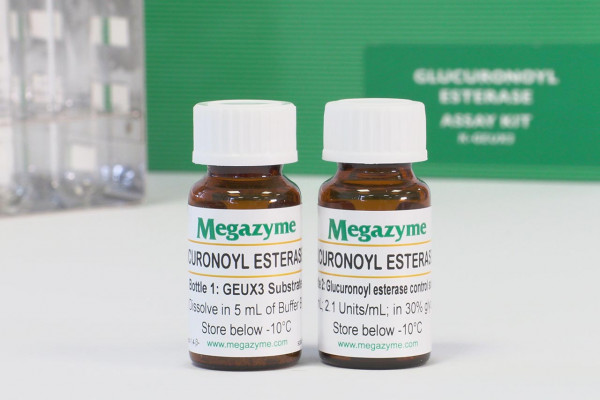
The Glucuronoyl Esterase Assay Kit provides a simple robust method for the measurement of glucuronoyl esterase. The assay kit employs a novel colourimetric reagent, termed GEUX3 that is highly specific for glucuronoyl esterase.
Detail
K-GEUX3
SKU: 700004294
100 assays per kit
Content:
100 assays per kit
Shipping Temperature:
Ambient
Storage Temperature:
Short term stability: 2-8oC, Long term stability: See individual component labels
Stability:
> 2 years under recommended storage conditions
Analyte:
Glucuronoyl Esterase
Assay Format:
Spectrophotometer, Auto-analyser
Detection Method:
Absorbance
Wavelength (nm):
400
Signal Response:
Increase
Reproducibility (%):
~ 3%
Total Assay Time:
10 min
Application examples:
Fermentation broths, industrial enzyme preparations and biofuels research.
Method recognition:
Novel method
The Glucuronoyl Esterase Assay Kit provides a simple robust method for the measurement of glucuronoyl esterase. The assay kit employs a novel colourimetric reagent, termed GEUX3 that is highly specific for glucuronoyl esterase.
Norgen’s Total Nucleic Acid Preservation Tubes are designed for ambient preservation and transport of total nucleic acids (DNA and RNA) from samples collected using a swab, including nasal, buccal, saliva, fecal, skin, surfaces, etc. The Total Nucleic Acid Preservation Tubes contain Norgen’s Total Nucleic Acid Preservative in a liquid format. The user simply collects the specimen using a sterile nylon flocked swab (not provided), and then transfers the swab into the Total Nucleic Acid Preservative. The preservative prevents the growth of Gram-negative and Gram-positive bacteria and fungi, and also inactivates viruses allowing the resulting non-infectious samples to be handled and shipped safely. In addition, the Total Nucleic Acid Preservative eliminates the need to immediately process or freeze samples and allows the samples to be shipped to centralized testing facilities at ambient temperatures. The components of the Preservative allow DNA samples to be stored at room temperature for over 4 months and RNA samples to be stored at room temperature for over 2 months. Swab samples collected and preserved using Norgen’s Total Nucleic Acid Preservation Tubes are compatible with most commercially available DNA and RNA isolation methods. Samples stored in the tubes have been used successfully with most of Norgen Biotek’s DNA and RNA isolation kits and reagents, including Norgen’s Total RNA Purification Kit (Cat# 17200) and Norgen’s Saliva DNA Isolation Kit (Cat# RU45400). For purification of total nucleic acids please refer to the supplementary protocol provided with Norgen’s Total RNA Purification Kit (Cat#17200).
The Total Nucleic Acid Preservation Tubes can be stored at room temperature for up 1 year without any reduction in kit performance. The collect before date is indicated on the tube label and the kit box label.
Magen’s HiPure columns are prepared by high quality glass fiber filter membrane as raw materials through membrane cutting, membrane release, ring release, ring pressing, gland, weighing and other processes. HiPure nucleic acid adsorption columns have the characteristics of long-term stability and high binding capacity. Experiments show that the highest binding capacity and binding efficiency of HiPure nucleic acid adsorption columns are basically unchanged when stored at room temperature for 4 years.
The series of nucleic acid columns produced by Magen Biotech are based on carefully selected imported glass fiber membranes (GF/B, GF/D, GF/F). Columns production processes such as polypropylene injection molding materials, injection molding process, and downstream membrane packing and compression rings are strictly controlled. This is to ensure that the column has extremely high adsorption capacity and long-term stability. Compared with conventional products on the market, Magen’s columns are with varieties, and binding rate will not change when stored at room temperature for 4 years.
Details
Specifications
Features
Specifications
Recommended application
Plasmid Medium Yield preparation
Preservation conditions
Room temperature
Stability
Up to 4 years
Filter membrane
High quality glass fiber filter GF/B, 8 layers
Membrane aperture
1.0 μm
Maximum binding yield of plasmid
250 μg
Maximum yield of alcohol mediated Binding
1 mg
Plasmid Yields
Up to 0.25mg
Single liquid carrying capacity of column
4 ml
Minimum elution volume
500 μl
Withstand centrifugal force
5,000 x g
Centrifuge
Lowspeed centrifuge for 15ml centrifuge tubes, >3000 x g, swing-out Rotor, or Fixed Angle Rotor
Adsorption Mechanism
Based on the negatively charged DNA skeleton, it has a high affinity for positively charged glass fibers. In high salt and ethanol solutions, DNA/RNA binds to glass fiber and interacts with hydrophilic matrix on silica through hydrogen bond. DNA/RNA is tightly bound. All pollutants can be removed by washing solution. At high salt concentration, nucleic acids selectively bind to silica gel membrane, while other pollutants, mainly proteins, are removed by membrane washing.
Ordering information
CAT.No.
Product Name
Package
C13121
HiPure DNA Midi Column III (8 x GF/B)with 15ml Collection Tubes
100/Bag
Purchase Guide
Item No.
Product Name
Membrane type/number of layers
Collection tubes
Plasmid DNA binding capacity (Physical adsorption)
Note: GF/B pore size is for 1.0μM glass fiber membrane; GF/F pore size is for 0.7μm glass fiber membrane.
Document
Magen’s HiPure columns are prepared by high quality glass fiber filter membrane as raw materials through membrane cutting, membrane release, ring release, ring pressing, gland, weighing and other processes. HiPure nucleic acid adsorption columns have the characteristics of long-term stability and high binding capacity. Experiments show that the highest binding capacity and binding efficiency of HiPure nucleic acid adsorption columns are basically unchanged when stored at room temperature for 4 years.