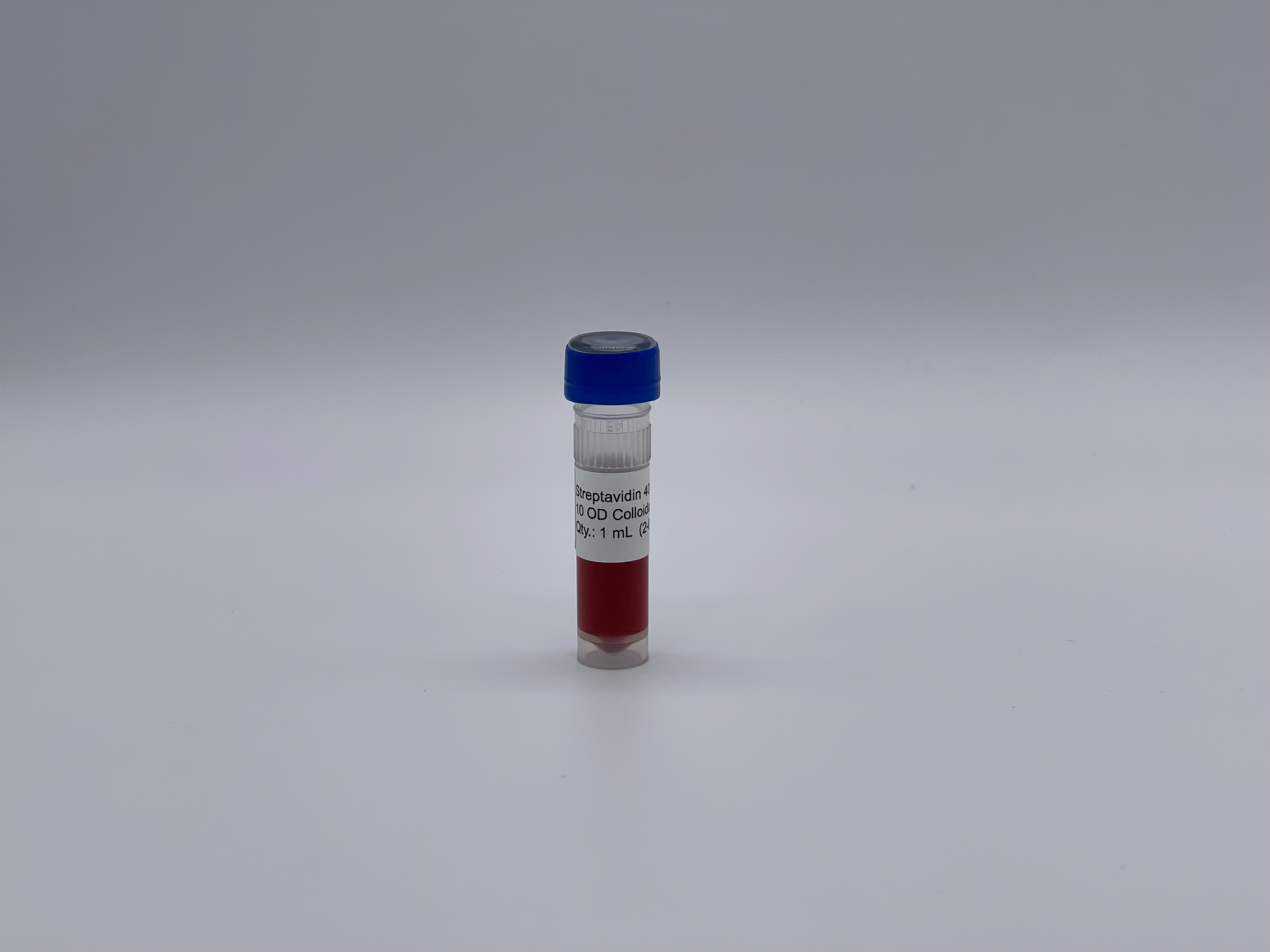
Functionally tested GAM conjugated gold Perfect for Lateral Flow Development and use in final product 40nm gold particles conjugated to GAM are offered in 10 OD 1mL size. If a different OD or amount is required please
Goat Anti-Rabbit (GAR) Conjugated Colloidal Gold for Lateral Flow (1mL of 10OD)
Product image shows functional testing of Goat Anti Mouse (GAM) 40nm colloidal gold on a lateral flow test.
Our products are produced in a state-of-the-art manufacturing facility that enable rapid turnaround times while ensuring batch to batch consistency and reliability.
Short term stability: 2-8oC, Long term stability: See individual component labels
Stability:
> 2 years under recommended storage conditions
Analyte:
D-Gluconate, D-Glucono-δ-lactone
Assay Format:
Spectrophotometer, Microplate, Auto-analyser
Detection Method:
Absorbance
Wavelength (nm):
340
Signal Response:
Increase
Linear Range:
0.8 to 50 µg of D-gluconic acid per assay
Limit of Detection:
0.792 mg/L
Reaction Time (min):
~ 6 min
Application examples:
Wine, meat, processed meat (e.g. additives), fruit juice, dairy products, pharmaceuticals, paper and other materials (e.g. biological cultures, samples, etc.).
Method recognition:
Methods based on this principle have been accepted by ISO, DIN and GOST
The D-Gluconic Acid/D-Glucono-δ-lactone test kit is suitable for the specific measurement and analysis of D-gluconic acid/D-gluconolactone in foods and beverages.
Note for Content: The number of manual tests per kit can be doubled if all volumes are halved. This can be readily accommodated using the MegaQuantTM Wave Spectrophotometer (D-MQWAVE).
Extended cofactors stability. Dissolved cofactors stable for > 1 year at 4oC.
All reagents stable for > 2 years after preparation
Very competitive price (cost per test)
Very rapid reaction
Mega-Calc™ software tool is available from our website for hassle-free raw data processing
Standard included
Suitable for manual, microplate and auto-analyser formats
Document
The D-Gluconic Acid/D-Glucono-δ-lactone test kit is suitable for the specific measurement and analysis of D-gluconic acid/D-gluconolactone in foods and beverages.
Short term stability: 2-8oC, Long term stability: See individual component labels
Stability:
> 2 years under recommended storage conditions
Analyte:
Dietary Fiber
Assay Format:
Enzymatic
Detection Method:
Gravimetric/HPLC
Signal Response:
Increase
Limit of Detection:
0.5 g/100 g
Total Assay Time:
~ 3 h work (over 1-2 days)
Application examples:
Food ingredients, food products and other materials.
Method recognition:
AACC Method 32-60.01, AOAC Method 2022.01, AOAC Method 2017.16, ICC Standard Method No. 185 and CODEX Method Type I
The Rapid Integrated Total Dietary Fiber Assay Kit method is validated under collaborative study (AACC Method 32-60.01, AOAC Method 2022.01, AOAC Method 2017.16, ICC Standard No. 185) and is recognized as a Type I Method by CODEX Alimentarius. The K-RINTDF method is the recommended one for the measurement of total dietary fiber in all foods that may or may not contain resistant starch. This method is updated to be more consistent with in vivo conditions in the human small intestine, i.e. a 4 h incubation time. Under these conditions more accurate measurement of resistant starch is obtained, including phosphate cross-liked starch (RS4). Use of higher enzyme concentrations ensures that resistant maltodextrins produced from non-resistant starch under the incubation conditions of the Integrated Total Dietary Fiber procedure (AOAC Methods 2009.01 and 2011.25) are no longer produced.
In this improved, rapid method, the incubation time with PAA + AMG is reduced to 4 h and the levels of both PAA and AMG are increased to ensure that resistant starch levels obtained with a set of control samples are consistent with ileostomy data. Under these conditions, the DF values obtained for most samples are the same as those obtained with AOAC Methods 2009.01 and 2011.25.
The dietary fiber fractions that are measured with this method are:
1. High Molecular Weight Dietary Fiber (HMWDF) including Insoluble Dietary Fiber (IDF) and High Molecular Weight Soluble Dietary Fiber (SDFP; soluble dietary fiber which is precipitated in the presence of 78% aqueous ethanol), and
2. Low Molecular Weight Soluble Dietary Fiber (SDFS; water soluble dietary fiber that is soluble in the presence of 78% aqueous ethanol).
Alternatively, IDF, SDFP and SDFS can be measured separately.
The enzymes used in this method are high purity and effectively devoid of contaminating enzymes active on other dietary fiber components such as β-glucan, pectin and arabinoxylan. They are supplied as freeze-dried powders; allowing the use of glycerol as an internal standard in the method.
* See McCleary, B. V., Sloane, N & Draga, A. (2015). Determination of total dietary fibre and available carbohydrates: a rapid integrated procedure that simulates in vivo digestion. Starch/Starke, 66, 1-24.
Validation of Methods
Advantages
More rapid measurement – incubation time with PAA + AMG reduced to 4 h in comparison with AOAC 2009.01 (increased levels of enzyme employed)
DF values for most samples are very similar to those obtained with AOAC Method 2009.01
Rapid Integrated Total Dietary Fiber method removes all of the limitations that have been identified with AOAC Method 2009.01*
All reagents stable for > 2 years after preparation
The method is consistent with the CODEX Alimentarius definition of dietary fiber
Mega-Calc™ software tool is available from our website for hassle-free raw data processing
Very competitive price (cost per test)
Document
The Rapid Integrated Total Dietary Fiber Assay Kit method is validated under collaborative study (AACC Method 32-60.01, AOAC Method 2022.01, AOAC Method 2017.16, ICC Standard No. 185) and is recognized as a Type I Method by CODEX Alimentarius. The K-RINTDF method is the recommended one for the measurement of total dietary fiber in all foods that may or may not contain resistant starch. This method is updated to be more consistent with in vivo conditions in the human small intestine, i.e. a 4 h incubation time. Under these conditions more accurate measurement of resistant starch is obtained, including phosphate cross-liked starch (RS4). Use of higher enzyme concentrations ensures that resistant maltodextrins produced from non-resistant starch under the incubation conditions of the Integrated Total Dietary Fiber procedure (AOAC Methods 2009.01 and 2011.25) are no longer produced.
Heat-Labile Exonuclease I (HL-ExoI) is a 3’ – 5’ exonuclease, specific for single stranded DNA. The enzyme is recombinantly produced in E. coli. HL-ExoI is active at 25 – 37°C and inactivated by 1 minute incubation at 80°C or 15 minutes at 60°C.
HL-ExoI is used for degradation of ssDNA such as primers and oligos. It is also ideal for treatment of sensitive samples and useful in the development of novel molecular diagnostics applications.
Key Features
3’-5’ exonuclease specific for single stranded DNA
High activity at 25 – 37°C
Easily heat-inactivated by 1 min incubation at 80°C, or 15 min at 60°C
Moderate salt tolerance
Application
Removal of primers post-PCR prior to DNA sequencing or SNP detection
Figures
Properties
Quality Control
ArcticZymes is dedicated to the quality of our products. We manufacture all products at our ISO 13485 certified facility in Norway.
Document
Heat-Labile Exonuclease I (HL-ExoI) is a 3’ – 5’ exonuclease, specific for single stranded DNA. The enzyme is recombinantly produced in E. coli. HL-ExoI is active at 25 – 37°C and inactivated by 1 minute incubation at 80°C or 15 minutes at 60°C.