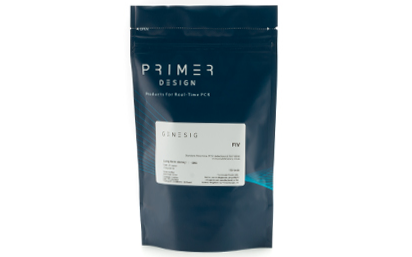
Primer and probe mix (150 reactions) Reverse Transcription, target specific primers (RNA genome viruses only) Copy number standard curve (sufficient for multiple standard curves) Internal extraction control – Read through VIC channel* Endogenous control (150 tests) RNAse/DNAse free water *alternative fluorophores available on request
Nucleic acid testing (NAT) is the method of choice for detection and quantification of a wide range of micro organisms. Primerdesign manufactures and supplies high quality quantitative real-time PCR kits for the detection and simultaneous quantification of numerous significant pathogens . A copy number standard curve is provided for quantification and an the internal extraction template (DNA or RNA), controls for the quality of the nucleic acid extraction and eliminates false negative results.
The kit is designed with the broadest possible detection profile to ensure that all clinically relevant strains and subtypes are detected. Target sequences are selected by working with data from key opinion leaders in the field. Multiple sequence alignments and unprecedented real-time PCR expertise in design and validation ensure the best possible kit. Details of the target and priming specificity are included in the individual handbooks above.
Packaged, optimised and ready to use. Expect Better Data.
Other Products
Propargyl-PEG3-t-butyl ester
Product Info
Document
Product Info
Propargyl-PEG3-t-butyl ester consists of an alkyne group and a t-butyl ester group. The alkyne groupreacts with azide-bearing compounds or biomolecules in copper catalyzed Click Chemistry reactions. The protected carboxyl group can be deprotected under acidic conditions. Reagent grade, for research purpose. Please contact us for GMP-grade inquiries.
Document
Propargyl-PEG3-t-butyl ester consists of an alkyne group and a t-butyl ester group. The alkyne groupreacts with azide-bearing compounds or biomolecules in copper catalyzed Click Chemistry reactions. The protected carboxyl group can be deprotected under acidic conditions. Reagent grade, for research purpose. Please contact us for GMP-grade inquiries.
Short term stability: 2-8oC, Long term stability: See individual component labels
Stability:
> 2 years under recommended storage conditions
Analyte:
D-Sorbitol, D-Xylitol
Assay Format:
Spectrophotometer, Microplate, Auto-analyser
Detection Method:
Absorbance
Wavelength (nm):
492
Signal Response:
Increase
Linear Range:
1.0 to 20 µg of D-sorbitol (or xylitol) per assay
Limit of Detection:
0.20 mg/L
Reaction Time (min):
~ 15 min
Application examples:
Diabetic foods (e.g. honey, jam and chocolate), dietetic foods, chewing gum, candies, fruit juice (e.g. apple juice), ice-cream, sweets, bakery products (e.g. desserts), marzipan, paper (and cardboard), cosmetics, pharmaceuticals and other materials (e.g. biological cultures, samples, etc.).
Method recognition:
Methods based on this principle have been accepted by IFU and AIJN
The D-Sorbitol/Xylitol test kit for the determination Of D-Sorbitol And Xylitol In Foodstuffs, such as bakery goods, diabetic foods, chocolate, fruit, sweets and more.
Sorbitol is non-cariogenic and finds many dietetic applications, but can cause gastrointestinal problems in adults if large quantities are consumed (10-50 g per day). It has been safely used in processed foods for almost half a century and finds applications in the cosmetics and pharmaceuticals industries.
Note for Content: The number of manual tests per kit can be doubled if all volumes are halved. This can be readily accommodated using the MegaQuantTM Wave Spectrophotometer (D-MQWAVE).
Each vial of sorbitol dehydrogenase is stable for > 2 months at 4oC after dissolution
No wasted diaphorase solution (stable suspension supplied)
Very competitive price (cost per test)
Reagents stable for > 2 years as supplied
Mega-Calc™ software tool is available from our website for hassle-free raw data processing
Standard included
Suitable for manual, microplate and auto-analyser formats
Document
The D-Sorbitol/Xylitol test kit for the determination Of D-Sorbitol And Xylitol In Foodstuffs, such as bakery goods, diabetic foods, chocolate, fruit, sweets and more.