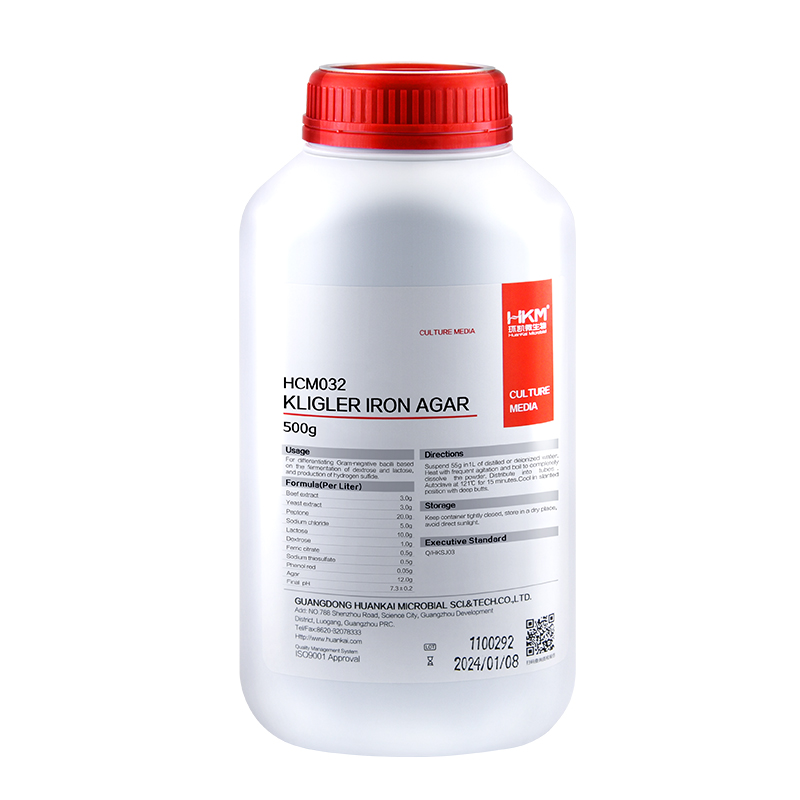
Peptone, beef extract powder and yeast extract powder provide nitrogen, vitamins, minerals; lactose, dextrose into fermentable sugars, which produce acid when measured by the phenol red indicator, acid yellow, basic red; thiosulfate sodium can be reduced to some bacteria to hydrogen sulfide, to produce a black iron sulfide and iron salts; sodium chloride to maintain osmotic equilibrium; agar as medium coagulant.
Formulation(per liter):
Peptone 20g
Beef extract powder 3g
Yeast extract powder 3g
Lactose 10g
Dextrose 1g
Sodium chloride 5g
Ferric ammonium citrate 0.5g
Sodium thiosulfate 0.5g
Agar 12g
Phenol red 0.05g
Final pH 7.4 ± 0.2
How to use:
1.Suspend 54.5g in 1L of distilled water , stirring heated to boiling ,autoclave at 121 for 15 minutes.
2.Diluted and treated samples.
Quality control:
Item
The name and number of strain
Growth
Colony Color
1
Escherichia coli ATCC25922
Good
A/A
2
Proteus CMCC (B) 49027
Good
K/A
3
Salmonella typhimurium CMCC (B) 50115
Good
K/A
“A”Acid , “K” Alkality
Storage: Keep container tightly closed, store in a cool, dry place, away from bright light. Storage period of 3 years.
Other Products
Liquid DNA Extraction Nucleic Acid Reagent 12 Months Shelf Life
Product Info
Document
Product Info
Product Description
Nucleic Acid Reagent For DNA Extraction: Fast, Efficient, High-Quality
Product Description:
Amp-future Bio’s Nucleic Acid Extraction Reagent is a high quality and reliable DNA extraction kit that is specifically designed for automated nucleic acid extraction. It has a shelf life of 12 months and comes in a convenient liquid form. This product is the perfect choice for researchers and laboratories that require fast and accurate results, as it offers a highly efficient solution for extracting nucleic acids from a variety of biological samples. It is easy to use and can be used in either manual or automated protocols. The reagent contains a broad spectrum of components that are essential for the successful isolation and extraction of nucleic acids. With its automated nucleic acid extractor, it ensures that all samples are processed with maximum efficiency and accuracy.
Features:
Product Name: Nucleic Acid Extraction Reagent
Form: Liquid
Brand: Amp-future Bio
Composition: DNA
Shelf Life: 12 Months
DNA RNA Extraction Kit
Automated Nucleic Acid Extractor
Technical Parameters:
Product Name
Technical Parameters
Nucleic Acid Extraction Reagent
Application: DNA Extract Form: Liquid Shelf Life: 12 Months Brand: Amp-future Bio Automated Nucleic Acid Extractor, DNA Extraction Kit, Automated Nucleic Acid Extractor
Applications:
Amp-future Bio Nucleic Acid Extraction Reagent is a liquid reagent specially formulated for automated nucleic acid extraction. It is widely used in DNA/RNA extraction from various sample matrixes, such as blood, tissue, cells, bacteria, etc. It ensures high-quality nucleic acid extraction in a short period of time. The reagent is produced in China and has a shelf life of 12 months.
Amp-future Bio Nucleic Acid Extraction Reagent is suitable for use with the Automated Nucleic Acid Extractor. It is highly efficient and reliable, allowing for fast and accurate nucleic acid extraction. The reagent is also suitable for use with the DNA Extraction Kit, which makes it ideal for clinical laboratories. It provides superior nucleic acid extraction performance.
Amp-future Bio Nucleic Acid Extraction Reagent is an essential product for laboratories that need to extract nucleic acids from various sample matrixes. It is highly reliable and efficient, providing superior results in a short period of time. The reagent is also suitable for use with the Automated Nucleic Acid Extractor and the DNA Extraction Kit. It is a reliable and cost-effective product for laboratories that require high quality nucleic acid extraction.
Customization:
Customized Nucleic Acid Reagent Service
Amp-future bio provides custom nucleic acid reagent services to meet your specific needs. We specialize in the production of DNA/RNA extraction reagents for automated nucleic acid extraction, purification and other related applications.
Brand Name: Amp-future bio
Place of Origin: China
Product Name: Nucleic Acid Extraction Reagent
Brand: Amp-future Bio
Form: Liquid
Shelf Life: 12 Months
Application: DNA Extract
Our products are suitable for DNA extraction, automated nucleic acid extraction, nucleic acid purification, and other related applications. We are confident that our products can meet the highest quality standards and provide the best performance. We are dedicated to providing the best customer service and technical support for our customers.
Support and Services:
Our team of experts provide the highest quality technical support and services for Nucleic Acid Reagents products.
Technical Support
Our technical support staff are available to assist you with any questions or troubleshooting related to the use of Nucleic Acid Reagents. Our team can provide guidance on the proper use and handling of our products, as well as any other technical questions. We offer technical support via phone, email, and online chat.
Services
We also offer a variety of services to support our customers in the use of Nucleic Acid Reagents. These services include:
Troubleshooting and technical advice
Installation and maintenance of products
Product training and certification
Custom protocols and procedures
Document
Amp-future Bio’s Nucleic Acid Extraction Reagent is a high quality and reliable DNA extraction kit that is specifically designed for automated nucleic acid extraction. It has a shelf life of 12 months and comes in a convenient liquid form. This product is the perfect choice for researchers and laboratories that require fast and accurate results, as it offers a highly efficient solution for extracting nucleic acids from a variety of biological samples. It is easy to use and can be used in either manual or automated protocols. The reagent contains a broad spectrum of components that are essential for the successful isolation and extraction of nucleic acids. With its automated nucleic acid extractor, it ensures that all samples are processed with maximum efficiency and accuracy.
[PM2500] ExcelBand™ 3-color Regular Range Protein Marker (9-180 kDa), 250 μl x 2
Product Info
Document
Product Info
Description
The PM2500 ExcelBand™ 3-color Regular Range Protein Marker is a ready-to-use three-color protein standard with 10 pre-stained proteins covering a wide range of molecular weights from 10 to 180 kDa in Tris-Glycine Buffer (9 to 170 kDa in Bis-Tris (MOPS) buffer and 10 to 170 kDa Bis-Tris (MES) buffer). Proteins are covalently coupled with a blue chromophore except for two reference bands (one green and one red band at 25 kDa and 75 kDa respectively) when separated on SDS-PAGE (Tris-Glycine buffer). PM2500 ExcelBand™ 3-color Regular Range Protein Marker is designed for monitoring protein separation during SDS-polyacrylamide gel electrophoresis, verification of Western transfer efficiency on membranes (PVDF, nylon, or nitrocellulose) and for approximating the size of proteins.
Features
Ready-to-use — Premixed with a loading buffer for direct loading, no need to boil.
Two reference bands — 75 kDa (red) and 25 kDa (green)
Contents
Approximately 0.1~0.4 mg/ml of each protein in the buffer (20 mM Tris-phosphate (pH 7.5 at 25°C), 2% SDS, 0.2 mM DTT, 3.6 M urea, and 15% (v/v) glycerol).
Quality Control
Under suggested conditions, PM2500 ExcelBand™ 3-color Regular Range Protein Marker resolves 10 major bands in 15% SDS-PAGE (Tris-Glycine buffer, MOPS, and MES buffer) and after Western blotting to nitrocellulose membrane.
Storage
4°C for 3 months -20°C for long term storage
Document
The PM2500 ExcelBand™ 3-color Regular Range Protein Marker is a ready-to-use three-color protein standard with 10 pre-stained proteins covering a wide range of molecular weights from 10 to 180 kDa in Tris-Glycine Buffer (9 to 170 kDa in Bis-Tris (MOPS) buffer and 10 to 170 kDa Bis-Tris (MES) buffer). Proteins are covalently coupled with a blue chromophore except for two reference bands (one green and one red band at 25 kDa and 75 kDa respectively) when separated on SDS-PAGE (Tris-Glycine buffer). PM2500 ExcelBand™ 3-color Regular Range Protein Marker is designed for monitoring protein separation during SDS-polyacrylamide gel electrophoresis, verification of Western transfer efficiency on membranes (PVDF, nylon, or nitrocellulose) and for approximating the size of proteins.
Propargyl-PEG3-acid is a reagent with an alkyne group and a carboxylic acid. The terminal carboxylic acid can form amide bond with primary amines (activation is needed). The alkyne can form triazole linkage with azide containing molecules via copper catalyzed reactions. Reagent grade, for research purpose. Please contact us for GMP-grade inquiries.
Document
Propargyl-PEG3-acid is a reagent with an alkyne group and a carboxylic acid. The terminal carboxylic acid can form amide bond with primary amines (activation is needed). The alkyne can form triazole linkage with azide containing molecules via copper catalyzed reactions. Reagent grade, for research purpose. Please contact us for GMP-grade inquiries.