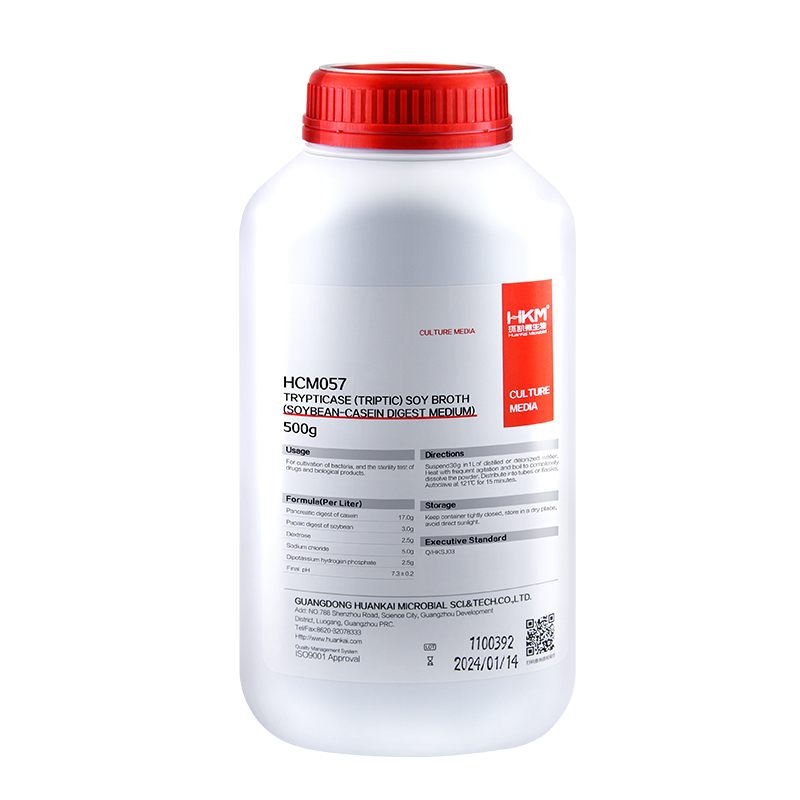
For cultivating of bacteria.And sterility test of drugs and biological products.
Principle:
Tryptone, peptone and yeast extract multivalent powder provides a nitrogen source, vitamins, and growth factors; sodium chloride to maintain osmotic balance; glucose carbon source; dipotassium hydrogen phosphate as a buffering agent.
Formulation(per liter):
Pancreatic Digest of Casein 17g
Papaic Digest of Soybean 3g
Sodium chloride 5g
Dipotassium hydrogen phosphate 2.5g
Glucose Monohydrate 2.5g
Final pH 7.3±0.2
How to use:
1.Suspend 30g in 1L of distilled water , stirring heated to boiling to completely dissolve ,autoclave at 121 for 15 minutes.
2.Diluted and treated samples.
Storage: Keep container tightly closed, store in a cool, dry place, away from bright light. Storage period of 3 years.
Other Products
R4165 HiPure HP Plant RNA Mini Kit
Product Info
Document
Product Info
Introduction
HiPure HP Plant RNA Mini Kit combines guanidine isothiocyanate lysing and silica gel membrane purification technology to simplify total RNA extraction. Ultracentrifugation in CsCl purification and LiCl / ethanol precipitation are not required. The kit uses DNase digestion to completely remove DNA. It is suitable for extracting up to 100μg of total RNA (including miRNA) from plant samples less than 200mg. Several samples can be extracted within 40 minutes. The purified RNA can be directly used for RT-PCR, fluorescent quantitative RT-PCR, Northern hybridization, second generation sequencing, etc.
Details
Specifications
Features
Specifications
Main Functions
Isolation total RNA (include miRNA) from <200mg difficult-to-extract plant samples (use low toxicity chloroform substitutes)
Applications
RT-PCR, qPCR, Northern hybridization, second generation sequencing, nucleic acid protection, in vitro translation
Purification method
Mini spin column
Purification technology
Silica technology
Process method
Manual (centrifugation or vacuum)
Sample type
Hard-to-extraction plant samples such as fruit and seed, grape leaves, tea
Sample amount
≤200 mg
Elution volume
≥30μl
Time per run
1-24 samples within 30 minutes
Liquid carrying volume per column
800µl
Binding yield of column
100µg
Principle
This kit uses glass fiber filter membrane purification technique, and only requires simple combination-washing-elution steps. The sample is lysed and homogenized in the solution containing guanidine salt, ethanol is added to provide appropriate binding conditions, and transferred to the purification column for centrifugation. Up to 100µg of RNA can be selectively bound to the membrane, pollutants are efficiently washed off after three times of washing, and finally the purified RNA is eluted by RNase Free Water.
Advantages
Completely remove DNA by using of DNase
High quality – one-step RNA extraction reagent combined with silica gel column can obtain the highest concentration
Fast – several samples can be extracted in 40 minutes by column method
Sensitive – RNA can be recovered at the level of PG
Broad spectrum – various types of plant samples can be processed by diversity of operating procedures
Kit Contents
Contents
R416502
D416503
Purification Times
50 Preps
250 Preps
HiPure RNA Mini Columns
50
250
2ml Collection Tubes
100
250
DNase I
600 μl
5 x 600 μl
DNase Buffer
6 ml
30 ml
Buffer PAL
60 ml
270 ml
Buffer GXP2*
20 ml
100 ml
Buffer BDP
60 ml
270 ml
Buffer RW1
50 ml
250 ml
Buffer RW2*
20 ml
2 x 50 ml
RNase Free Water
10 ml
30 ml
Storage and Stability
DNase I should be stored at -20-8°C upon arrival. The remaining kit components can be stored at room temperature (15-25°C) and are stable for at least 18 months under these conditions. The entire kit can be stored at 2-8°C, but in this case buffers should be redissolved before use. Make sure that all buffers are at room temperature when used.
Purchase Guide
1. When dealing with woody or uncommon samples, R4150 is recommended first. R4150 contains two polysaccharide/polyphenol lysis buffer, which is the most universal product.
2. R4151 is recommended for handling common economic crop samples for the first time. Strong lysis solution can be used to process easy-extraction samples. The amount of corn or rice leaves samples can reach up to 300mg.
3. R4165 adopts CTAB/chloroform method, which can also handle a large number of difficult-to-extraction plants, but requires contact with chloroform substitutes, which is less safe than other kits. This kit uses DNase Ⅰ to remove DNA, which is also a good choice for extracting polysaccharide/polyphenol-rich plant samples.
4. R4014 is recommended for fruit/starch plant samples, which uses improved trizol pre-treatment, single column operation and is more economical.
Select the right purification kit to get impactful results:
HiPure HP Plant RNA Mini Kit combines guanidine isothiocyanate lysing and silica gel membrane purification technology to simplify total RNA extraction. Ultracentrifugation in CsCl purification and LiCl / ethanol precipitation are not required. The kit uses DNase digestion to completely remove DNA. It is suitable for extracting up to 100μg of total RNA (including miRNA) from plant samples less than 200mg. Several samples can be extracted within 40 minutes. The purified RNA can be directly used for RT-PCR, fluorescent quantitative RT-PCR, Northern hybridization, second generation sequencing, etc.
Isolate DNA from a wide range of food materials. (e.g boiled, fluid, processed or raw food products)
No hazardous chemicals required (e.g. phenol or chloroform)
Effective lysis with Proteinase K and optional lysozyme treatment
Fast (less than 15 minutes hands-on time) and convenient processing using a rapid spin-column format
Wide compatibility with a variety of food products for GMO-DNA isolation
Universal protocol for food related pathogen DNA isolation (Gram positive and Gram negative)
This kit provides a rapid spin column method for the isolation and purification of total DNA from a wide range of food samples originating from animals or plants. The kit is designed for identification of GMO-DNA or animal components in food and feed and can be used for a wide range of starting materials including raw or processed food, meat, liquids, sauces and dairy products including milk, cheese and yogurt.
This kit also provides a convenient method for the detection of food-related pathogens and will isolate such DNA (enriched or as is) including Gram-positive bacteria, Gram-negative bacteria, yeast and fungi which may contaminate food sources. A number of pathogens have been tested including E. coli O157:H7, Staphylococcus, Listeria monocytogenes, Salmonella enterica & Campylobacter jejuni. The purified DNA is of the highest integrity, and can be used in a number of downstream applications including PCR based detection, sequencing and genotyping.
Maximum Amount of Starting Material: Solid food material Liquid sample (e.g. milk or concentrated juice)
200 mg 1 mL to 1.5 mL
Time to Complete 10 Purifications
45 minutes
Storage Conditions and Product Stability All solutions should be kept tightly sealed and stored at room temperature. This kit is stable for 1 year after the date of shipment. The kit contains a ready-to-use Proteinase K, which is dissolved in a specially prepared storage buffer. The buffered Proteinase K is stable for up to 1 year after the date of shipment when stored at room temperature.
Samples Tested by PCR
Food Materials
Samples that Have Been Tested by PCR
Plant related
Cereal, Jam, Chocolate, Spices, Sauce
Animal related
Raw and processed meat products (e.g. ham, beef jerky, taco seasoned ground beef, pork and sausage)
Dairy product
Milk, Yogurt, Cheese
Pathogens (enriched from food samples)
E. coli O157:H7 from food sample Staphylococcus from milk Listeria monocytogenes from milk Salmonella enterica from raw meat Campylobacter jejuni from milk
DBCO-C5-NHS ester is an amine-reactive compound, which can be used to modify an amine-containing molecule in organic media. This reagent isn’t soluble in aqueous media. The extended 5-carbon atom spacer arm improves solubility in commonly used organic solvents including dichloromethane, chloroform, THF, and ethyl acetate, and it also improves derivatization efficiency and stability of conjugates. DBCO is commonly used for copper-free Click Chemistry reactions. Reagent grade, for research use only.
Document
DBCO-C5-NHS ester is an amine-reactive compound, which can be used to modify an amine-containing molecule in organic media. This reagent isn’t soluble in aqueous media. The extended 5-carbon atom spacer arm improves solubility in commonly used organic solvents including dichloromethane, chloroform, THF, and ethyl acetate, and it also improves derivatization efficiency and stability of conjugates. DBCO is commonly used for copper-free Click Chemistry reactions. Reagent grade, for research use only.