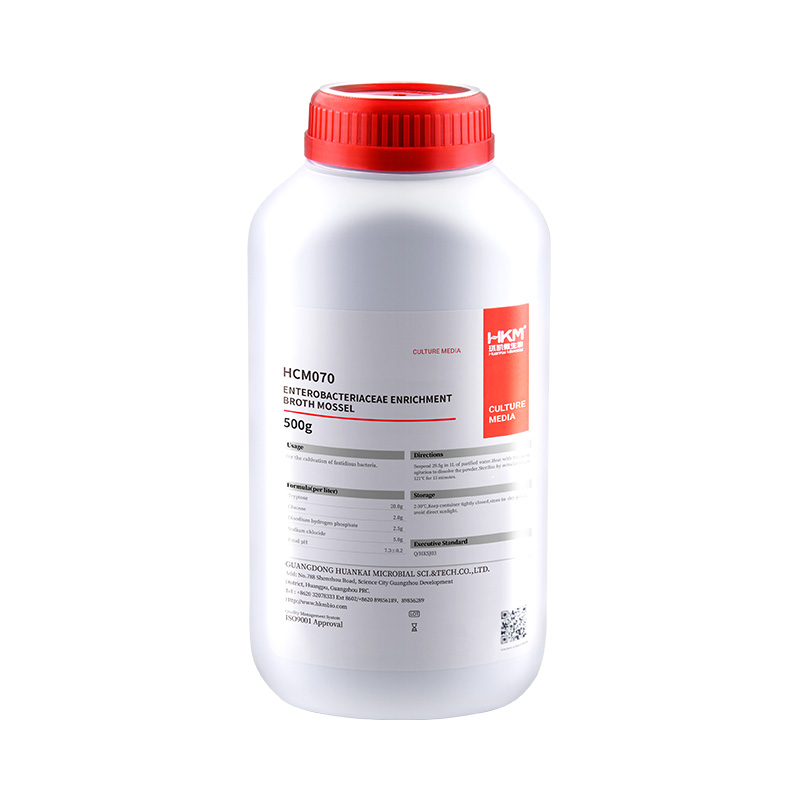
Intended Use For enriching bile-tolerant Gram-negative bacteria in the microbiological examination of pharmaceutical products. Principle and Interpretation Pancreatic digest of gelatin pro……
Detail
Introduction
Intended Use
For enriching bile-tolerant Gram-negative bacteria in the microbiological examination of pharmaceutical products.
Principle and Interpretation
Pancreatic digest of gelatin provide protein, vitamins and amino acids; glucose carbon source; disodium hydrogen phosphate and potassium dihydrogen phosphate as a buffer; ox bile and brilliant green as selective antibacterial agent, inhibiting the growth of non-Enterobacteriaceae.
Formulation
Ingredients
/liter
Pancreatic digest of gelatin
10g
Glucose monohydrate
5g
Dehydrated ox bile
20g
Potassium dihydrogen phosphate
2g
Disodium hydrogen phosphate dihydrate
8g
Brilliant green
15mg
pH7.2±0.2 at 25°C
Preparation
Suspend 45g in 1L of distilled water,stir until completely dissolved and dispense 100 mL into test tubes , heat at 100 °C for 30 min in a waterbath or flowing steam.
Quality Control
The following quality control strains were inoculated and cultured at 30-35℃ for 24h-48h. The results are as follows:
Quality control strains
Inoculum (CFU)
Growth
Escherichia coli ATCC8739
< 100
Good growth
Pseudomonas aeruginosa ATCC9027
Staphylococcus aureus ATCC6538
> 100
Inhibited
Storage and Shelf Life
2-30℃,Keep container tightly closed, avoid direct sunlight.
Use before expiry date on the label.
Precautions
1. When weighing the dehydrated medium, please wear masks to avoid causing respiratory system discomfort
2. Keep container tightly closed after using to prevent clumping.
Waste Disposal
Microbiological contamination was disposed by autoclaving at 121°C for
30 minutes.
Other Products
C1410 MagPure Particles
Product Info
Document
Product Info
Introduction
Magnetic bead nucleic acid purification technology uses nano or micron superparamagnetic material as the matrix, generally black ferric oxide or yellowish brown ferricoxide as the magnetic material. The surface of bead is coated with appropriate functional groups, which can adsorb nucleic acid. Magnetic beads commonly used for nucleic acids, containing carboxyl groups, hydroxyl groups, or silicon groups. Silicon-based magnetic beads are the most common, and its principle of adsorbing nucleic acid is consistent with the classical glass milk purification technology or glass fiber filter membrane purification method. Magpure particle is a kind of polydisperse fast speed silica magnetic beads. The core is ferricoxide, accounting for 50%, and the surface coating is silica, accounting for 50%. The product can be used for plasmid extraction, gel DNA recovery, product purification, genomic DNA and RNA extraction, and viral nucleic acid extraction.
Details
Specifications
Features
Specifications
Concentration
100 mg/ml
Appearance
Suspension of black particles
Surface functional group
Si-OH, Silanol
Dispersibility
Polydisperse Amorphous
Particle size
1.5-5 μm
Preservation conditions
Room Temperature, valid for up to 2 years.It is recommended to store in 2-8°C to prevent microbial growth.
Magnetic response speed
15-30 seconds
Settling velocity
>5 minutes
High salt mediated binding
>2M guanidine isothiocyanate, DNA recovery up to 80%
Alcohol mediated binding
2M guanidine hydrochloride / isopropanol (30%), and the recovery of DNA / RNA was as high as 85%
PEG8000 mediated binding
The recovery of DNA/RNA was up to 85%
DNase/RNase
Not detected
DNA residue
<1 ppm
Recommended application
Plasmid extraction, gel DNA recovery, genomic DNA extraction and RNA extraction.
Principle
Highsalt mediated binding: in the solution containing 2-4M guanidine isothiocyanate, Magpure particles can selectively recover DNA molecules, and impurities such as protein polysaccharides are not adsorbed.
Alcohol mediated binding: in the solution containing guanidine salt and alcohol (>25%), Magpure particles can selectively recover DNA/RNA molecules, and proteins and other impurities are not adsorbed.
After biological samples are treated with digestive solution or lysis Buffer, DNA/RNA is released from cells, organelles and protein complexes (ribosomes and nucleosomes) into reagents. After Magpure particles and binding solution are added, DNA/RNA is adsorbed to the surface of Magpure particles to form DNA/RNA bead complex. Under the action of the magnetic field, the magnetic beads are separated and collected, and the impurities such as protein are removed with the waste liquid. After two or three steps of further cleaning, the DNA/RNA magnetic bead complex is resuspended in sterilized water or TE buffer, and the DNA/RNA falls off from the surface of the magnetic beads, so as to achieve the purpose of purification.
gDNA/RNA Isolation from Blood, Tissue, Plant, Swab, Spots, Stool, Soil and etc.Viral DNA/RNA IsolationAgarose Gel DNA Purification
DNA/RNA Isolation from low nucleic acid content samplesPlasmid IsolationDNA/RNA Clean Up
Circulating DNA IsolationViral Nucleic acid IsolationgDNA Isolation FFPE DNA/RNA Isolation
Plasmid extractiongel DNA recoverygenomicDNA/RNA extraction viral nucleic acid extractionCirculating DNA extraction
DNA/RNA Clean Up and concentrationDNA/RNA Isolation from low nucleic acid content samplesResearch immuno assays
The MagPure magnetic-particle technology combines the speed and efficiency of silica-based DNA purification with the convenient handling of magnetic particles. DNA binds to the silica surface of the magnetic particles in the presence of a chaotropic salt. DNA bound to the particles is then efficiently washed, considerably improving the purity of DNA. High-quality DNA is eluted. The automated purification procedure completely removes enzymes, nucleotides, and other contaminants and inhibitors. Purified DNA is suitable for direct use in downstream applications, such as sequencing and microarray analysis.
Document
Magnetic bead nucleic acid purification technology uses nano or micron superparamagnetic material as the matrix, generally black ferric oxide or yellowish brown ferricoxide as the magnetic material. The surface of bead is coated with appropriate functional groups, which can adsorb nucleic acid. Magnetic beads commonly used for nucleic acids, containing carboxyl groups, hydroxyl groups, or silicon groups. Silicon-based magnetic beads are the most common, and its principle of adsorbing nucleic acid is consistent with the classical glass milk purification technology or glass fiber filter membrane purification method. Magpure particle is a kind of polydisperse fast speed silica magnetic beads. The core is ferricoxide, accounting for 50%, and the surface coating is silica, accounting for 50%. The product can be used for plasmid extraction, gel DNA recovery, product purification, genomic DNA and RNA extraction, and viral nucleic acid extraction.
The 16S V1-V3 Library Preparation Kit for Illumina consists of the reagents and components required for library preparation of the 16S V1-V3 amplicon libraries to be used for next-generation sequencing on Illumina platforms. All molecular reagents including primers, enzyme mixes, indexes, and buffers are provided. Instructions for PCR clean up with the AMPure XP Magnetic Beads (supplied by customer) are also included for rapid purification of nucleic acid products generated at two steps of the workflow. The library prep workflow could be used for purified DNA inputs from different sources including stool, soil, water, saliva, plant, urine, skin swab, vaginal swab, cheek swab, nasal swab, plasma/serum, tongue swab, gum swab, and others.
The 16S V1-V3 Library Preparation Kit for Illumina has a streamlined procedure that reduces the handling time such that the library prep procedure can be completed in approximately 4 hours (see diagram below). Input DNA is first subjected to targeted PCR to amplify the V1-V3 region of the DNA encoding 16S rRNA. The post-PCR reaction is then cleaned up using AMPure XP beads. Dual index primers are then added using a limited-cycle PCR. The indexed amplicons flanked by 5′ and 3′ barcoded adaptors are then cleaned using AMPure XP beads. The libraries are then ready for quantification, pooling and sequencing.
Storage Conditions and Product Stability Norgen’s 16S V1-V3 Library Prep Kit for Illumina is shipped as one kit box (for the 24 prep kit) or two sub-component kits (for the 96 prep kit). All kits should be stored at -20°C upon arrival.
All kit components should remain stable for at least 1 year when stored at the specified storage conditions.
We accelerate RT-PCR for SARS-CoV-2 detection and make Covid-19 research easier!
The Volcano product family supports this goal with optimized reaction components for sensitive and reliable results. The key driver is an engineered, truly thermostable Taq DNA polymerases with reverse transcriptase activity. Have a look at the products or contact us directly for support optimizing your products:
Volcano3G® RT-PCR Probe 2x Master Mix Volcano3G® RT-PCR Probe 2x Master Mix contains all components required for general RT-qPCR. (to the product)
RevTaq RT-PCR DNA polymerase RevTaq RT-PCR DNA polymerase has RNA-dependent (reverse transcriptase) and DNA-dependent DNA polymerase activity. It is a thermostable DNA polymerase suitable for RT-PCR. (to the product)
Volcano3G® RT-PCR Probe 2x Master Mix (with SARS-CoV-2 Research Components) If you are interested in sourcing a Volcano3G® RT-PCR Probe 2x Master Mix with components needed for SARS-CoV-2 research, please contact us.
Document
The Volcano product family supports this goal with optimized reaction components for sensitive and reliable results. The key driver is an engineered, truly thermostable Taq DNA polymerases with reverse transcriptase activity. Have a look at the products or contact us directly for support optimizing your products: