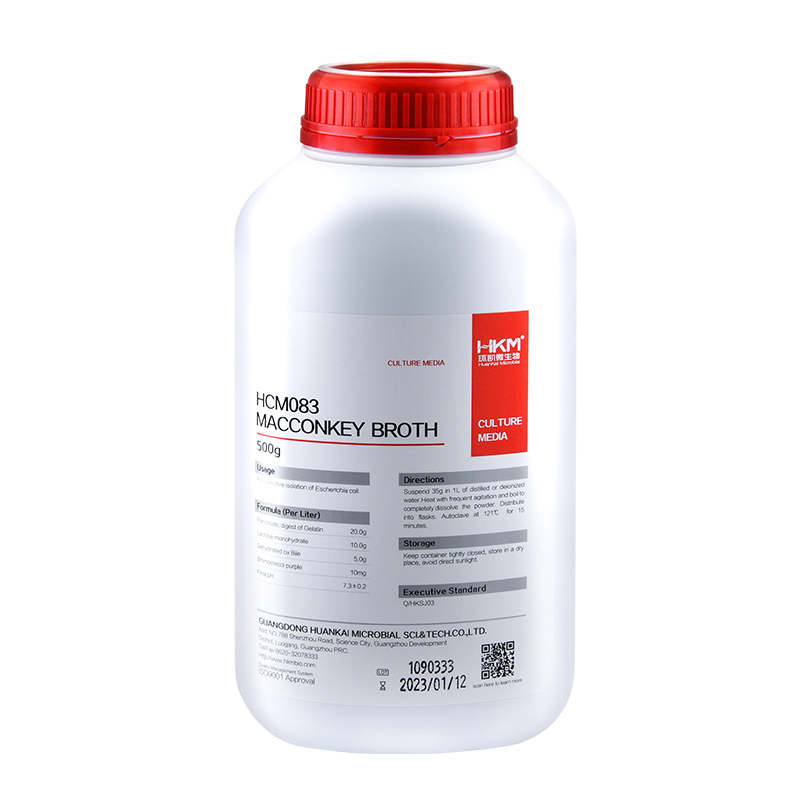
Principle: Peptone provide nitrogen, vitamins and growth factors; sodium chloride to maintain osmotic equilibrium; lactose into fermentable sugars.
Formulation(per liter): Pancreatic Digest of Gelatin 20 g Lactose Monohydrate 10g Dehydrated Ox Bile 5g Bromocresol Purple 10mg final pH 7.3±0.2
How to use: 1.Suspend 35g in 1 L of distilled water , stirring heated to boiling until completely dissolved, dispensing flask, 121 autoclave for 15min. 2.Diluted and treated samples.
Storage: Keep container tightly closed, store in a cool, dry place, away from bright light. Storage period of 3 years.
Short term stability: 2-8oC, Long term stability: See individual component labels
Stability:
> 2 years under recommended storage conditions
Analyte:
L-Fucose
Assay Format:
Spectrophotometer, Microplate, Auto-analyser
Detection Method:
Absorbance
Wavelength (nm):
340
Signal Response:
Increase
Linear Range:
0.5 to 100 µg of L-fucose per assay
Limit of Detection:
0.68 mg/L
Reaction Time (min):
~ 10 min
Application examples:
L-Fucose is present as the main component in fucoidan (a marine polysaccharide), foods, pharmaceuticals and other materials (e.g. biological samples, etc.).
Method recognition:
Novel method
The L-Fucose test kit is a simple, rapid and reliable method, for the measurement and analysis of L-Fucose in plant extracts, biological samples and other materials. This kit can be used in the measurement of α-fucosidases that do not act on chromogenic substrates.
Note for Content: The number of manual tests per kit can be doubled if all volumes are halved. This can be readily accommodated using the MegaQuantTM Wave Spectrophotometer (D-MQWAVE).
All reagents stable for > 2 years after preparation
Only enzymatic kit available
Simple format
Rapid reaction time (~ 10 min)
Mega-Calc™ software tool is available from our website for hassle-free raw data processing
Standard included
Suitable for manual, microplate and auto-analyser formats
Document
The L-Fucose test kit is a simple, rapid and reliable method, for the measurement and analysis of L-Fucose in plant extracts, biological samples and other materials. This kit can be used in the measurement of α-fucosidases that do not act on chromogenic substrates.
This product provides a fast and easy way to purify DNA from plant and fungal tissue. Up to 3g of tissue can be processed. Easy-to-use Plant procedures provide pure total DNA (genomic, mitochondrial, and chloroplast) for reliable PCR and southern blot in less than 1 hour.
Details
Specifications
Features
Specifications
Main Functions
Isolation total DNA from 3g plant and fungal tissue
Applications
PCR, SSR, AFLP, RAPD and southern blot, etc.
Purification method
Mini spin column
Purification technology
Silica technology
Process method
Manual (centrifugation or vacuum)
Sample type
Various plant samples (including conventional, polysaccharides and polyphenols)
This product is based on silica Column purification. Plant material is first mechanically disrupted and then lysed by addition of lysis buffer and incubation. RNase A in the lysis buffer digests the RNA in the sample. After lysis, proteins and polysaccharides are salt-precipitated. Binding buffer and ethanol are added to the cleared lysate to promote binding of the DNA to the HiPure membrane. The sample is then applied to a column and then centrifuged.DNA binds to the membrane, while contaminants such as proteins and polysaccharides are efficiently removed by 2 wash steps. Pure DNA is eluted in a small volume of low-salt buffer or water.
Advantages
Broad spectrum – suitable for extracting DNA from various plant samples
Fast – several samples can be extracted in 30 minutes by silica technology
High purity – high quality DNA, completely remove inhibitors
High yield – silica technology can achieve the highest yield
Kit Contents
Contents
D316302
D316303
Purification Times
10 Preps
50 Preps
RNase A
20 mg
90 mg
Protease Dissolve Buffer
1.8 ml
10 ml
Buffer PAL
180 ml
900 ml
Buffer GWP
150 ml
800 ml
Buffer GW2
25 ml
200 ml
Buffer AE
30 ml
120 ml
HiPure DNA Maxi Columns II
10
50
50 ml Collection Tubes
20
100
Storage and Stability
RNase A should be stored at 2-8°C upon arrival. However, short-term storage (up to 12 weeks) at room temperature (15-25°C) does not affect its performance. The remaining kit components can be stored dry at room temperature (15-25°C) and are stable for at least 18 months under these conditions. The entire kit can be stored at 2-8°C, but in this case buffers should be redissolved before use. Make sure that all buffers are at room temperature when used.
This product provides a fast and easy way to purify DNA from plant and fungal tissue. Up to 3g of tissue can be processed. Easy-to-use Plant procedures provide pure total DNA (genomic, mitochondrial, and chloroplast) for reliable PCR and southern blot in less than 1 hour.
N-(Propargyl-PEG4-carbonyl)-N-bis(PEG1-acid) is a crosslinker that can react with azide compounds or biomolecules via copper catalyzed Click Chemistry to form a stable triazole linkage. The terminal carboxylic acids can react with primary amino groups in the presence of activators (e.g. HATU) to form a stable amide bond.
Document
N-(Propargyl-PEG4-carbonyl)-N-bis(PEG1-acid) is a crosslinker that can react with azide compounds or biomolecules via copper catalyzed Click Chemistry to form a stable triazole linkage. The terminal carboxylic acids can react with primary amino groups in the presence of activators (e.g. HATU) to form a stable amide bond.