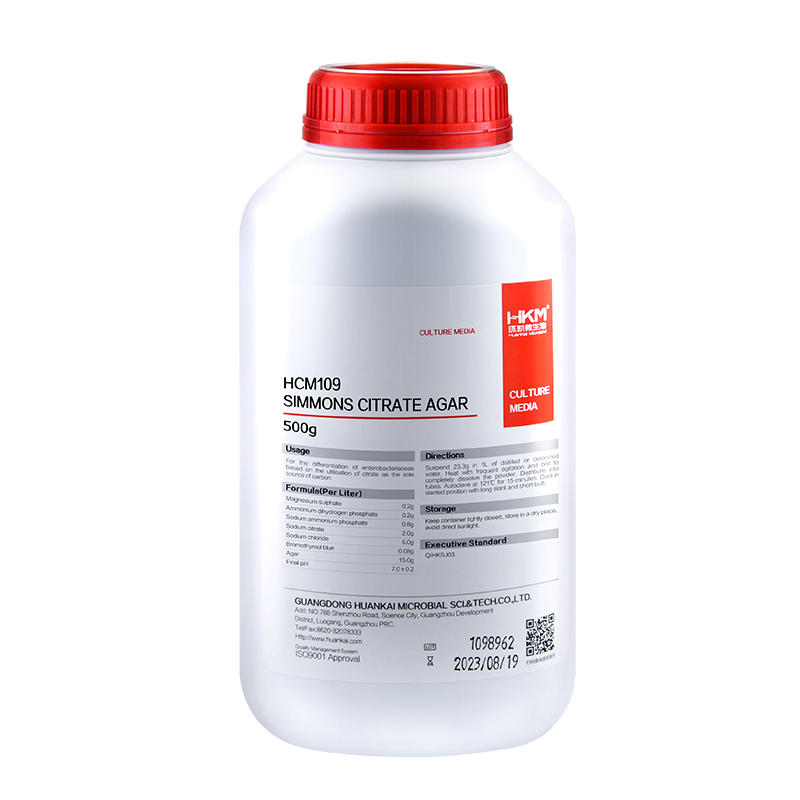
Usages: For the differentiation of Gram-negative bacteria on the basis of citrate utilization.
Principle: Magnesium ions in various metabolic cofactors; ammonium dihydrogen phosphate to provide nitrogen; dipotassium hydrogen phosphate is the buffer; sodium citrate as a carbon source; agar as medium coagulant.
Formulation(per liter): Sodium chloride 5g Magnesium sulfate 0.2g Ammonium dihydrogen phosphate 0.2g Sodium ammonium phosphate 0.8g Sodium citrate 2g Agar 15g Bromothymol blue 0.08g Final pH 7.0 ± 0.2
How to use: 1.Suspend 23.3g in 1 L of distilled water , stirring heated to boiling until completely dissolved, dispensing flask, 121 autoclave for 15min. 2.Diluted and treated samples.
Storage: Keep container tightly closed, store in a cool, dry place, away from bright light. Storage period of 3 years.
Other Products
Aluminum Block – 1.5 / 2.0mL tubes
Product Info
Document
Product Info
The Opentrons 24-well Aluminum Block can be placed directly on the OT-2/Opentrons Flex deck or on the Opentrons Temperature Module. This block acts as a 24 position rack to keep 2mL tubes, 1.5mL tubes, and the NEST 0.5mL tubes at constant temperature. The aluminum block holds temperatures between 4°C and 95°C when used with the Opentrons Temperature Module (GEN2).
Document
The Opentrons 24-well Aluminum Block can be placed directly on the OT-2/Opentrons Flex deck or on the Opentrons Temperature Module. This block acts as a 24 position rack to keep 2mL tubes, 1.5mL tubes, and the NEST 0.5mL tubes at constant temperature. The aluminum block holds temperatures between 4°C and 95°C when used with the Opentrons Temperature Module (GEN2).
Urine DNA Isolation Kit for Exfoliated Cells or Bacteria
Product Info
Document
Product Info
Overview
Isolate genomic DNA from either exfoliated cells or bacteria found in urine
Isolate and detect genomic DNA from as little as 1 mL of urine and up to 50 mL urine
High quality DNA for sensitive applications
Rapid processing time
Norgen’s Urine DNA Isolation Kit for Exfoliated Cells or Bacteria is designed for the rapid isolation of either: 1) human genomic DNA from exfoliated cells that have been shed into the urine from the urinary tract; or 2) bacterial genomic DNA from urine samples. The kit allows for the isolation of DNA from 1 to 50 mL of urine. The genomic DNA isolated from exfoliated cells can be used in a number of diagnostic and research applications including the diagnosis and monitoring of bladder, kidney, or other urinary-tract cancers. Bacterial genomic DNA from both human urine samples and urine samples from animals can be isolated with this kit in order to study the levels and types of bacteria that are present. The kit allows for the isolation of genomic DNA from both Gram negative and Gram positive bacteria, including E. coli, Proteus spp., Klebsiella spp., Enterobacter spp., Serratia spp., Pseudomonas spp, Clostridial ssp. and Leptospirosis spp.Chlamydia trachomatis and Neisseria gonorrhoeae.
Typical yields of human genomic DNA from exfoliated cells will vary depending on the cell density of the urine sample, which is affected by a number of factors including health, diet and sex of the individual donating the urine. Typical yields of bacterial genomic DNA will vary depending on the urine sample and the bacterial species, if any, present in the urine. Healthy humans generally have < 10, 000 CFU of bacteria per mL of urine, and this kit is sufficiently sensitive to isolate and detect DNA from even this minimal amount of bacteria. The genomic DNA purified with this kit is fully digestible with all restriction enzymes tested, and is completely compatible with downstream applications such as PCR, qPCR and Southern Blot analysis.
10 minutes (Plus a 30 minute incubation – Bacteria) (Plus a 15 minute incubation – Exfoliated)
Storage Conditions and Product Stability All solutions should be kept tightly sealed and stored at room temperature. This kit is stable for 2 years after the date of shipment. The kit contains a ready-to-use Proteinase K, which is dissolved in a specially prepared storage buffer. The buffered Proteinase K is stable for up to 2 years after the date of shipment when stored at room temperature.
Propargyl-PEG4-CH2CO2-NHS has a propargyl group and an NHS group. This reagent is amine reactive, thus, useful for derivatizing biomolecules with amine group. The propargyl group reacts with azides via copper catalyzed azide-alkyne Click Chemistry to form stable triazole bond. Reagent grade, for research purpose. Please contact us for GMP-grade inquiries.
Document
Propargyl-PEG4-CH2CO2-NHS has a propargyl group and an NHS group. This reagent is amine reactive, thus, useful for derivatizing biomolecules with amine group. The propargyl group reacts with azides via copper catalyzed azide-alkyne Click Chemistry to form stable triazole bond. Reagent grade, for research purpose. Please contact us for GMP-grade inquiries.