
Introduction
Discover Huankai’s Modified MSRV Agar Base, designed for the selective detection and isolation of motile Salmonella species, ensuring reliable food and environmental testing.

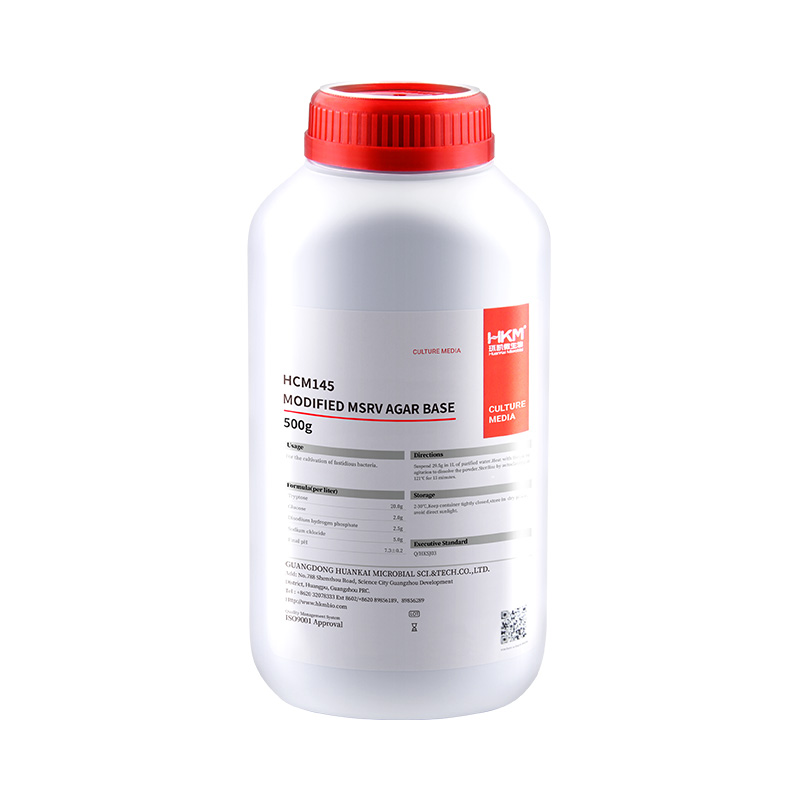
Discover Huankai’s Modified MSRV Agar Base, designed for the selective detection and isolation of motile Salmonella species, ensuring reliable food and environmental testing.
Amine-Tri(3-methoxypropanamide-PEG10-Propargyl) Methane HCl salt is reactive with azide-bearing compounds or biomolecules via copper catalyzed azide-alkyne Click Chemistry to yield a stable triazole linkage. The amino group (NH2) is reactive with carboxylic acids, activated NHS esters, carbonyls (ketone, aldehyde), etc. Reagent grade, for research use only.
These kits provide a fast, reliable and convenient method to purify and concentrate high quality, high purity and inhibitor-free cell-free circulating and exosomal RNA using a convenient spin column method. These kits can purify RNA from fresh or frozen serum or plasma samples prepared from blood collected on either EDTA or Citrate. Plasma samples prepared from blood collected on heparin should not be used, as heparin can significantly interfere with many downstream applications such as RT-PCR. The purified plasma/serum RNA is fully compatible with all downstream applications including PCR, qPCR, methylation-sensitive reverse transcription qPCR, reverse transcription PCR, Northern blotting, RNase protection and primer extension, expression array assays, and NGS.
Background
Plasma/Serum cell-free circulating RNA or exosomal RNA has the potential to provide biomarkers for certain cancers and disease states. Exosomes are 40 – 150 nm membrane vesicles, which are secreted by most cell types. Exosomes can be found in saliva, blood, urine, amniotic fluid and malignant ascitic fluids, among other biological fluids. Evidence has been accumulating recently that these vesicles act as cellular messengers, conveying information to distant cells and tissues within the body. These exosomes may play a functional role in mediating adaptive immune responses to infectious agents and tumours, tissue repair, neural communication and transfer of pathogenic proteins. For this reason exosomal RNAs may serve as biomarkers for various diseases including cancer. As the RNA molecules encapsulated within exosomes are protected from degradation by RNAses they can be efficiently recovered from biological fluids, such as plasma or serum.
Plasma/Serum RNA Purification Mini Kit
This kit can purify RNA from fresh or frozen serum or plasma samples prepared from blood collected on either EDTA or Citrate, from volumes ranging from 50 µL to 200 µL. The purified plasma/serum RNA is eluted in a flexible final volume of 10 µL to 25 µL.
Plasma/Serum RNA Purification Midi Kit
This utilizes a two column method, and can purify RNA from fresh or frozen serum or plasma samples prepared from blood collected on either EDTA or Citrate, from volumes ranging from 250 µL to 1.5 mL. The first column will handle the large volume input of bodily fluids that is followed by a concentration on a mini column for a final elution of 50 µL to 100 µL.
Plasma/Serum RNA Purification Maxi Kit
This kit can purify RNA from fresh or frozen serum or plasma samples prepared from blood collected on either EDTA or Citrate, from volumes ranging from 2 mL to 5 mL. The first column will handle the large volume input of bodily fluids that is followed by a concentration on a mini column for a final elution of 50 µL to 100 µL.
Isolate RNA after Purifying EVs and Exosomes
For Ultracentrifugation, Exoquick, and Filtration
| Cat. # | Name | Elution Volume | Plasma/Serum | Urine | Cell-Culture Media |
|---|---|---|---|---|---|
| 55000 | Plasma/Serum RNA Purification Mini Kit | 10 – 25 µL | 50 µL – 1 mL | 250 µL – 1 mL | 5 – 10 mL |
| 35300 | Total RNA Purification Micro Kit | 20 – 50 µL | 1 – 4 mL | 2 – 10 mL | 10 – 20 mL |
| 17200 | Total RNA Purification Kit | 50 – 100 µL | 4 – 10 mL | 11 – 30 mL | 20 – 35 mL |
Figure 1 / 13
Click for expanded view
| Kit Specifications | |
| Sample Volume Range | 50 to 200 μL |
| Anti-coagulant (for Plasma)* | EDTA or Citrate |
| Size of RNA Purified | All sizes, including small RNA (< 200 nt) |
| Minimum Elution Volume | 10 μL |
| Maximum Elution Volume | 25 μL |
| Time to Complete 10 Purifications | 15-20 minutes |
| Average Yield** | Variable depending on specimen |
*This kit is suitable for the isolation of RNA from fresh or frozen serum or plasma prepared from blood collected on either EDTA or Citrate. Plasma samples prepared from blood collected on heparin should not be used as heparin can significantly interfere with many downstream applications such as RT-PCR.
**Please check page 7 for Average Plasma/Serum Yields and Common RNA Quantification Methods.
Storage Conditions and Product Stability
All solutions should be kept tightly sealed and stored at room temperature. This kit is stable for 2 years after the date of shipment. It is recommended to warm Lysis Buffer A for 20 minutes at 60°C if any salt precipitation is observed.
| Kit Components | Cat. 55000 (50 preps) | Cat. 56100 (20 preps) | Cat. 56200 (10 preps) |
|---|---|---|---|
| Lysis Buffer A | 2 x 20 mL | 100 mL | 1 x 130 mL 1 x 30 mL |
| Wash Solution A | 18 mL | 1 x 38 mL 1 x 18 mL | 38 mL |
| Elution Solution A | 6 mL | 6 mL | 6 mL |
| Elution Buffer F | – | 15 mL | 15 mL |
| Micro Spin Columns | 50 | – | – |
| Mini Spin Columns | – | 20 | 10 |
| Midi Spin Columns | – | 20 | – |
| Maxi Spin Columns | – | – | 10 |
| Collection Tubes | 50 | 20 | 10 |
| Elution Tubes (1.7 mL) | 50 | 20 | 10 |
| Product Insert | 1 | 1 | 1 |
The cfDNA Purification Kit (Magnetic Beads) was developed for cell free DNA (cfDNA) enrichment by separating genomic DNA contamination from isolated cfDNA samples.
Many diagnostic technologies for detection of disease signals in cfDNA begin with isolation and purification of DNA from liquid biopsy that include urine, plasma, cerebrospinal fluid. The most widely explored biotechnology is assays used to detect cancer-derived plasma cfDNA. Silica-based magnetic bead cfDNA isolation kits can reliably extract total DNA from plasma, but typically yield a large variation in cfDNA that includes the presence of genomic DNA that often depends on tumor stage, tumor size, or healthy status individuals. Most of the commercial cfDNA isolation kits can’t specifically recover the cfDNA while leaving the high molecular weight genomic DNA behind. The presence of genomic DNA can lead to decreased sensitivity or inconsistent results in downstream applications such as next-generation sequencing (NGS), PCR, QPCR, and digital PCR etc.
Therefore, an additional purification step to enrich cfDNA before downstream methods helps to improve signal from fragments that originate from cancer cells. A proportion of cancer-derived cfDNA fragment signals are below 100 bp and are often not detectable except by qPCR or single-stranded DNA based library preparation for NGS (1, 2, 3). Furthermore only 1% of cancer-derived fragments are found above 400 bp (1, 2). Capture of size-selected fragments between 90-150 bp improved detection of cancer by 2-4 fold (4). Furthermore, TF-bound and protected cfDNA fragments are also being investigated for active cancer-specific signals down to 35-80 bp (5, 6).
This kit uses Dual Solid Phase Reversible Immobilization (SPRI) technology for cfDNA purification. Most Dual SPRI procedures do NOT recover fragments below 100 bp. The kit can be used for the enrichment of cfDNA isolated from liquid biopsies, plasma, serum, and urine. The kit separates cfDNA (50-500 bp) and genomic DNA, and recovers of 90% of the cfDNA without the high molecular weight genomic DNA with high efficiency. Fragments at 500 bp and above may also be retained. Both the 50-500 bp and >500 bp DNA fractions can be used for downstream applications such as single-stranded or double stranded NGS library prep, qPCR, ddPCR, and other methods.
Features
Examples of cfDNA purification. Both cfDNA and genomic DNA can be recovered separately.
The range of recovered small DNA fragments is from 50 to 500 bp. The input DNA are mixtures of sheared small DNA fragments and intact genomic DNA. The ratios of sheared DNA fragments versus genomic DNA are indicated.
Recovery rates of cfDNA and genomic DNA.
Many diagnostic technologies for detection of disease signals in cfDNA begin with isolation and purification of DNA from liquid biopsy that include urine, plasma, cerebrospinal fluid. The most widely explored biotechnology is assays used to detect cancer-derived plasma cfDNA. Silica-based magnetic bead cfDNA isolation kits can reliably extract total DNA from plasma, but typically yield a large variation in cfDNA that includes the presence of genomic DNA that often depends on tumor stage, tumor size, or healthy status individuals. Most of the commercial cfDNA isolation kits can’t specifically recover the cfDNA while leaving the high molecular weight genomic DNA behind. The presence of genomic DNA can lead to decreased sensitivity or inconsistent results in downstream applications such as next-generation sequencing (NGS), PCR, QPCR, and digital PCR etc.