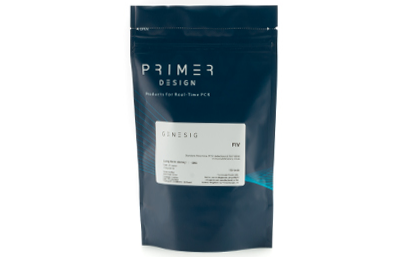
Exceptional value for money Rapid detection of all clinically relevant subtypes Positive copy number standard curve for quantification Highly specific detection profile High priming efficiency Broad dynamic detection range (>6 logs) Sensitive to < 100 copies of target
Accurate controls to confirm findings
150 reactions
Nucleic acid testing (NAT) is the method of choice for detection and quantification of a wide range of micro organisms. Primerdesign manufactures and supplies high quality quantitative real-time PCR kits for the detection and simultaneous quantification of numerous significant pathogens . A copy number standard curve is provided for quantification and an the internal extraction template (DNA or RNA), controls for the quality of the nucleic acid extraction and eliminates false negative results.
The kit is designed with the broadest possible detection profile to ensure that all clinically relevant strains and subtypes are detected. Target sequences are selected by working with data from key opinion leaders in the field. Multiple sequence alignments and unprecedented real-time PCR expertise in design and validation ensure the best possible kit. Details of the target and priming specificity are included in the individual handbooks above.
Packaged, optimised and ready to use. Expect Better Data.
Other Products
[DM2400] AccuBand™ 100 bp+3K DNA Ladder II, 500 μl
Product Info
Document
Product Info
Description
AccuBand™ 100 bp+3K DNA Ladder II is composed of 14 individual DNA fragments, presenting 3k, 2k, 1.5k, 1.2k, 1k, 900, 800, 700 600, 500, 400, 300, 200 and 100 bp sharp bands respectively. This product contains 2 enhanced bands (1k and 500 bp) for easy band identification. AccuBand™ 100 bp+3K DNA Ladder II is ready-to-use, containing loading buffer with dual color tracking dyes (orange G and Xylene cyanol FF). AccuBand™ 100 bp+3K DNA Ladder II provides a sufficient amount of DNA for clear observation of all DNA bands ranging from 100 bp to 3 kb, either in agarose gel or in polyacrylamide gel electrophoresis.
Features
Sharp bands
Suitable for polyacrylamide gel electrophoresis
Quick reference— enhanced bands
Ready-to-use— premixed with loading dye for direct loading
Stable— room temperature storage over 6 months
Source
Phenol extracted PCR products and dsDNA digested with specific restriction enzymes, equilibrated in 10 mM Tris-HCl (pH 8.0) and 10 mM EDTA.
Range
100 ~ 3,000 bp
Concentration
54.4 µg/ 500 µl
Recommended loading volume
5 µl/ well
Storage
Room temperature for 6 months 4°C for 12 months -20°C for 36 months
Free-circulating nucleic acids, such as tumor-specific extracellular DNA fragments and mRNAs in the blood or fetal nucleic acids in maternal blood, are present in serum or plasma usually as short fragments, <1000bp (DNA). HiPure Circulating DNA Midi Kit enables efficient purification of these circulating nucleic acids from human plasma, serum, or urine. The extracted products can be used for clinical in vitro detection.
Details
Specifications
Features
Specifications
Main Functions
Isolation circulating DNA from 1-5ml plasma, serum, body fluids using vacuum protocol
Applications
qPCR, liquid or solid chip analysis, hybridization and SNP detection, etc.
Purification method
Mini spin column
Purification technology
Silica technology
Process method
Manual (vacuum)
Sample type
Serum, plasma and other cell-free fluid samples
Sample amount
1-5ml
Elution volume
≥50μl
Time per run
≤60 minutes
Liquid carrying volume per column
4ml
Binding yield of column
1mg
Principle
This product is based on silica Column purification. The sample is lysed and digested with lysate and protease, DNA is released into the lysate. Transfer to an adsorption column. Nucleic acid is adsorbed on the membrane, while protein is not adsorbed and is removed with filtration. After washing proteins and other impurities, Nucleic acid was finally eluted with low-salt buffer.
Advantages
High yield – most optimal process, free DNA (>50bp) can be obtained to the maximum extent
High concentration – low elution volume, ensuring high nucleic acid concentration
High purity – low alcohol binding method, completely removing inhibitor and protein pollution
High recovery – DNA can be recovered at thelevel of PG by silica gel column purification
Kit Contents
Contents
IVD3182
Purification Times
50
Buffer ACL
250 ml
Buffer ACB*
300 ml
Buffer DCW1*
22 ml
Buffer DCW2*
10 ml
Proteinase K
540 mg
Protease Dissolve Buffer
30 ml
Carrier RNA
110 μg
Nuclease Free Water
20 ml
HiPure CFDNA Mini Columns
50
2 ml Collection Tubes
100
Extender Tube
50
Vac-Connector
50
Storage and Stability
Proteinase K, Carrier RNA should be stored at 2-8°C upon arrival. However, short-term storage (up to 12 weeks) at room temperature (15-25°C) does not affect their performance. The remaining kit components can be stored dry at room temperature (15-25°C) and are stable for at least 18 months under these conditions. The entire kit can be stored at 2-8°C, but in this case buffers should be redissolved before use. Make sure that all buffers are at room temperature when used.
Experiment Data
Document
Free-circulating nucleic acids, such as tumor-specific extracellular DNA fragments and mRNAs in the blood or fetal nucleic acids in maternal blood, are present in serum or plasma usually as short fragments,
The MagPure Plasmid purification system uses the paramagnetic bead technology for high-throughput preparation of high-copy or low-copy plasmid DNA from E. coli cells. This kit also can be used with fosmid and BAC vector-based constructs. The system uses alkaline lysis followed by a MagPure purification to differentially bind plasmid DNA to paramagnetic beads. While the DNA is bound to the beads, contaminants can be rinsed away using a simple washing procedure. Because MagPure uses magnetic separation technology, the protocol does not require vacuum filtration. This makes kit extremely amenable to automation. Plasmid DNA purified with this system is most commonly used in Sanger Sequencing and PCR amplification.
Details
Specifications
Features
Specifications
Main Functions
Isolation up to 20µg plasmid DNA from 1-3ml bacterial culture
Applications
Enzyme digestion, sequencing, PCR and labeling, etc.
Purification technology
Magnetic beads technology
Process method
Manual or automatic
Sample type
Conventional plasmid, plasmid≤30KB
Sample amount
1-3ml
Elution volume
≥50μl
Principle
This product is based on the purification method of high binding magnetic particles. The sample is lysed and digested under the action of lysate and Lysozyme. DNA is released into the lysate. After adding magnetic particles and binding solution, DNA will be adsorbed on the surface of magnetic particles, and impurities such as proteins will be removed without adsorption.The adsorbed particles were washed with washing solution to remove proteins and impurities, washed with ethanol to remove salts, and finally DNA was eluted by Elution Buffer.
Advantages
1. Suitable for extracting plasmids from 1-5ml or <3ml YT medium. 2. The same amount of buffer 1, 2, and 3 avoids errors caused by adjusting the pipette, making it convenient to use in conjunction with automated workstations. 3. Containing buffer 1 for washing, reducing the problem of false high production. 4. The purified plasmid can be directly used for sequencing, enzyme digestion, PCR, and other applications.
Kit Contents
Contents
P181102
P181103
P181104
Purification Times
100 Preps
500 Preps
5000 Preps
RNase A
10 mg
50 mg
2 x 250 mg
Buffer P1
30 ml
150 ml
2 x 750 ml
Buffer P2
30 ml
150 ml
2 x 750 ml
Buffer N3
30 ml
150 ml
2 x 750 ml
Buffer PW1
35 ml
180 ml
2 x 900 ml
MagPure Particle NB*
2.2 ml
11 ml
2 x 60 ml
Storage and Stability
RNase A and MagPure Particle NB should be stored at 2-8°C upon arrival. However, short-term storage (up to 24 weeks) at room temperature (15-25°C) does not affect its performance. The remaining kit components can be stored dry at room temperature (15-25°C) and are stable for at least 18 months under these conditions. After addition of RNase A, Buffer P1 is stable for 6 months when stored at 2-8°C.
Experiment Data
Document
The MagPure Plasmid purification system uses the paramagnetic bead technology for high-throughput preparation of high-copy or low-copy plasmid DNA from E. coli cells. This kit also can be used with fosmid and BAC vector-based constructs. The system uses alkaline lysis followed by a MagPure purification to differentially bind plasmid DNA to paramagnetic beads. While the DNA is bound to the beads, contaminants can be rinsed away using a simple washing procedure. Because MagPure uses magnetic separation technology, the protocol does not require vacuum filtration. This makes kit extremely amenable to automation. Plasmid DNA purified with this system is most commonly used in Sanger Sequencing and PCR amplification.