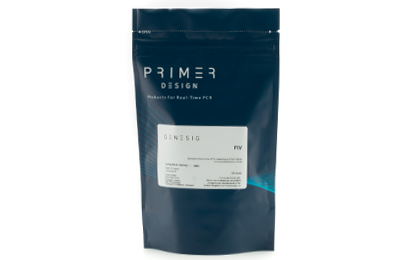
Exceptional value for money Rapid detection of all clinically relevant subtypes Highly specific detection profile High priming efficiency Broad dynamic detection range (>6 logs) Sensitive to < 100 copies of target
Accurate controls to confirm findings
This kit provides a single tube to screen for the presence of high-risk HPV types, HPV16, HPV18, HPV31, HPV33, HPV35, HPV39, HPV45, HPV51, HPV52, HPV56, HPV58, HPV59, HPV66 and HPV68. The multiplex test is detected in two fluorescent channels differentiating between HPV16 / HPV18 which both produce a VIC channel signal and all others which produce a signal in the FAM channel. HPV16 and HPV18 account for 70% of positive findings in clinical practice so it is helpful to know if either of these are present. All other high risk genotypes together make up the remaining 30% of clinical positives and are grouped together into the FAM channel. In this configuration, the kit gives a partial genotyping result and some additional information on which high risk strains are present.
Q-PAGE™ TGN (Tris-Glycine Novel) Precast Gels are ready-to-use acrylamide gels for SDS-PAGE running in Tris-Glycine buffer system. With unique formula, Q-PAGE™ TGN Precast Gels perform enhanced speed, better separation, and longer shelf life as compared with conventional Laemmli Tris-HCl gels. The protein migration patterns in Q-PAGE™ TGN series, however, are similar with typical Laemmli Tris-HCl gels, and thus Q-PAGE™ TGN Precast Gels are compatible to traditional SDS-PAGE and subsequent analyses.
Q-PAGE™ TGN Precast Gels are available in gradient (4 to 15%) and fixed (10%) concentrations of polyacrylamide in 12- and 15-well formats. Two available cassette sizes, Mini (10 x 8.3 cm) and Midi (10 x 10 cm), are compatible with most popular protein electrophoresis systems. Q-PAGE™ Mini (QP4XXX) Gels are suitable for Bio-Rad® and other systems. Q-PAGE™ Midi (QP5XXX) Gels are suitable for Invitrogen® XCell SureLock® Mini-Cell, Invitrogen® Mini Gel Tank, Hoefer SE260, and other systems.
Key Features
User-friendly gel cassette:
Numbered and framed wells for sample loading
Labeled warning sign and green tape as reminder
Enhanced gel performance:
Enhanced gel electrophoresis speed
Better band separation, equivalent to commercially 4-20% TG gels
Stable for shipping at ambient temperature
Easy compatibility:
Available as homogeneous and adjusted gradient gels for a wide range of protein separation.
Compatible with most popular protein electrophoresis systems
Storage and stability
Store Q-PAGE™ Precast Gels at 4°C for periods up to 12 months.
Do not freeze Q-PAGE™ Precast Gels. Remove tape and comb before electrophoresis.
Keep Q-PAGE™ Precast Gels flat during storage.
Document
Q-PAGE™ TGN (Tris-Glycine Novel) Precast Gels are ready-to-use acrylamide gels for SDS-PAGE running in Tris-Glycine buffer system. With unique formula, Q-PAGE™ TGN Precast Gels perform enhanced speed, better separation, and longer shelf life as compared with conventional Laemmli Tris-HCl gels. The protein migration patterns in Q-PAGE™ TGN series, however, are similar with typical Laemmli Tris-HCl gels, and thus Q-PAGE™ TGN Precast Gels are compatible to traditional SDS-PAGE and subsequent analyses.
Q-PAGE™ TGN Precast Gels are available in gradient (4 to 15%) and fixed (10%) concentrations of polyacrylamide in 12- and 15-well formats. Two available cassette sizes, Mini (10 x 8.3 cm) and Midi (10 x 10 cm), are compatible with most popular protein electrophoresis systems. Q-PAGE™ Mini (QP4XXX) Gels are suitable for Bio-Rad® and other systems. Q-PAGE™ Midi (QP5XXX) Gels are suitable for Invitrogen® XCell SureLock® Mini-Cell, Invitrogen® Mini Gel Tank, Hoefer SE260, and other systems.
[PM5100] ExcelBand™ 3-color Pre-Stained Protein Ladder, High Range (9-245 kDa), 250 μl x 2
Product Info
Document
Product Info
Description
The PM5100 3-color Pre-Stained Protein Ladder High Range is a ready-to-use three-color protein standard with 14 pre-stained proteins covering a wide range of molecular weights from 10 to 245 kDa in Tris-Glycine Buffer (9 to 235 kDa in Bis-Tris (MOPS) buffer and 10 to 235 kDa in Bis-Tris (MES) buffer). Proteins are covalently coupled with different chromophores for easy identification of bands, with three reference proteins carrying enhanced intensity corresponding to a blue band at 20 kDa, green at 40 kDa, and red at 75 kDa, respectively, as separated on SDS-PAGE (Tris-Glycine buffer). The PM5100 3-color Pre-Stained Protein Ladder High Range is designed for monitoring protein separation during SDS-polyacrylamide gel electrophoresis, verification of Western transfer efficiency on membranes (PVDF, nylon, or nitrocellulose) and for approximating the size of proteins.
Features
Ready-to-use — Premixed with a loading buffer for direct loading, no need to boil.
Three reference bands — 75 kDa (red), 40 kDa (green), and 20 kDa (blue)
Contents
Approximately 0.1~0.4 mg/ml of each protein in the buffer (20 mM Tris-phosphate (pH 7.5 at 25°C), 2% SDS, 0.2 mM DTT, 3.6 M urea, and 15% (v/v) glycerol).
Quality Control
Under suggested conditions, PM5100 ExcelBand™ 3-color Pre-Stained Protein Ladder High Range resolves 14 major bands in SDS-PAGE (Tris-Glycine, MOPS, and MES buffer) and after Western blotting to nitrocellulose membrane.
Storage
4°C for 3 months -20°C for long term storage
Document
The PM5100 3-color Pre-Stained Protein Ladder High Range is a ready-to-use three-color protein standard with 14 pre-stained proteins covering a wide range of molecular weights from 10 to 245 kDa in Tris-Glycine Buffer (9 to 235 kDa in Bis-Tris (MOPS) buffer and 10 to 235 kDa in Bis-Tris (MES) buffer). Proteins are covalently coupled with different chromophores for easy identification of bands, with three reference proteins carrying enhanced intensity corresponding to a blue band at 20 kDa, green at 40 kDa, and red at 75 kDa, respectively, as separated on SDS-PAGE (Tris-Glycine buffer). The PM5100 3-color Pre-Stained Protein Ladder High Range is designed for monitoring protein separation during SDS-polyacrylamide gel electrophoresis, verification of Western transfer efficiency on membranes (PVDF, nylon, or nitrocellulose) and for approximating the size of proteins.