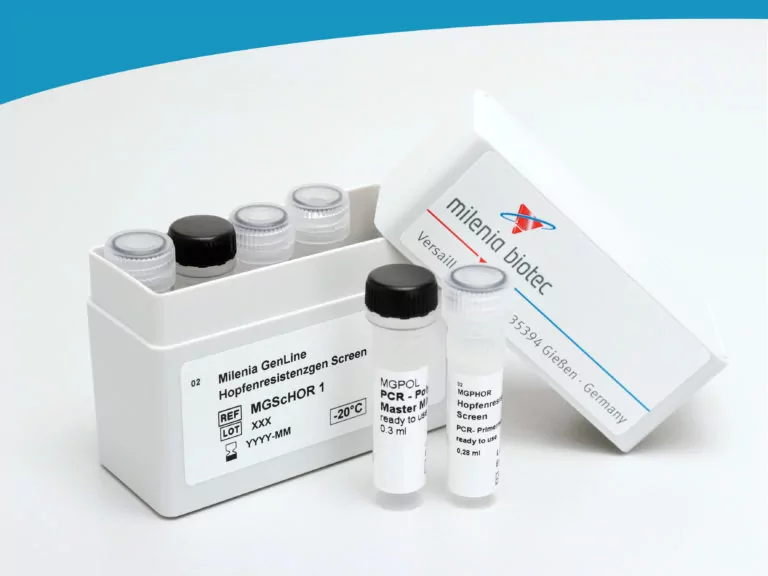
Name of Product Hop Resistance Gene-Screen Catalog Number MGScHOR 1 Short Info This test discovers hop resistance genes in a timely and precise manner
Method/Platform PCR Range/Assay Sensivity 10^4 – 10^5 cfu/mL Test Principle The technological basis for the GenLine tests is the polymerase chain reaction (PCR) combined with lateral flow Tests.
Detail
Name of Product
Hop Resistance Gene-Screen
Catalog Number
MGScHOR 1
Short Info
This test discovers hop resistance genes in a timely and precise manner
Method/Platform
PCR
Range/Assay Sensivity
10^4 – 10^5 cfu/mL
Test Principle
The technological basis for the GenLine tests is the polymerase chain reaction (PCR) combined with lateral flow Tests.
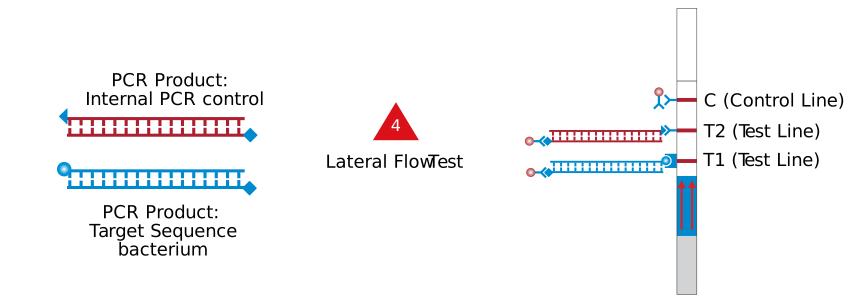
Labelled specific primers are used to amplify specific DNA fragments. In addition to the target gene, a control gene, which is also present in the PCR mixes, is amplified in order to make sure that the PCR process works properly.
The resulting PCR products carry the labels of the incorporated primers.
In a second part of the test, the created PCR products are detected by a lateral flow Test Strip. A “molecular sandwich” is formed and becomes visible as a line on the test Strip.
Brief Instructions
The PCR reagents and the samples are prepared.
After the addition of the sample to the PCR reagents, the PCR is started.
The resulting PCR products are detected by a simple lateral flow test Strip
Fasciolosis is one of the most frequently encountered autochthonous helminthic infections in Central Europe. The immunodiagnosis of Fasciola hepatica infections is challenged by high serological cross-reacitivity with other (hepatic) parasitological infections encountered in Central Europe, such as alveolar echinococcosis, toxocarosis and ascariosis, but also other parasitic infections acquired during overseas travel. The SAP-2 recombinant antigen shows a high specificity, especially with patients with other parasitic infections. It is a suitable serological test for routine diagnosis of human fasciolosis, particularly if the results are supported by clinical history.
This product is manufactured by Bordier Affinity Products in Switzerland and distributed in Germany exclusively by Milenia Biotec.
Method/Platform
ELISA in microplate format
Range/Assay Sensivity
77% sensitivity, 98% specificity
Test Principle
The kit provides all the material needed to perform 96 enzyme-linked immunosorbant assays (ELISA) on breakable microtitration wells sensitized with Fasciola hepaticarecombinant antigen. Specific antibodies in the sample will bind to the antigen and washing will remove unspecific antibodies. The presence of parasite specific antibodies is detected with a Protein A – alkaline phosphatase conjugate. A second washing step will remove unbound conjugate. Revealing bound antibodies is made by the addition of pNPP substrate which turns yellow in the presence of alkaline phosphatase. Color intensity is proportional to the amount of Fasciola hepatica specific antibodies in the sample. Potassium phosphate is added to stop the reaction. Absorbance at 405 nm is read using an ELISA microplate reader.The test can be performed with automatic systems, but this must be validated by the user.
12 x 8 strips (96 tests) Fasciolosis is one of the most frequently encountered autochthonous helminthic infections in Central Europe. The immunodiagnosis of Fasciola hepatica infections is challenged by high serological cross-reacitivity with other (hepatic) parasitological infections encountered in Central Europe, such as alveolar echinococcosis, toxocarosis and ascariosis, but also other parasitic infections acquired during overseas travel. The SAP-2 recombinant antigen shows a high specificity, especially with patients with other parasitic infections. It is a suitable serological test for routine diagnosis of human fasciolosis, particularly if the results are supported by clinical history.
CE-IVDR marked in accordance with the European Commission Regulation (EU) No. 2017/746.
Ideal for use in in vitro diagnostic workflows
Reliable and cost-effective
Non-invasive, user-friendly sample collection
Sample collection and preservation in one convenient kit
Samples are non-infectious and can be handled and shipped safely
Preserved DNA is stable for 2 years at ambient temperature
High quality DNA is suitable for sensitive downstream applications including PCR, qPCR, sequencing, SNP analysis, microarrays, RFLP and Southern Blot Analysis
Shipping accessories can be purchased separately
Norgen’s Saliva DNA Collection and Preservation Devices are designed for 1) simple and non-invasive saliva collection and 2) preservation of DNA in saliva samples at ambient temperature. Each of the 50 Saliva DNA Collection and Preservation Devices consists of 3 components: (1) Saliva Collection Funnel and Collection Tube, (2) Collection Tube Cap, and (3) Norgen’s Saliva DNA Preservative contained within a sealed squeezable ampoule. Saliva samples are collected by spitting inside the Collection Funnel which has been assembled with the Collection Tube. After collecting the required volume of saliva the Collection Funnel is removed and the contents of the Preservative Ampoule are then added and mixed with the collected saliva. The Saliva Collection Tube is subsequently sent to the laboratory for DNA isolation and analysis. DNA can be isolated from the preserved saliva samples using Norgen’s Saliva DNA Isolation Kit (Cat# Dx45400). Each of Norgen’s Collection Tubes is labeled with a unique serial number that can be used for secure and anonymous tracking of the sample. The saliva DNA in preserved samples is stable for more than 2 years at room temperature. This kit is ideal for collecting and preserving DNA samples for in vitro diagnostic use for medical purposes.
Saliva DNA Preservative
Norgen’s Saliva DNA Preservative is an aqueous storage buffer designed for rapid cellular lysis and subsequent preservation of DNA from fresh specimens. The buffer prevents the growth of Gram-negative and Gram-positive bacteria and fungi, and also inactivates viruses allowing the resulting non-infectious samples to be handled and shipped safely. In addition, the buffer eliminates the need to immediately process or freeze samples and allows the samples to be shipped to centralized testing facilities at ambient temperature. The components of the buffer allow samples to be stored for more than 2 years without any detectable DNA degradation.
DNA Isolation from Preservative
Prior to saliva DNA isolation, vortex the Collection Tube containing preserved saliva for 10 seconds and incubate at 55°C for one hour. Saliva DNA can now be isolated from the preserved saliva samples using Norgen’s spin-column based Saliva DNA Isolation Kit Dx (Cat# Dx45400) or other commercially available methods that have been validated for use with Norgen’s Saliva DNA Collection and Preservation Devices.
NOTE: This product is not available for sale in the United States.
The Collection Device should be kept tightly sealed and stored at room temperature for up to 3 years without any reduction in kit performance (The collection due date is written on the device label).
Once collected, saliva is stable for more than 2 years when kept tightly sealed and stored at room temperature.
The Collection Tube, the Collection Funnel and the Device Container of each Individual Saliva DNA Collection and Preservation Device are recyclable.
Kit Components
Cat. 49000 (50 Devices)
Individual Saliva DNA Collection and Preservation Devices
50
Donor Procedure Flowchart
1
Product Insert
1
Individual Saliva DNA Collection and Preservation Device Contents
Short term stability: 2-8oC, Long term stability: See individual component labels
Stability:
> 2 years under recommended storage conditions
Analyte:
β-Glucan
Assay Format:
Spectrophotometer
Detection Method:
Absorbance
Wavelength (nm):
510
Signal Response:
Increase
Limit of Detection:
1 g/100 g
Reaction Time (min):
~ 100 min
Application examples:
Yeast preparations and other materials
Method recognition:
Novel method
This product has been discontinued (see here), please use the recommended replacement product β-Glucan Assay Kit (Yeast and Mushroom) for all your yeast and mushroom β-Glucan testing needs.
Enzymatic Yeast Beta-Glucan test kit, an enzymatic procedure for the measurement and analysis of 1,3:1,6-β-glucan in yeast. Also measures 1,3-β-glucan.
All reagents stable for > 12 months after preparation
Mega-Calc™ software tool is available from our website for hassle-free raw data processing
Document
This product has been discontinued (see here), please use the recommended replacement product β-Glucan Assay Kit (Yeast and Mushroom) for all your yeast and mushroom β-Glucan testing needs.