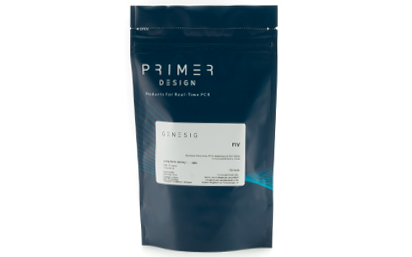
Primer and probe mix (150 reactions) Reverse Transcription, target specific primers (RNA genome viruses only) Copy number standard curve (sufficient for multiple standard curves) Internal extraction control – Read through VIC channel* Endogenous control (150 tests) RNAse/DNAse free water *alternative fluorophores available on request
Nucleic acid testing (NAT) is the method of choice for detection and quantification of a wide range of micro organisms. Primerdesign manufactures and supplies high quality quantitative real-time PCR kits for the detection and simultaneous quantification of numerous significant pathogens . A copy number standard curve is provided for quantification and an the internal extraction template (DNA or RNA), controls for the quality of the nucleic acid extraction and eliminates false negative results.
The kit is designed with the broadest possible detection profile to ensure that all clinically relevant strains and subtypes are detected. Target sequences are selected by working with data from key opinion leaders in the field. Multiple sequence alignments and unprecedented real-time PCR expertise in design and validation ensure the best possible kit. Details of the target and priming specificity are included in the individual handbooks above.
Packaged, optimised and ready to use. Expect Better Data.
Other Products
One Step Isothermal Basic RNA Amplification Kit For High Throughput RNA Analysis
Product Info
Document
Product Info
Product Description
One-Step Isothermal Amplification Basic Kit for High Throughput RNA Analysis
Product Detail
Kit Storage and Term of Validity
Storage term: stored at ≤-20℃,keep away from light, avoid heavy weight and repeated freezing and thawing.
Term of Validity: 14 months
Isothermal Nucleic Acid Principle Summary
This kit is based on a rapid nucleic acid amplification technology at room temperature and constant temperature:at room temperature and constant temperature(generally 39℃~42℃),reverse transcriptaseuses specific primers and template RNA tosynthesize cDNA strands,and binds the auxiliary protein and single strand with the help of the protein, the recombinase and the primer form a complex; perform a homology search and bind the target homology domain, at this time a D-loop region is formed at the homology positionand strand exchange begins; accompanied by the recombinase from the complex upon dissociation,the polymerase also bindsto the 3′ end of the primer,initiating chainextension.It is suitable for laboratory-level RNA amplification and RNA amplification for other detection purposes.
Technical Parameters:
Parameters
Details
Product Name
RNA Isothermal Amplification Kit Basic
Manufacturer
Amp-future
Storage Temperature
-20°C
Kit Components
Enzymes, Buffers ,Reagents
Packaging
48 Tests/box
Detection Limit
500-1000copies/µL
Shipping
ICE
Test Time
5-20mins
Isothermal Nucleic Acid Product Features
1/ High sensitivity and specificity, short reaction time.
2/ The reagent form is freeze-dried, stable and easy to operate.
3/ The reaction can be operated by metal bath and water bath pot without purchasing expensive PCR apparatus.
Isothermal Nucleic Acid Applications
Suitable for RNA isothermal rapid amplification kit(BASIC type)
Primer: Require pair of nucleotide primers with the length of 25-35 bp.
RNA basic kit reaction temperature is 39 to 42℃ and time is 5-20 minutes.
Notes
1/ Please avoid nucleic acid contamination and set blank control during reaction due to the high sensitivity of the kit.
2/ Please take out the required quantity of MIRA reaction units for the experiment, and put the rest under storage conditions when performing the experiment.
This product is suitable for extracting total RNA from 50-150mg conventional plantor fungal samples as well as samples rich in polyphenolic and polysaccharides. This kit is based on silica gel column purification technology, and the extraction process does not require the use of toxic phenol chloroform extraction. The entire extraction process only takes 20-30 minutes. This kit adopts DNA filtration technology, which can efficiently filter and remove DNA. The obtained RNA can be directly used for experiments such as RT-PCR, Northern Blot, poly A+ purification, nucleic acid protection, and in vitro translation.
Details
Kit Contents
Contents
R415002
D415003
Purification Times
50 Preps
250 Preps
HiPure RNA Mini Columns
50
250
gDNA Filter Columns
50
250
2ml Collection Tubes
100
500
TCEP (1M)
0.29 g
5 x 0.29 g
Buffer EP
1.0 ml
5.0 ml
Buffer PSL
50 ml
250 ml
Buffer RW1
50 ml
250 ml
Buffer RW2*
20 ml
2 x 50 ml
RNase Free Water
10 ml
30 ml
Storage and Stability
Except TCEP, the kit components can be stored dry at room temperature (15–25°C) and are stable for at least 18 months under these conditions. After receiving the product, it is recommended to store TCEP (dry powder) at -20-8°C. At low temperatures, Buffer PSL may form precipitates, dissolve it completely by 55°C water bath.
Purchase Guide
1. When dealing with woody or uncommon samples, R4150 is recommended first. R4150 contains two polysaccharide/polyphenol lysis buffer, which is the most universal product.
2. R4151 is recommended for handling common economic crop samples for the first time. Strong lysis solution can be used to process easy-extraction samples. The amount of corn or rice leaves samples can reach up to 300mg.
3. R4165 adopts CTAB/chloroform method, which can also handle a large number of difficult-to-extraction plants, but requires contact with chloroform substitutes, which is less safe than other kits. This kit uses DNase Ⅰ to remove DNA, which is also a good choice for extracting polysaccharide/polyphenol-rich plant samples.
4. R4014 is recommended for fruit/starch plant samples, which uses improved trizol pre-treatment, single column operation and is more economical.
Document
This product is suitable for extracting total RNA from 50-150mg conventional plantor fungal samples as well as samples rich in polyphenolic and polysaccharides. This kit is based on silica gel column purification technology, and the extraction process does not require the use of toxic phenol chloroform extraction. The entire extraction process only takes 20-30 minutes. This kit adopts DNA filtration technology, which can efficiently filter and remove DNA. The obtained RNA can be directly used for experiments such as RT-PCR, Northern Blot, poly A+ purification, nucleic acid protection, and in vitro translation.
Trichinellosis is caused by Trichinella spiralis, a parasitic nematode of pork, horse and wild animals. Humans can be infected by eating raw or undercooked meat from infected animals. Most infected people do not show any symptoms. However, in some cases, symptoms appear during intestinal stage (diarrhea and abdominal pain) and muscular stage (muscle pain, fever, edema). Diagnosis is based on signs and symptoms, but in many cases it is not conclusive for the diagnosis. Serological assays have an important place on the final diagnosis of the disease. The ELISA kit has shown appropriate performance for the serological screening of trichinellosis.
This product is manufactured by Bordier Affinity Products in Switzerland and distributed in Germany exclusively by Milenia Biotec.
Method/Platform
ELISA in microplate format
Range/Assay Sensivity
95% sensitivity, 98% specificity
Test Principle
The kit provides all the material needed to perform 96 enzyme-linked immunosorbent assays (ELISA) on breakable microtitration wells sensitized with Trichinella spiralisexcreted/secreted (E/S) larval antigens. Specific antibodies in the sample will bind to these antigens and washing will remove unspecific antibodies. The presence of parasite specific antibodies is detected with a Protein A – alkaline phosphatase conjugate. A second washing step will remove unbound conjugate. Revealing bound antibodies is made by the addition of pNPP substrate which turns yellow in the presence of alkaline phosphatase. Color intensity is proportional to the amount of Trichinella spiralis specific antibodies in the sample. Potassium phosphate is added to stop the reaction. Absorbance at 405 nm is read using an ELISA microplate reader. The test can be performed with automatic systems, but this must be validated by the user.
Trichinellosis is caused by Trichinella spiralis, a parasitic nematode of pork, horse and wild animals. Humans can be infected by eating raw or undercooked meat from infected animals. Most infected people do not show any symptoms. However, in some cases, symptoms appear during intestinal stage (diarrhea and abdominal pain) and muscular stage (muscle pain, fever, edema). Diagnosis is based on signs and symptoms, but in many cases it is not conclusive for the diagnosis. Serological assays have an important place on the final diagnosis of the disease. The ELISA kit has shown appropriate performance for the serological screening of trichinellosis.