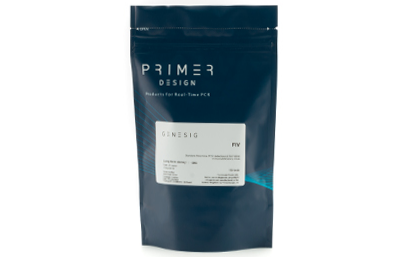
Primer and probe mix (150 reactions) Reverse Transcription, target specific primers (RNA genome viruses only) Copy number standard curve (sufficient for multiple standard curves) Internal extraction control – Read through VIC channel* Endogenous control (150 tests) RNAse/DNAse free water *alternative fluorophores available on request
Nucleic acid testing (NAT) is the method of choice for detection and quantification of a wide range of micro organisms. Primerdesign manufactures and supplies high quality quantitative real-time PCR kits for the detection and simultaneous quantification of numerous significant pathogens . A copy number standard curve is provided for quantification and an the internal extraction template (DNA or RNA), controls for the quality of the nucleic acid extraction and eliminates false negative results.
The kit is designed with the broadest possible detection profile to ensure that all clinically relevant strains and subtypes are detected. Target sequences are selected by working with data from key opinion leaders in the field. Multiple sequence alignments and unprecedented real-time PCR expertise in design and validation ensure the best possible kit. Details of the target and priming specificity are included in the individual handbooks above.
Packaged, optimised and ready to use. Expect Better Data.
This kit is suitable for extracting total pathogen nucleic acid from a variety of clinical samples (including serum and plasma). The kit is based on super paramagnetic particles purification technology. Purified DNA/RNA is ready for downstream applications such as Real Time PCR, biochip analysis, NGS and other related experiments.
Details
Specifications
Features
Specifications
Main Functions
Extract Pathogen RNA/DNA from 0.5ml plasma, serum, body fluid, homogenate suspension, culture solution, cell suspension, soaking solution or concentrate pathogen solution for mNGS application, remove host background nucleic acid.
Applications
RT-PCR,Real Time PCR, biochip analysis, NGS
Products
Pathogen DNA / RNA
Purification method
Polydisperse magnetic beads
Purification technology
Magnetic beads technology
Process method
Manual or automatic
Sample type
low/cell-free samples such as plasma, serum, body fluid, homogenate suspension, culture solution, cell suspension, soaking solution or concentrate pathogen solution
Sample amount
0.5 ml
Adaptive instrument
Nucleic acid extractor, pipetting workstation
Principle
This product is based on the purification method of high binding magnetic particles. The sample is lysed and digested under the action of lysate and Protease. After adding magnetic particles and binding solution, DNA/RNA will be adsorbed on the surface of magnetic particles, and impurities such as proteins will be removed without adsorption. The adsorbed particles were washed with washing solution to remove proteins and impurities, washed with ethanol to remove salts, and finally DNA/RNA was eluted by Buffer NFW.
Kit Contents
Contents
R667200B
R6672-02B
Purification Times
24 Preps
96 Preps
2ml Bead Tubes
24
96
Proteinase K
12 mg
50 mg
Protease Dissolve Buffer
1.8 ml
3 ml
Buffer SDS (20%)
1.8 ml
8 ml
MagBind Particles
0.6 ml
2.5 ml
Buffer MLB
15 ml
60 ml
Buffer MW1*
13 ml
44 ml
Buffer MW2*
6 ml
50 ml
Buffer AVE
5 ml
30 ml
Storage and Stability
MagBind Particles and Proteinase K Solution should be stored at 2–8°C upon arrival. However, short-term storage (up to 8 weeks) at room temperature (15–25°C) does not affect their performance. The remaining kit components can be stored at room temperature (15–25°C) and are stable for 18 months under these conditions.
Document
This kit is suitable for extracting total pathogen nucleic acid from a variety of clinical samples (including serum and plasma). The kit is based on super paramagnetic particles purification technology. Purified DNA/RNA is ready for downstream applications such as Real Time PCR, biochip analysis, NGS and other related experiments.
Attogene Fluorescent UniversalLateral Flow Assay Kits are a convenient ready-to-use kit for quick and cost-effective development of a fluorescent lateral flow dipstick assay for detection of DNA and RNA products.
Fluorescent lateral flow assays can be 2-100 fold more sensitive that gold based lateral flow tests. Europium dyed polystyrene beads conjugated to streptavidin
Formats (fluorescent broad range UV light excitation range of 300nm to 400nm, 610nm emission) Streptavidin conjugate pad):
• Detectable using a black light such as a black light UV flashlight or fluorescent lateral flow reader.
• Detection of nucleic Acid (DNA or RNA) requires the use of a biotin and FAM-labelled primer during amplification.
• Test line: anti-FITC/FAM
• Control Line: Biotin
• Multiplex detection of nucleic Acid (DNA or RNA) requires the use of a biotin, FAM and Dig labelled primers during amplification.:
• Test Line #1: anti FITC/FAM, Line #2: anti-Dig, Line #3 Biotin.
For example, this product can be configured with alternative/custom streptavidin fluorescent particles.
Kit Components
50 -4.5mm Fluorescent Lateral Flow Dipsticks
10 mL Sample assay running buffer
Features & Benefits
Can be used for development of a lateral flow assay for detection of a variety of different molecules such as amplified DNA products from PCR, LAMP and RPA reactions.
No need to stripe capture antibodies
No expensive equipment required (Black Light)
Cost-effective way to screen for further downstream lateral flow assay development.



 • Detectable using a black light such as a black light UV flashlight or fluorescent lateral flow reader.