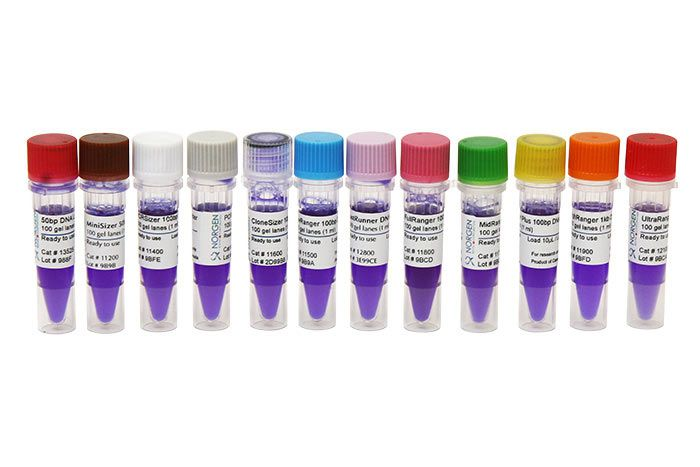
Internal Lane Standard (60bp – 600bp, ROX) for ABI Genetic Analyzer
Facebook
X
Pinterest
Email
Detail
Overview
Ready-to-use
Highly stable
Precise
22 discrete bands from 60 bp to 600 bp
High quality ready-to-use double-stranded DNA ladder derived by recombinant technology for precise size and mass determination in various fluorescence-detection instruments including different models of Applied Biosystems® PRISM® and Genetic Analyzers
22 discrete bands, ranging from 60 bp to 600 bp
The ladder is asymmetrically labelled with ROX that can be detected by excitation at 576 nm and fluorescent emission at 597 nm
Compatible with products for fragment analysis including Promega PowerPlex® 16 System
Ladder Properties: • 22 discrete bands, ranging from 60 bp to 600 bp
Storage: • Store at -20°C in small aliquots. For longer term storage, -70°C is recommended. • The product is light-sensitive. Minimize light exposure.
Other Products
Plant RNA/DNA Purification Kit
Product Info
Document
Product Info
Overview
Robust Lysis Solution processes even the most challenging plant species such as pine needle and grape
No phenol extractions
DNA and all sizes of RNA are recovered, including microRNA
High quality DNA and RNA are purified simultaneously using the same spin column
No need to split the lysate
Purification is based on spin column chromatography that uses Norgen’s proprietary resin separation matrix
This kit provides for rapid spin column isolation and purification of total RNA and genomic DNA simultaneously from a single plant sample without splitting the lysate. Norgen’s plant lysis solution is highly robust and effective over a wide range of plants including challenging samples. The total RNA and genomic DNA are both column purified in under 30 minutes. Since RNA and DNA are isolated without splitting the lysate, variability and inconsistent results are reduced.All sizes of RNA including microRNA are recovered without the need for phenol. Optional on-column DNase and RNase treatments provide flexibility to isolate DNA-free RNA or RNA-free DNA respectively. Isolated nucleic acids are of a high quality and yield, and are ready for downstream use including PCR, qPCR, RT-PCR, qRT-PCR, sequencing and more.
Background
It is often necessary to isolate total RNA and genomic DNA from a single plant sample, such as for studies of gene expression, mutant or transgenic plant characterization, and host plant-pathogen characterization. This is of great benefit when isolating RNA and DNA from precious, difficult to obtain or very small samples. Furthermore, gene expression analysis will be more reliable since the RNA and DNA are derived from the same sample, therefore eliminating inconsistent results.
Maximum Amount of Starting Material: Plant Tissues Plant Cells
100 mg 5 x 10⁶
Time to Complete 10 Purifications
30 minutes
Average Yields* Peach Leaves (100 mg)
40 μg RNA, 5 μg gDNA
* Yield will vary depending on the type of sample processed
Storage Conditions and Product Stability All solutions should be kept tightly sealed and stored at room temperature. These reagents should remain stable for at least 2 years in their unopened containers.
N-(t-butyl ester-PEG2)-N-bis(PEG2-propargyl) is a multi-functional PEG linker with two terminal propargyl groups and a t-butyl ester. The propargyl groups enables formation of triazole linkage with azide-bearing compounds or biomolecules in copper catalyzed Click Chemistry. The t-butyl protected carboxyl group can be deprotected under mild acidic conditions. Reagent grade, for research purpose. Please contact us for GMP-grade inquiries.
Document
N-(t-butyl ester-PEG2)-N-bis(PEG2-propargyl) is a multi-functional PEG linker with two terminal propargyl groups and a t-butyl ester. The propargyl groups enables formation of triazole linkage with azide-bearing compounds or biomolecules in copper catalyzed Click Chemistry. The t-butyl protected carboxyl group can be deprotected under mild acidic conditions. Reagent grade, for research purpose. Please contact us for GMP-grade inquiries.