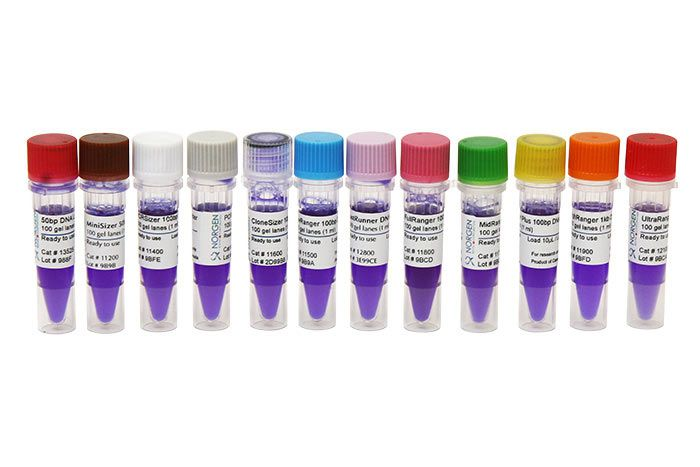
Internal Lane Standard (60bp – 600bp, ROX) for ABI Genetic Analyzer
Facebook
X
Pinterest
Email
Detail
Overview
Ready-to-use
Highly stable
Precise
22 discrete bands from 60 bp to 600 bp
High quality ready-to-use double-stranded DNA ladder derived by recombinant technology for precise size and mass determination in various fluorescence-detection instruments including different models of Applied Biosystems® PRISM® and Genetic Analyzers
22 discrete bands, ranging from 60 bp to 600 bp
The ladder is asymmetrically labelled with ROX that can be detected by excitation at 576 nm and fluorescent emission at 597 nm
Compatible with products for fragment analysis including Promega PowerPlex® 16 System
Q-PAGE™ Bis-Tris Precast Gel is a high-performance and easy to use precast polyacrylamide gel for electrophoresis in Bis-Tris buffer system (MOPS or MES). The optimized gel formula allows Q-PAGE™ Bis-Tris Precast Gel to show improved resolution, accurate results, and an extended shelf-life over conventional Laemmli Tris-HCl gels.
Q-PAGE™ Bis-Tris Precast Gels are available in gradient (4 to 12%) and fixed (8% and 12%) concentrations of polyacrylamide in 12-and 15-well formats. Two available cassette sizes, Mini (10 x 8.3 cm) and Midi (10 x 10 cm), are compatible with most popular protein electrophoresis systems. Q-PAGE™ Mini (QP2XXX) Gels are suitable for Bio-Rad® and other systems. Q-PAGE™ Midi (QP3XXX) Gels are suitable for Invitrogen® XCell SureLock® Mini-Cell, Invitrogen® Mini Gel Tank, Hoefer SE260, and other systems.
Key Features
User-friendly gel cassette:
Numbered and framed wells for sample loading
With cassette opener for easy use
Enhanced gel performance:
Enhanced band sharpness
Better resolution of small proteins
Stable for shipping at ambient temperature
Easy compatibility:
Available as homogeneous and adjusted gradient gels for a wide range of protein separation.
Compatible with most popular protein electrophoresis systems
Storage and stability
Store Q-PAGE™ Precast Gels at 4°C for periods up to 12 months.
Do not freeze Q-PAGE™ Precast Gels Remove tape and comb before electrophoresis.
Keep Q-PAGE™ Precast Gels flat during storage.
Document
Q-PAGE™ Bis-Tris Precast Gel is a high-performance and easy to use precast polyacrylamide gel for electrophoresis in Bis-Tris buffer system (MOPS or MES). The optimized gel formula allows Q-PAGE™ Bis-Tris Precast Gel to show improved resolution, accurate results, and an extended shelf-life over conventional Laemmli Tris-HCl gels.
Q-PAGE™ Bis-Tris Precast Gels are available in gradient (4 to 12%) and fixed (8% and 12%) concentrations of polyacrylamide in 12-and 15-well formats. Two available cassette sizes, Mini (10 x 8.3 cm) and Midi (10 x 10 cm), are compatible with most popular protein electrophoresis systems. Q-PAGE™ Mini (QP2XXX) Gels are suitable for Bio-Rad® and other systems. Q-PAGE™ Midi (QP3XXX) Gels are suitable for Invitrogen® XCell SureLock® Mini-Cell, Invitrogen® Mini Gel Tank, Hoefer SE260, and other systems.
Genotype directly from RNA samples. RNA reverse transcription and cDNA PCR genotyping simultaneously in a single, one-step reaction.
About
ProbeSure OneStep RT-PCR Master Mix combines reverse transcription (RT) and PCR in a single step. This advanced master mix simplifies workflows by eliminating the need for separate reactions for reverse transcription of RNA to cDNA, and PCR amplification from the newly generated cDNA.
ProbeSure OneStep RT-PCR Master Mix is highly efficient and sensitive, enabling detection of low-abundance RNA targets, particularly useful for applications such as gene expression analysis and viral RNA detection. ProbeSure OneStep RT-PCR Master Mix demonstrates robust performance across a wide range of RNA templates and can be employed for both routine and challenging samples.
Document
Genotype directly from RNA samples. RNA reverse transcription and cDNA PCR genotyping simultaneously in a single, one-step reaction.