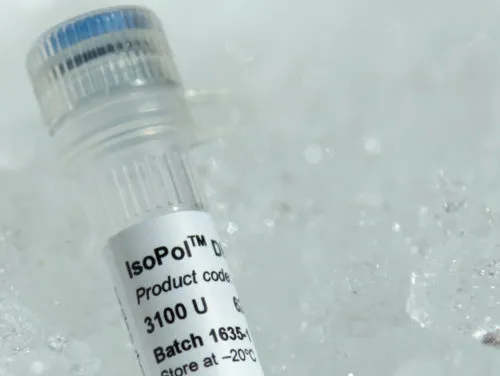
These DNA polymerases are ideal for Isothermal Amplification
IsoPol® BST+ is a heat-tolerant BST polymerase (large fragment) with enhanced strand-displacement activity. IsoPol® BST+ is active from 25 to 65°C. It is lacking 5’-3’- and 3’-5’-exonuclease activity.
Key features
IsoPol® BST+ lacks 5’-3’- and 3’-5’-exonuclease activity.
Inactivation – IsoPol® BST+ is completely inactivated after one minute incubation at 95°C
Enhanced strand displacement and processivity.
Increased salt tolerance.
IsoPol® BST+ Glycerol FREE
Is the popular choice f or isothermal applications such as LAMP and RT-LAMP at point-of-care diagnostics for its superior amplification performance and robustness. The enzyme is offered in a 1X storage buffer at a concentration < 300 U/µl
IsoPol® BST+ High Concentration Glycerol FREE
(IsoPol® BST+ HC Glycerol FREE) is used to ease the product development processes in sequencing technologies, solid phase amplification and several isothermal technologies. Same performance as IsoPol® BST+ (i.e., high processivity, relative SDA, and relative activity) with the only difference that it is offered in a 2X storage buffer at a concentration > 500 U/
Key features
High concentration
High purity
Lyophilisation and automation friendly
Figures
Properties
Other Products
Bioprocessing with Salt Active Nucleases – High Salt Conditions
Product Info
Document
Product Info
Bioprocessing with Salt Active Nucleases – High Salt Conditions
OverView
For SAN HQ, SAN HQ ELISA Kit, and now SAN HQ GMP
SAN HQ GMP is biochemically identical to SAN HQ but produced under GMP conditions.
Applications
Purification of biologics from residual nucleic acids in biopharma manufacturing
Purification of recombinant proteins and enzymes for research and diagnostic use
Removal of unwanted nucleic acids contamination in molecular biology reagents in challenging conditions
Reduction of viscosity in biological samples during production and automation
Vaccine manufacturing and viral vector preparation
DNA removal in high-salt lysates
SAN HQ – Peak performance at high salt conditions
Salt Active Nuclease High Quality (SAN HQ) is a Bioprocessing Grade nuclease developed as the most efficient solution for removal of both single and double stranded DNA and RNA at high salt conditions.
This nonspecific endonuclease has peak activity at salt concentrations between 400 – 700 mM (Fig. 1)
Non-enveloped viruses like Adenoviruses and Adeno-Associated Viruses (AAV’s) are inherently more robust with two distinct advantages: 1) They exhibit higher tolerance to additives like salt and detergents and 2) their production often involves the lysis of host cells, allowing for harvesting non-secreted vectors.
For Adeno-Associated Viruses (AAVs), which are often harvested from crude cell lysate, the high salt tolerance of SAN HQ is particularly beneficial. Salt is typically added to such lysates to reduce viral aggregation, facilitating more effective nuclease action to digest residual DNA.
SAN HQ’s is engineered for optimum activity in these high salt environments ensuring that you achieve unparalleled DNA removal without compromising the integrity of these robust viral vectors.
Key Benefits
Optimized Residual DNA Removal: Ensures efficient degradation of residual DNA in high-salt conditions, meeting stringent quality requirements for biologics and vaccines.
Boosted AAV Vector Purification: Enhances the purification process for adeno-associated viral vectors in high-salt conditions, improving quality and yield.
Streamlined Workflow: Eliminates the need for desalting stages, simplifying the bioprocessing protocol and saving time and resources.
Enable High-Throughput Processes: Facilitates scale-up and automation by working effectively in high-salt environments, increasing operational throughput.
Potential Surge in Virus Yield: Operates under conditions that may boost the titer yield of AAV production, potentially enhancing overall viral yield.
Economized Enzyme Usage: Reduces the need for excess enzyme and additional process adjustments, resulting in significant cost savings.
Minimized Risk of Process Disruptions: Offers reliable performance in various high-salt bioprocessing conditions, reducing the likelihood of disruptions due to enzyme inhibition.
Reliability: Provides consistent enzyme activity in challenging high-salt conditions, adding a layer of predictability and dependability to your operations.
Broader Applicability: Versatile enough to be used in a wide range of viral vector systems, expanding your research and production capabilities.
Enhanced Viral Stability: High-salt levels stabilize viral vectors, and SAN HQ operates effectively in these conditions, maintaining high yield and quality.
Host Cell Lysis: Facilitates efficient lysis of host cells in high-salt conditions, optimizing the harvest of both secreted and non-secreted viral vectors.
Key Features
High purity (≥ 98%)
No protease detected
Supplied with extended product documentation
Compatible with SAN HQ ELISA
The Challenge in Removing Host Cell Chromatin Impurities
In bioprocessing, the primary role of a nuclease is to efficiently digest and fragment host-cell DNA into sufficiently small pieces, facilitating its removal during downstream processing. While most nucleases can effectively degrade naked DNA into tiny fragments under optimal conditions—as demonstrated by M-SAN HQ and SAN HQ, which can digest dsDNA into fragments smaller than 6 nt—the reality in bioprocessing is more complex. (See fig. 5)
The DNA targeted for removal often exists as chromatin, embedded in a complex matrix containing remnants of the lysed host cell as well as large amounts of the therapeutic product.The product may or may not have an affinity for the chromatin you aim to remove.
High salt is often applied to mitigate issues like aggregation. The real challenge lies in a nuclease’s ability to efficiently fragment chromatin under these more complicated, high-salt, conditions—not merely degrading naked DNA under ideal circumstances.
SAN HQ ELISA kit is developed for the detection and quantification of SAN HQ and SAN HQ GMP. The kit is designed as a classical sandwich ELISA, with two monoclonal antibodies specific towards SAN HQ nuclease (fig 6).
Features
Sensitive: 0.4 – 25.6 ng/ml
Precise: RSD ≤ 15%
Accurate: 100% ± 15%
Stability: 12 months when stored between +2°C to +8°C
Document
For SAN HQ, SAN HQ ELISA Kit, and now SAN HQ GMP
SAN HQ GMP is biochemically identical to SAN HQ but produced under GMP conditions.
t-Boc-N-Amido-PEG6-propargyl can be used in copper catalyzed Click Chemistry reactions with azides. The Boc group can be removed under mild acidic conditions to yield the free amine. Reagent grade, for research purpose. Please contact us for GMP-grade inquiries.
Document
t-Boc-N-Amido-PEG6-propargyl can be used in copper catalyzed Click Chemistry reactions with azides. The Boc group can be removed under mild acidic conditions to yield the free amine. Reagent grade, for research purpose. Please contact us for GMP-grade inquiries.
Sequentially isolate and purify total RNA and DNA from a single sample
Two column system: one for DNA and one for RNA
The RNA column is for the purification of total RNA including microRNA
No need to split the lysate, or to use phenol or precipitation methods
Rapid and efficient spin column procedure – it takes only 30 minutes
Purification is based on spin column chromatography that uses Norgen’s proprietary resin separation matrix
These kits provide a rapid method for the isolation and purification of total RNA and DNA sequentially from a single sample of cultured animal cells and tissues, blood, bacteria, yeast, or fungi. The lysate is passed over two columns: 1) a DNA column and 2) an RNA column. Total RNA of all sizes is purified, including microRNA. Both DNA and RNA are of the highest purity and yield.
These kits are ideal for researchers who are interested in studying the genome and transcriptome of a single sample, such as for studies of microRNA profiling, gene expression including gene silencing experiments or mRNA knockdowns, studies involving biomarker discovery, and for characterization of cultured cell lines. Norgen’s RNA/DNA Purification Kits are especially useful for researchers who are isolating macromolecules from precious, difficult to obtain or small samples such as biopsy materials or single foci from cell cultures, as they eliminate the need to fractionate the sample. Furthermore, analysis will be more reliable since the RNA and DNA are derived from the same sample, thereby eliminating inconsistent results. The purified macromolecules are of the highest purity and can be used in a number of different downstream applications
RNA/DNA Purification Kit (Spin Column)
Maximum column binding capacity of 50 μg for RNA and 20 μg for DNA.
RNA/DNA Purification Micro Kit (Micro)
The purified RNA and DNA fractions can be eluted in as little as 20 μL. Ideal for cell number inputs of 500,000 and as little as 5 cells. Maximum column binding capacity of 35 μg for RNA and 10 μg for DNA.
Maximum Amount of Starting Material: Animal Cells Animal Tissues Blood Bacteria Yeast Fungi Plant Tissues
5 x 10⁶ cells 25 mg (for most tissues)** 200 μL 1 x 10⁹ cells 1 x 10⁸ cells 50 mg 50 mg
Time to Complete 10 Purifications
30 minutes
Average Yield*: HEK 293 Cells (1 x 10⁶ cells) HEK 293 Cells (1 x 10⁶ cells) Liver (15 mg) Liver (15 mg)
10-15 μg RNA 2-4 μg DNA 30-35 μg RNA 4-6 μg DNA
*Average Yield will vary depending upon a number of factors including species, growth conditions used, and development stage.
**Tissue inputs of up to 40 mg may be used, however for inputs greater than the recommended 25 mg, cross-contamination of the RNA and DNA fractions is possible.
Storage Conditions and Product Stability Store Proteinase K at -20°C upon arrival. All other solutions should be kept tightly sealed and stored at room temperature. This kit is stable for 1 year after the date of shipment.