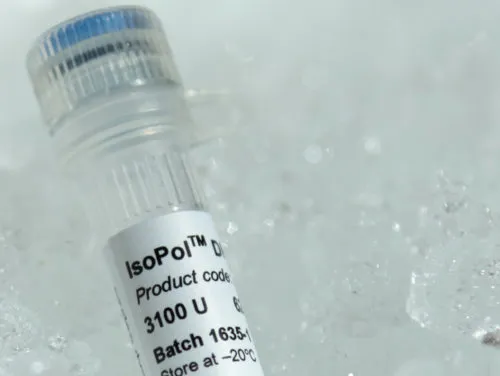
To accommodate the need for high quality enzymes for isothermal amplification ArcticZymes developed the IsoPol® series of polymerases. For isothermal amplification at lower temperatures (37°C and below) we offer two enzymes, IsoPol® DNA Polymerase and IsoPol® SD+. Both enzymes exhibit excellent processivity and high strand displacement activity, having 5’-3’ polymerase activity while lacking both 3’-5’and 5’-3’ exonuclease activity.
Detail
OverView
To accommodate the need for high quality enzymes for isothermal amplification ArcticZymes developed the IsoPol® series of polymerases. For isothermal amplification at lower temperatures (37°C and below) we offer two enzymes, IsoPol® DNA Polymerase and IsoPol® SD+. Both enzymes exhibit excellent processivity and high strand displacement activity, having 5’-3’ polymerase activity while lacking both 3’-5’and 5’-3’ exonuclease activity.
IsoPol® SD+ is an engineered version of IsoPol® DNA Polymerase with even stronger strand displacement and higher salt tolerance.
Figures
Properties
Quality Control
ArcticZymes is dedicated to the quality of our products. IsoPol® polymerases are is manufactured at our ISO 13485 certified facility in Norway.
Other Products
[TQ1200] ExcelTaq™ 2X Fast Q-PCR Master Mix (SYBR, no ROX), 200 RXN
Product Info
Document
Product Info
Description
The ExcelTaq™ 2X Fast Q-PCR Master Mix (SYBR, no ROX) is a ready-to-use reagent with all the essential components for quantitative real-time PCR (qPCR) except primers and templates. The master mix contains a highly stable hot-start Taq polymerase in an optimized buffer with dsDNA specific SYBR green fluorescent dye. Consequently, the ExcelTaq™ 2X Fast Q-PCR Master Mix (SYBR, no ROX) features high stability during storage, even at 37°C for weeks. In addition to high sensitivity and signal intensity, the ExcelTaq™ 2X Fast Q-PCR Master Mix (SYBR, no ROX) performs a low background/ high specificity qPCR results, as well as a better compatibility with fast PCR program.
With inert smart blue contrast dye, the ExcelTaq™ 2X Fast Q-PCR Master Mix (SYBR, no ROX) is ready-to-use and greatly reduces pipetting errors, while largely improving the reproducibility of the process. The ExcelTaq™ 2X Fast Q-PCR Master Mix (SYBR, no ROX) is also compatible with ROX reference dye if ROX is recommended by the manufacturer of the qPCR system. This master mix allows sensitive, precise amplification, real-time tracking of the amplification process, and simultaneous quantification for targeted DNA molecules.
Features
High Stability
Fast Hot Start
High Sensitivity
Low Background
Suitable for Fast Program
Smart Blue Contrast Dye
Storage
Protect from light. Aliquot to avoid multiple freeze-thaw cycles. -20°C for 12 months
Document
The ExcelTaq™ 2X Fast Q-PCR Master Mix (SYBR, no ROX) is a ready-to-use reagent with all the essential components for quantitative real-time PCR (qPCR) except primers and templates. The master mix contains a highly stable hot-start Taq polymerase in an optimized buffer with dsDNA specific SYBR green fluorescent dye. Consequently, the ExcelTaq™ 2X Fast Q-PCR Master Mix (SYBR, no ROX) features high stability during storage, even at 37°C for weeks. In addition to high sensitivity and signal intensity, the ExcelTaq™ 2X Fast Q-PCR Master Mix (SYBR, no ROX) performs a low background/ high specificity qPCR results, as well as a better compatibility with fast PCR program.
With inert smart blue contrast dye, the ExcelTaq™ 2X Fast Q-PCR Master Mix (SYBR, no ROX) is ready-to-use and greatly reduces pipetting errors, while largely improving the reproducibility of the process. The ExcelTaq™ 2X Fast Q-PCR Master Mix (SYBR, no ROX) is also compatible with ROX reference dye if ROX is recommended by the manufacturer of the qPCR system. This master mix allows sensitive, precise amplification, real-time tracking of the amplification process, and simultaneous quantification for targeted DNA molecules.
Q-PAGE™ TGN (Tris-Glycine Novel) Precast Gels are ready-to-use acrylamide gels for SDS-PAGE running in Tris-Glycine buffer system. With unique formula, Q-PAGE™ TGN Precast Gels perform enhanced speed, better separation, and longer shelf life as compared with conventional Laemmli Tris-HCl gels. The protein migration patterns in Q-PAGE™ TGN series, however, are similar with typical Laemmli Tris-HCl gels, and thus Q-PAGE™ TGN Precast Gels are compatible to traditional SDS-PAGE and subsequent analyses.
Q-PAGE™ TGN Precast Gels are available in gradient (4 to 15%) and fixed (10%) concentrations of polyacrylamide in 12- and 15-well formats. Two available cassette sizes, Mini (10 x 8.3 cm) and Midi (10 x 10 cm), are compatible with most popular protein electrophoresis systems. Q-PAGE™ Mini (QP4XXX) Gels are suitable for Bio-Rad® and other systems. Q-PAGE™ Midi (QP5XXX) Gels are suitable for Invitrogen® XCell SureLock® Mini-Cell, Invitrogen® Mini Gel Tank, Hoefer SE260, and other systems.
Key Features
User-friendly gel cassette:
Numbered and framed wells for sample loading
Labeled warning sign and green tape as reminder
Enhanced gel performance:
Enhanced gel electrophoresis speed
Better band separation, equivalent to commercially 4-20% TG gels
Stable for shipping at ambient temperature
Easy compatibility:
Available as homogeneous and adjusted gradient gels for a wide range of protein separation.
Compatible with most popular protein electrophoresis systems
Storage and stability
Store Q-PAGE™ Precast Gels at 4°C for periods up to 12 months.
Do not freeze Q-PAGE™ Precast Gels. Remove tape and comb before electrophoresis.
Keep Q-PAGE™ Precast Gels flat during storage.
Document
Q-PAGE™ TGN (Tris-Glycine Novel) Precast Gels are ready-to-use acrylamide gels for SDS-PAGE running in Tris-Glycine buffer system. With unique formula, Q-PAGE™ TGN Precast Gels perform enhanced speed, better separation, and longer shelf life as compared with conventional Laemmli Tris-HCl gels. The protein migration patterns in Q-PAGE™ TGN series, however, are similar with typical Laemmli Tris-HCl gels, and thus Q-PAGE™ TGN Precast Gels are compatible to traditional SDS-PAGE and subsequent analyses.
Q-PAGE™ TGN Precast Gels are available in gradient (4 to 15%) and fixed (10%) concentrations of polyacrylamide in 12- and 15-well formats. Two available cassette sizes, Mini (10 x 8.3 cm) and Midi (10 x 10 cm), are compatible with most popular protein electrophoresis systems. Q-PAGE™ Mini (QP4XXX) Gels are suitable for Bio-Rad® and other systems. Q-PAGE™ Midi (QP5XXX) Gels are suitable for Invitrogen® XCell SureLock® Mini-Cell, Invitrogen® Mini Gel Tank, Hoefer SE260, and other systems.
HiPure Bacterial RNA Kit uses silica gel column purification to simplify the extraction. The whole process does not require phenol chloroform extraction and time-consuming alcohol precipitation. The kit is suitable for efficiently extracting RNA from various bacterial samples. The purified RNA can be directly used for RT-PCR, Northern hybridization, etc. The kit has included lysozyme and glass beads, which can be used to treat gram-negative bacteria which is easy to be lysed, as well as gram-positive bacteria which is hard to be lysed, including enterococcus faecalis, staphylococcus, etc.
Details
Specifications
Features
Specifications
Main Functions
Isolation total RNA from bacteria culture
Applications
RT-PCR, Northern blot, poly-A + purification, nucleic acid protection and in vitro translation
Purification method
Mini spin column
Purification technology
Silica technology
Process method
Manual (centrifugation or vacuum)
Sample type
Bacteria culture
Sample amount
Bacteria: <10^9
Elution volume
≥30μl
Time per run
≤40 minutes
Liquid carrying volume per column
800µl
Binding yield of column
100µg
Principle
Hipure silica gel column is based on glass fiber filter membrane with high binding force. Under the condition of high concentration of ionizing agent (such as guanidine hydrochloride or guanidine isothiocyanate), the filter membrane can adsorb nucleic acid through hydrogen bond and electrostatic, while protein and other impurities are not adsorbed and removed. The filter membrane adsorbed with nucleic acid is washed to remove the residual protein and salt. Finally, the nucleic acid adsorbed on the filter membrane can be washed out with low salt buffer (such as buffer TE) or water. The obtained nucleic acid has high purity and can be directly used in various downstream experiments.
Advantages
Fast – several samples can be extracted in 30 minutes
High purity – the purified RNA can be directly used in various downstream applications
High recovery – RNA can be recovered at the level of PG
Good repeatability – silica gel column purification technology can obtain ideal results every time
Broad spectrum – it can deal with various bacteria, including Gram-positive bacteria that are difficult to be lysed
Sufficient components – the kit contains carried lysozyme and glass beads
Kit Contents
Contents
R418101
R418102
R418103
Purification Times
10 Preps
50 Preps
250 Preps
gDNA Filter Mini Columns
10
50
250
HiPure RNA Mini Columns
10
50
250
2ml Collection Tubes
20
100
500
Glass Beads (0.1-0.6mm)
10 g
30 g
150 g
Plastic spoon
2
4
10
Lysozyme
20 mg
90 mg
400 mg
Protease Dissolve Buffer
1.8 ml
1.8 ml
10 ml
Buffer TE
1.8 ml
1.8 ml
5 ml
Buffer STL
5 ml
20 ml
90 ml
Buffer RLC
10 ml
30 ml
150 ml
Buffer RW1
10 ml
50 ml
250 ml
Buffer RW2*
5 ml
20 ml
2 x 50 ml
RNase Free Water
1.8 ml
10 ml
30 ml
Storage and Stability
The kit components can be stored at room temperature (15–25°C) and are stable for at least 18 months under these conditions. Due to the lack of antibacterial agents, RNase Free Water may be contaminated by bacterial or fungal when placed or operated at room temperature. It is recommended to pack and store at 2-8°C to reduce contamination.
Document
HiPure Bacterial RNA Kit uses silica gel column purification to simplify the extraction. The whole process does not require phenol chloroform extraction and time-consuming alcohol precipitation. The kit is suitable for efficiently extracting RNA from various bacterial samples. The purified RNA can be directly used for RT-PCR, Northern hybridization, etc. The kit has included lysozyme and glass beads, which can be used to treat gram-negative bacteria which is easy to be lysed, as well as gram-positive bacteria which is hard to be lysed, including enterococcus faecalis, staphylococcus, etc.